 Add to Chrome
 Add to Firefox
 Add to Edge
BuildMamba: A Visual State-Space Based Model for Multi-Task Building Segmentation and Height Estimation from Satellite Images
Mar 09, 2026
Accurate building segmentation and height estimation from single-view RGB satellite imagery are fundamental for urban analytics, yet remain ill-posed due to structural variability and the high computational cost of global context modeling. While current approaches typically adapt monocular depth architectures, they often suffer from boundary bleeding and systematic underestimation of high-rise structures. To address these limitations, we propose BuildMamba, a unified multi-task framework designed to exploit the linear-time global modeling of visual state-space models. Motivated by the need for stronger structural coupling and computational efficiency, we introduce three modules: a Mamba Attention Module for dynamic spatial recalibration, a Spatial-Aware Mamba-FPN for multi-scale feature aggregation via gated state-space scans, and a Mask-Aware Height Refinement module using semantic priors to suppress height artifacts. Extensive experiments demonstrate that BuildMamba establishes a new performance upper bound across three benchmarks. Specifically, it achieves an IoU of 0.93 and RMSE of 1.77~m on DFC23 benchmark, surpassing state-of-the-art by 0.82~m in height estimation. Simulation results confirm the model's superior robustness and scalability for large-scale 3D urban reconstruction.

VLMFusionOcc3D: VLM Assisted Multi-Modal 3D Semantic Occupancy Prediction
Mar 03, 2026This paper introduces VLMFusionOcc3D, a robust multimodal framework for dense 3D semantic occupancy prediction in autonomous driving. Current voxel-based occupancy models often struggle with semantic ambiguity in sparse geometric grids and performance degradation under adverse weather conditions. To address these challenges, we leverage the rich linguistic priors of Vision-Language Models (VLMs) to anchor ambiguous voxel features to stable semantic concepts. Our framework initiates with a dual-branch feature extraction pipeline that projects multi-view images and LiDAR point clouds into a unified voxel space. We propose Instance-driven VLM Attention (InstVLM), which utilizes gated cross-attention and LoRA-adapted CLIP embeddings to inject high-level semantic and geographic priors directly into the 3D voxels. Furthermore, we introduce Weather-Aware Adaptive Fusion (WeathFusion), a dynamic gating mechanism that utilizes vehicle metadata and weather-conditioned prompts to re-weight sensor contributions based on real-time environmental reliability. To ensure structural consistency, a Depth-Aware Geometric Alignment (DAGA) loss is employed to align dense camera-derived geometry with sparse, spatially accurate LiDAR returns. Extensive experiments on the nuScenes and SemanticKITTI datasets demonstrate that our plug-and-play modules consistently enhance the performance of state-of-the-art voxel-based baselines. Notably, our approach achieves significant improvements in challenging weather scenarios, offering a scalable and robust solution for complex urban navigation.
GaussianOcc3D: A Gaussian-Based Adaptive Multi-modal 3D Occupancy Prediction
Jan 30, 20263D semantic occupancy prediction is a pivotal task in autonomous driving, providing a dense and fine-grained understanding of the surrounding environment, yet single-modality methods face trade-offs between camera semantics and LiDAR geometry. Existing multi-modal frameworks often struggle with modality heterogeneity, spatial misalignment, and the representation crisis--where voxels are computationally heavy and BEV alternatives are lossy. We present GaussianOcc3D, a multi-modal framework bridging camera and LiDAR through a memory-efficient, continuous 3D Gaussian representation. We introduce four modules: (1) LiDAR Depth Feature Aggregation (LDFA), using depth-wise deformable sampling to lift sparse signals onto Gaussian primitives; (2) Entropy-Based Feature Smoothing (EBFS) to mitigate domain noise; (3) Adaptive Camera-LiDAR Fusion (ACLF) with uncertainty-aware reweighting for sensor reliability; and (4) a Gauss-Mamba Head leveraging Selective State Space Models for global context with linear complexity. Evaluations on Occ3D, SurroundOcc, and SemanticKITTI benchmarks demonstrate state-of-the-art performance, achieving mIoU scores of 49.4%, 28.9%, and 25.2% respectively. GaussianOcc3D exhibits superior robustness across challenging rainy and nighttime conditions.
Gaussian Based Adaptive Multi-Modal 3D Semantic Occupancy Prediction
Jan 20, 2026The sparse object detection paradigm shift towards dense 3D semantic occupancy prediction is necessary for dealing with long-tail safety challenges for autonomous vehicles. Nonetheless, the current voxelization methods commonly suffer from excessive computation complexity demands, where the fusion process is brittle, static, and breaks down under dynamic environmental settings. To this end, this research work enhances a novel Gaussian-based adaptive camera-LiDAR multimodal 3D occupancy prediction model that seamlessly bridges the semantic strengths of camera modality with the geometric strengths of LiDAR modality through a memory-efficient 3D Gaussian model. The proposed solution has four key components: (1) LiDAR Depth Feature Aggregation (LDFA), where depth-wise deformable sampling is employed for dealing with geometric sparsity, (2) Entropy-Based Feature Smoothing, where cross-entropy is employed for handling domain-specific noise, (3) Adaptive Camera-LiDAR Fusion, where dynamic recalibration of sensor outputs is performed based on model outputs, and (4) Gauss-Mamba Head that uses Selective State Space Models for global context decoding that enjoys linear computation complexity.
TransAdapter: Vision Transformer for Feature-Centric Unsupervised Domain Adaptation
Dec 05, 2024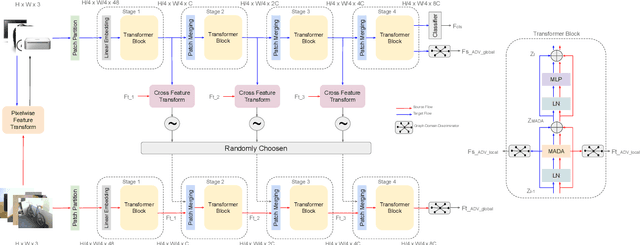
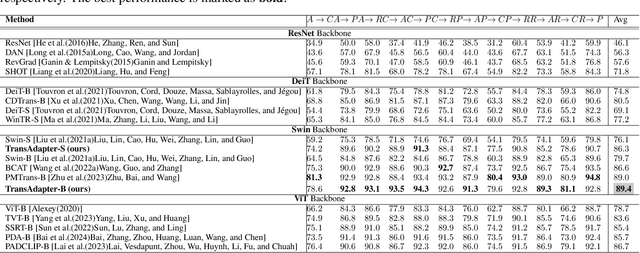
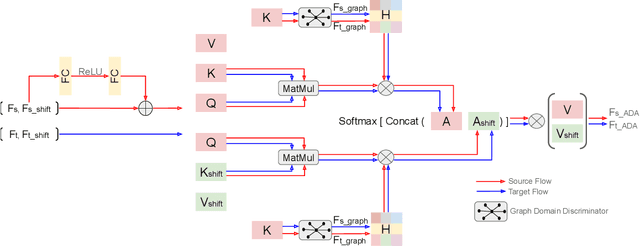
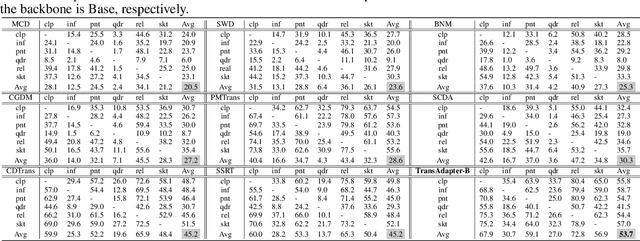
Unsupervised Domain Adaptation (UDA) aims to utilize labeled data from a source domain to solve tasks in an unlabeled target domain, often hindered by significant domain gaps. Traditional CNN-based methods struggle to fully capture complex domain relationships, motivating the shift to vision transformers like the Swin Transformer, which excel in modeling both local and global dependencies. In this work, we propose a novel UDA approach leveraging the Swin Transformer with three key modules. A Graph Domain Discriminator enhances domain alignment by capturing inter-pixel correlations through graph convolutions and entropy-based attention differentiation. An Adaptive Double Attention module combines Windows and Shifted Windows attention with dynamic reweighting to align long-range and local features effectively. Finally, a Cross-Feature Transform modifies Swin Transformer blocks to improve generalization across domains. Extensive benchmarks confirm the state-of-the-art performance of our versatile method, which requires no task-specific alignment modules, establishing its adaptability to diverse applications.