 Add to Chrome
 Add to Firefox
 Add to Edge
Reddit Corpus
Papers and Code
HumanLLM: Towards Personalized Understanding and Simulation of Human Nature
Jan 22, 2026
Motivated by the remarkable progress of large language models (LLMs) in objective tasks like mathematics and coding, there is growing interest in their potential to simulate human behavior--a capability with profound implications for transforming social science research and customer-centric business insights. However, LLMs often lack a nuanced understanding of human cognition and behavior, limiting their effectiveness in social simulation and personalized applications. We posit that this limitation stems from a fundamental misalignment: standard LLM pretraining on vast, uncontextualized web data does not capture the continuous, situated context of an individual's decisions, thoughts, and behaviors over time. To bridge this gap, we introduce HumanLLM, a foundation model designed for personalized understanding and simulation of individuals. We first construct the Cognitive Genome Dataset, a large-scale corpus curated from real-world user data on platforms like Reddit, Twitter, Blogger, and Amazon. Through a rigorous, multi-stage pipeline involving data filtering, synthesis, and quality control, we automatically extract over 5.5 million user logs to distill rich profiles, behaviors, and thinking patterns. We then formulate diverse learning tasks and perform supervised fine-tuning to empower the model to predict a wide range of individualized human behaviors, thoughts, and experiences. Comprehensive evaluations demonstrate that HumanLLM achieves superior performance in predicting user actions and inner thoughts, more accurately mimics user writing styles and preferences, and generates more authentic user profiles compared to base models. Furthermore, HumanLLM shows significant gains on out-of-domain social intelligence benchmarks, indicating enhanced generalization.

Introducing OmniGEC: A Silver Multilingual Dataset for Grammatical Error Correction
Sep 18, 2025

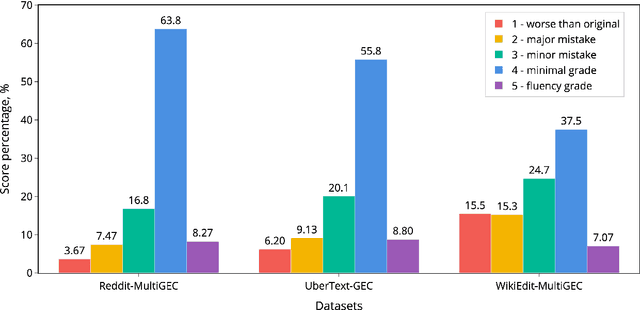
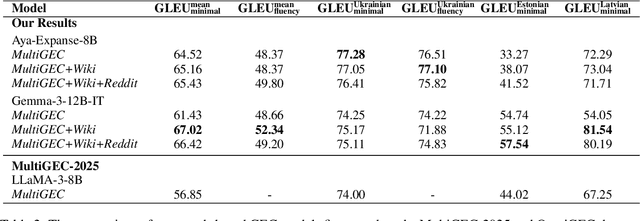
In this paper, we introduce OmniGEC, a collection of multilingual silver-standard datasets for the task of Grammatical Error Correction (GEC), covering eleven languages: Czech, English, Estonian, German, Greek, Icelandic, Italian, Latvian, Slovene, Swedish, and Ukrainian. These datasets facilitate the development of multilingual GEC solutions and help bridge the data gap in adapting English GEC solutions to multilingual GEC. The texts in the datasets originate from three sources: Wikipedia edits for the eleven target languages, subreddits from Reddit in the eleven target languages, and the Ukrainian-only UberText 2.0 social media corpus. While Wikipedia edits were derived from human-made corrections, the Reddit and UberText 2.0 data were automatically corrected with the GPT-4o-mini model. The quality of the corrections in the datasets was evaluated both automatically and manually. Finally, we fine-tune two open-source large language models - Aya-Expanse (8B) and Gemma-3 (12B) - on the multilingual OmniGEC corpora and achieve state-of-the-art (SOTA) results for paragraph-level multilingual GEC. The dataset collection and the best-performing models are available on Hugging Face.
Assessing how hyperparameters impact Large Language Models' sarcasm detection performance
Apr 08, 2025Sarcasm detection is challenging for both humans and machines. This work explores how model characteristics impact sarcasm detection in OpenAI's GPT, and Meta's Llama-2 models, given their strong natural language understanding, and popularity. We evaluate fine-tuned and zero-shot models across various sizes, releases, and hyperparameters. Experiments were conducted on the political and balanced (pol-bal) portion of the popular Self-Annotated Reddit Corpus (SARC2.0) sarcasm dataset. Fine-tuned performance improves monotonically with model size within a model family, while hyperparameter tuning also impacts performance. In the fine-tuning scenario, full precision Llama-2-13b achieves state-of-the-art accuracy and $F_1$-score, both measured at 0.83, comparable to average human performance. In the zero-shot setting, one GPT-4 model achieves competitive performance to prior attempts, yielding an accuracy of 0.70 and an $F_1$-score of 0.75. Furthermore, a model's performance may increase or decline with each release, highlighting the need to reassess performance after each release.
Worse than Zero-shot? A Fact-Checking Dataset for Evaluating the Robustness of RAG Against Misleading Retrievals
Feb 22, 2025Retrieval-augmented generation (RAG) has shown impressive capabilities in mitigating hallucinations in large language models (LLMs). However, LLMs struggle to handle misleading retrievals and often fail to maintain their own reasoning when exposed to conflicting or selectively-framed evidence, making them vulnerable to real-world misinformation. In such real-world retrieval scenarios, misleading and conflicting information is rampant, particularly in the political domain, where evidence is often selectively framed, incomplete, or polarized. However, existing RAG benchmarks largely assume a clean retrieval setting, where models succeed by accurately retrieving and generating answers from gold-standard documents. This assumption fails to align with real-world conditions, leading to an overestimation of RAG system performance. To bridge this gap, we introduce RAGuard, a fact-checking dataset designed to evaluate the robustness of RAG systems against misleading retrievals. Unlike prior benchmarks that rely on synthetic noise, our dataset constructs its retrieval corpus from Reddit discussions, capturing naturally occurring misinformation. It categorizes retrieved evidence into three types: supporting, misleading, and irrelevant, providing a realistic and challenging testbed for assessing how well RAG systems navigate different retrieval information. Our benchmark experiments reveal that when exposed to misleading retrievals, all tested LLM-powered RAG systems perform worse than their zero-shot baselines (i.e., no retrieval at all), highlighting their susceptibility to noisy environments. To the best of our knowledge, RAGuard is the first benchmark to systematically assess RAG robustness against misleading evidence. We expect this benchmark will drive future research toward improving RAG systems beyond idealized datasets, making them more reliable for real-world applications.
Reddit is all you need: Authorship profiling for Romanian
Oct 13, 2024
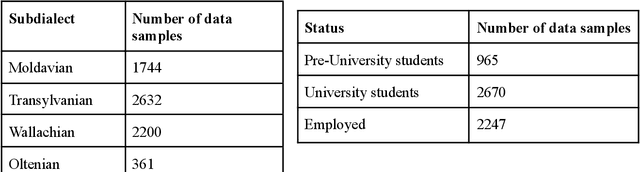
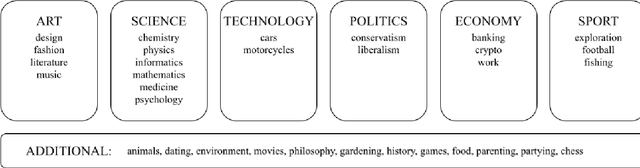
Authorship profiling is the process of identifying an author's characteristics based on their writings. This centuries old problem has become more intriguing especially with recent developments in Natural Language Processing (NLP). In this paper, we introduce a corpus of short texts in the Romanian language, annotated with certain author characteristic keywords; to our knowledge, the first of its kind. In order to do this, we exploit a social media platform called Reddit. We leverage its thematic community-based structure (subreddits structure), which offers information about the author's background. We infer an user's demographic and some broad personal traits, such as age category, employment status, interests, and social orientation based on the subreddit and other cues. We thus obtain a 23k+ samples corpus, extracted from 100+ Romanian subreddits. We analyse our dataset, and finally, we fine-tune and evaluate Large Language Models (LLMs) to prove baselines capabilities for authorship profiling using the corpus, indicating the need for further research in the field. We publicly release all our resources.
A Few Hypocrites: Few-Shot Learning and Subtype Definitions for Detecting Hypocrisy Accusations in Online Climate Change Debates
Sep 25, 2024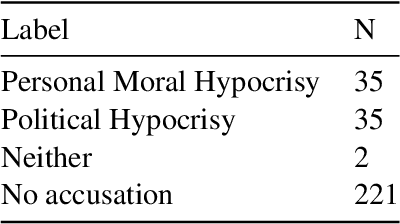

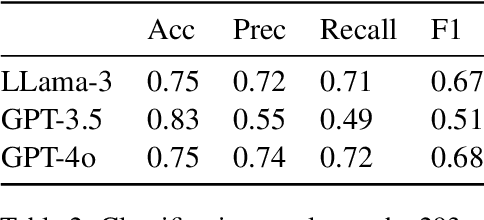
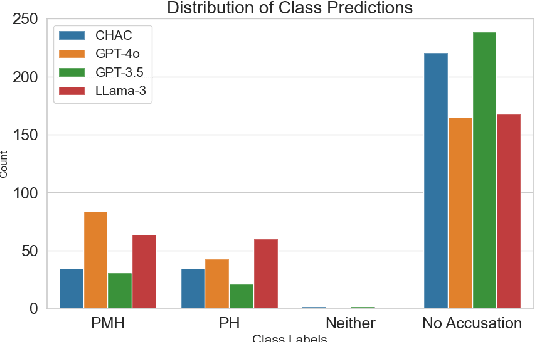
The climate crisis is a salient issue in online discussions, and hypocrisy accusations are a central rhetorical element in these debates. However, for large-scale text analysis, hypocrisy accusation detection is an understudied tool, most often defined as a smaller subtask of fallacious argument detection. In this paper, we define hypocrisy accusation detection as an independent task in NLP, and identify different relevant subtypes of hypocrisy accusations. Our Climate Hypocrisy Accusation Corpus (CHAC) consists of 420 Reddit climate debate comments, expert-annotated into two different types of hypocrisy accusations: personal versus political hypocrisy. We evaluate few-shot in-context learning with 6 shots and 3 instruction-tuned Large Language Models (LLMs) for detecting hypocrisy accusations in this dataset. Results indicate that the GPT-4o and Llama-3 models in particular show promise in detecting hypocrisy accusations (F1 reaching 0.68, while previous work shows F1 of 0.44). However, context matters for a complex semantic concept such as hypocrisy accusations, and we find models struggle especially at identifying political hypocrisy accusations compared to personal moral hypocrisy. Our study contributes new insights in hypocrisy detection and climate change discourse, and is a stepping stone for large-scale analysis of hypocrisy accusation in online climate debates.
LGDE: Local Graph-based Dictionary Expansion
May 13, 2024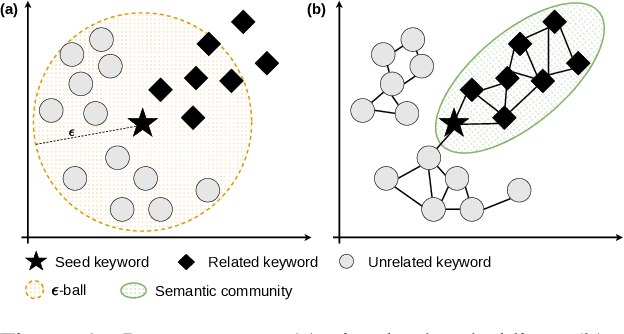
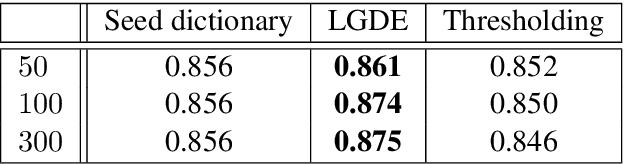


Expanding a dictionary of pre-selected keywords is crucial for tasks in information retrieval, such as database query and online data collection. Here we propose Local Graph-based Dictionary Expansion (LGDE), a method that uses tools from manifold learning and network science for the data-driven discovery of keywords starting from a seed dictionary. At the heart of LGDE lies the creation of a word similarity graph derived from word embeddings and the application of local community detection based on graph diffusion to discover semantic neighbourhoods of pre-defined seed keywords. The diffusion in the local graph manifold allows the exploration of the complex nonlinear geometry of word embeddings and can capture word similarities based on paths of semantic association. We validate our method on a corpus of hate speech-related posts from Reddit and Gab and show that LGDE enriches the list of keywords and achieves significantly better performance than threshold methods based on direct word similarities. We further demonstrate the potential of our method through a real-world use case from communication science, where LGDE is evaluated quantitatively on data collected and analysed by domain experts by expanding a conspiracy-related dictionary.
Cost-Efficient Subjective Task Annotation and Modeling through Few-Shot Annotator Adaptation
Feb 21, 2024In subjective NLP tasks, where a single ground truth does not exist, the inclusion of diverse annotators becomes crucial as their unique perspectives significantly influence the annotations. In realistic scenarios, the annotation budget often becomes the main determinant of the number of perspectives (i.e., annotators) included in the data and subsequent modeling. We introduce a novel framework for annotation collection and modeling in subjective tasks that aims to minimize the annotation budget while maximizing the predictive performance for each annotator. Our framework has a two-stage design: first, we rely on a small set of annotators to build a multitask model, and second, we augment the model for a new perspective by strategically annotating a few samples per annotator. To test our framework at scale, we introduce and release a unique dataset, Moral Foundations Subjective Corpus, of 2000 Reddit posts annotated by 24 annotators for moral sentiment. We demonstrate that our framework surpasses the previous SOTA in capturing the annotators' individual perspectives with as little as 25% of the original annotation budget on two datasets. Furthermore, our framework results in more equitable models, reducing the performance disparity among annotators.
COMMUNITY-CROSS-INSTRUCT: Unsupervised Instruction Generation for Aligning Large Language Models to Online Communities
Jun 17, 2024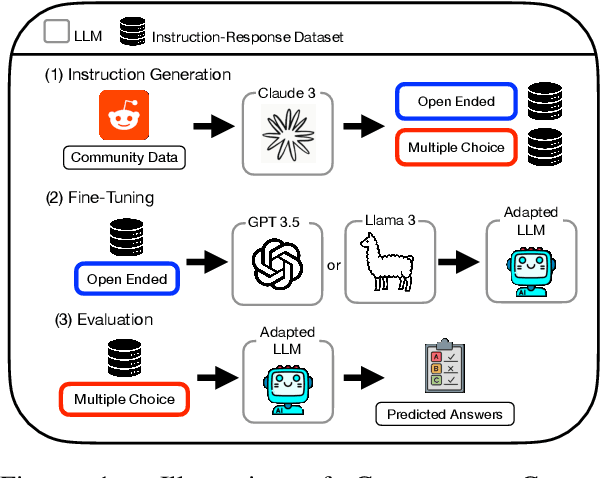



Social scientists use surveys to probe the opinions and beliefs of populations, but these methods are slow, costly, and prone to biases. Recent advances in large language models (LLMs) enable creating computational representations or "digital twins" of populations that generate human-like responses mimicking the population's language, styles, and attitudes. We introduce Community-Cross-Instruct, an unsupervised framework for aligning LLMs to online communities to elicit their beliefs. Given a corpus of a community's online discussions, Community-Cross-Instruct automatically generates instruction-output pairs by an advanced LLM to (1) finetune an foundational LLM to faithfully represent that community, and (2) evaluate the alignment of the finetuned model to the community. We demonstrate the method's utility in accurately representing political and fitness communities on Reddit. Unlike prior methods requiring human-authored instructions, Community-Cross-Instruct generates instructions in a fully unsupervised manner, enhancing scalability and generalization across domains. This work enables cost-effective and automated surveying of diverse online communities.
Polarization and Morality: Lexical Analysis of Abortion Discourse on Reddit
Jun 29, 2024This study investigates whether division on political topics is mapped with the distinctive patterns of language use. We collect a total 145,832 Reddit comments on the abortion debate and explore the languages of subreddit communities r/prolife and r/prochoice. With consideration of the Moral Foundations Theory, we examine lexical patterns in three ways. First, we compute proportional frequencies of lexical items from the Moral Foundations Dictionary in order to make inferences about each group's moral considerations when forming arguments for and against abortion. We then create n-gram models to reveal frequent collocations from each stance group and better understand how commonly used words are patterned in their linguistic context and in relation to morality values. Finally, we use Latent Dirichlet Allocation to identify underlying topical structures in the corpus data. Results show that the use of morality words is mapped with the stances on abortion.