 Add to Chrome
 Add to Firefox
 Add to Edge
Sparse OFDM Design for Interference and Ambiguity Mitigation in Multi-Static ISAC
Paper and Code
Dec 16, 2025
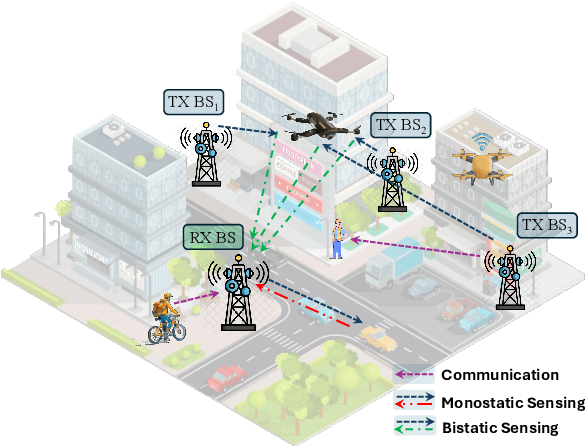
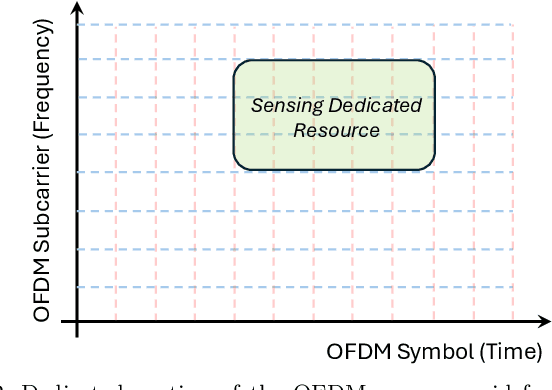
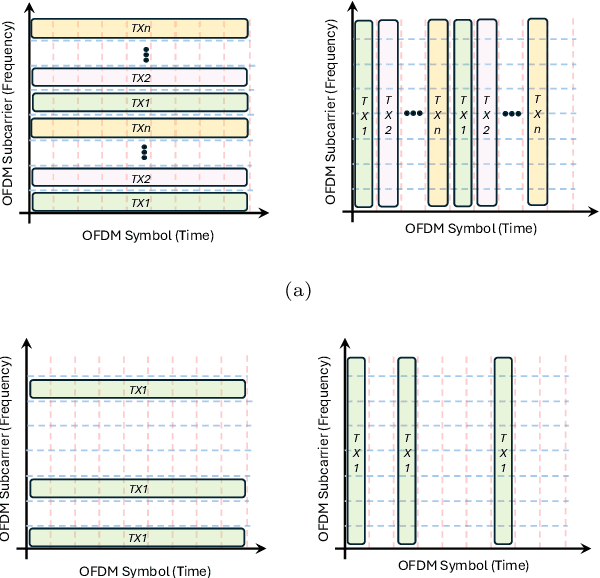
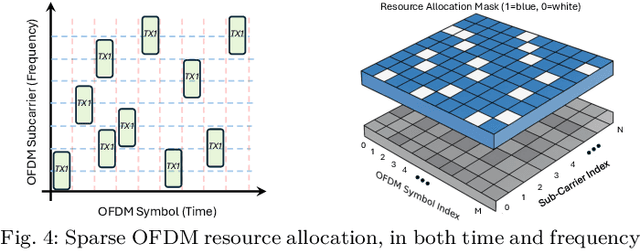
The sixth-generation (6G) wireless networks promises the integration of radar-like sensing capabilities into communication infrastructure. In this paper, we investigate a multi-static sensing framework where half-duplex base stations (BSs) are assigned as either transmitter or sensing receiver nodes. We propose a randomized sparse resource allocation scheme based on orthogonal frequency division multiplexing (OFDM) waveform design tailored for the multi-static scenario to simultaneously mitigate inter-BS interference (IBI) and sensing ambiguities. The waveform design also ensures robustness against inter-symbol interference (ISI) and intercarrier interference (ICI) via a judicious choice of subcarrier spacing according to the deployment of BSs. The potential ambiguity caused by sparse signaling is addressed through controlled irregularity in both time and frequency domains, with a negligible noise floor elevation. Simulation results demonstrate the effectiveness and resilience of the proposed design in the presence of multiple targets and clutter.
