 Add to Chrome
 Add to Firefox
 Add to Edge
Communication Efficient Decentralized Training with Multiple Local Updates
Paper and Code
Oct 28, 2019
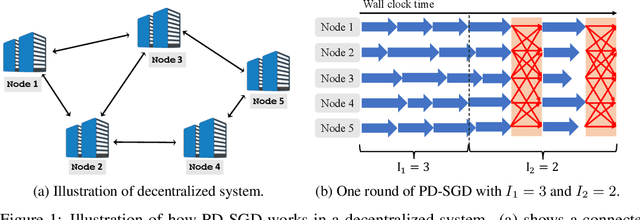

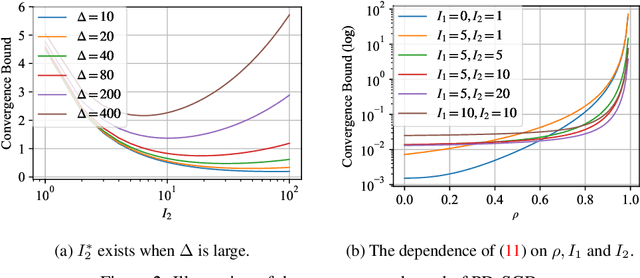
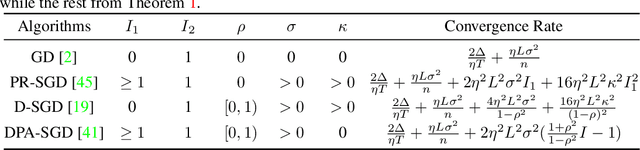
Decentralized optimization has been demonstrated to be very useful in machine learning. This work studies the communication-efficiency issue in decentralized optimization. We analyze the Periodic Decentralized Stochastic Gradient Descent (PD-SGD) algorithm, a straightforward combination of federated averaging and decentralized SGD. For the setting of for non-convex objective and non-identically distributed data, we prove that PD-SGD converges to a critical point. In particular, the number of local SGDs trades off communication and local computation. From an algorithmic perspective, we analyze a novel version of PD-SGD, which alternates between multiple local updates and multiple decentralized SGDs. We also show that when we periodically shrink the length of local updates, this generalized PD-SGD can better balance the communication-convergence trade-off both theoretically and empirically.
