 Add to Chrome
 Add to Firefox
 Add to Edge
UrbanVerse: Learning Urban Region Representation Across Cities and Tasks
Feb 17, 2026
Recent advances in urban region representation learning have enabled a wide range of applications in urban analytics, yet existing methods remain limited in their capabilities to generalize across cities and analytic tasks. We aim to generalize urban representation learning beyond city- and task-specific settings, towards a foundation-style model for urban analytics. To this end, we propose UrbanVerse, a model for cross-city urban representation learning and cross-task urban analytics. For cross-city generalization, UrbanVerse focuses on features local to the target regions and structural features of the nearby regions rather than the entire city. We model regions as nodes on a graph, which enables a random walk-based procedure to form "sequences of regions" that reflect both local and neighborhood structural features for urban region representation learning. For cross-task generalization, we propose a cross-task learning module named HCondDiffCT. This module integrates region-conditioned prior knowledge and task-conditioned semantics into the diffusion process to jointly model multiple downstream urban prediction tasks. HCondDiffCT is generic. It can also be integrated with existing urban representation learning models to enhance their downstream task effectiveness. Experiments on real-world datasets show that UrbanVerse consistently outperforms state-of-the-art methods across six tasks under cross-city settings, achieving up to 35.89% improvements in prediction accuracy.

CtrTab: Tabular Data Synthesis with High-Dimensional and Limited Data
Mar 09, 2025


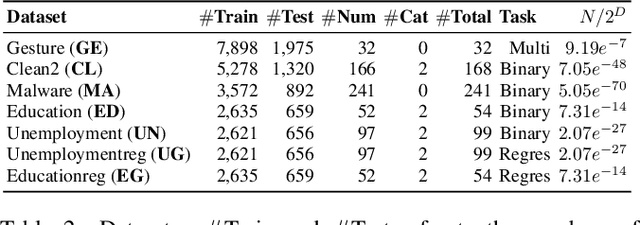
Diffusion-based tabular data synthesis models have yielded promising results. However, we observe that when the data dimensionality increases, existing models tend to degenerate and may perform even worse than simpler, non-diffusion-based models. This is because limited training samples in high-dimensional space often hinder generative models from capturing the distribution accurately. To address this issue, we propose CtrTab-a condition controlled diffusion model for tabular data synthesis-to improve the performance of diffusion-based generative models in high-dimensional, low-data scenarios. Through CtrTab, we inject samples with added Laplace noise as control signals to improve data diversity and show its resemblance to L2 regularization, which enhances model robustness. Experimental results across multiple datasets show that CtrTab outperforms state-of-the-art models, with performance gap in accuracy over 80% on average. Our source code will be released upon paper publication.