 Add to Chrome
 Add to Firefox
 Add to Edge
Spatiotemporal Degradation-Aware 3D Gaussian Splatting for Realistic Underwater Scene Reconstruction
Apr 26, 2026
Reconstructing realistic underwater scenes from underwater video remains a meaningful yet challenging task in the multimedia domain. The inherent spatiotemporal degradations in underwater imaging, including caustics, flickering, attenuation, and backscattering, frequently result in inaccurate geometry and appearance in existing 3D reconstruction methods. While a few recent works have explored underwater degradation-aware reconstruction, they often address either spatial or temporal degradation alone, falling short in more real-world underwater scenarios where both types of degradation occur. We propose MarineSTD-GS, a novel 3D Gaussian Splatting-based framework that explicitly models both temporal and spatial degradations for realistic underwater scene reconstruction. Specifically, we introduce two paired Gaussian primitives: Intrinsic Gaussians represent the true scene, while Degraded Gaussians render the degraded observations. The color of each Degraded Gaussian is physically derived from its paired Intrinsic Gaussian via a Spatiotemporal Degradation Modeling (SDM) module, enabling self-supervised disentanglement of realistic appearance from degraded images. To ensure stable training and accurate geometry, we further propose a Depth-Guided Geometry Loss and a Multi-Stage Optimization strategy. We also construct a simulated benchmark with diverse spatial and temporal degradations and ground-truth appearances for comprehensive evaluation. Experiments on both simulated and real-world datasets show that MarineSTD-GS robustly handles spatiotemporal degradations and outperforms existing methods in novel view synthesis with realistic, water-free scene appearances.
* 12 pages, 10 figures, 6 tables. Author version of the paper published in Proceedings of ACM Multimedia 2025

Aquatic-GS: A Hybrid 3D Representation for Underwater Scenes
Oct 31, 2024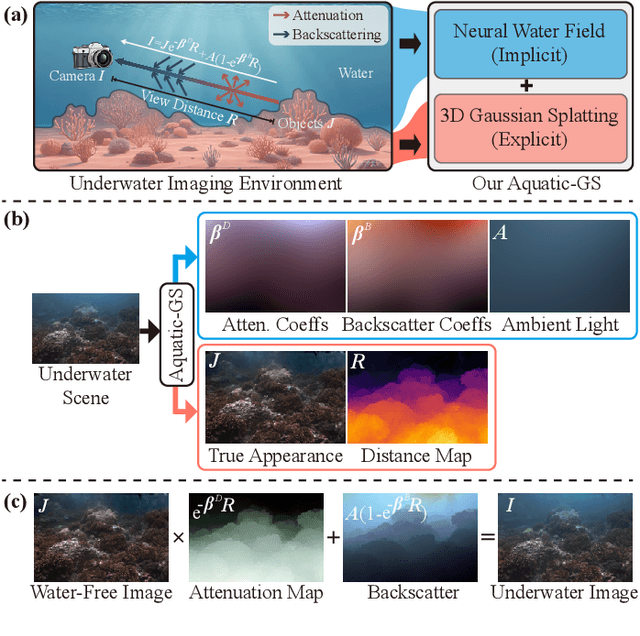
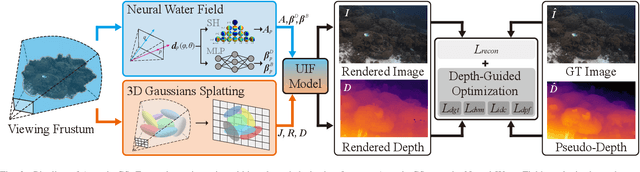
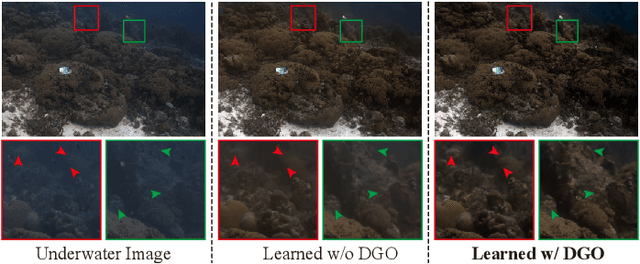
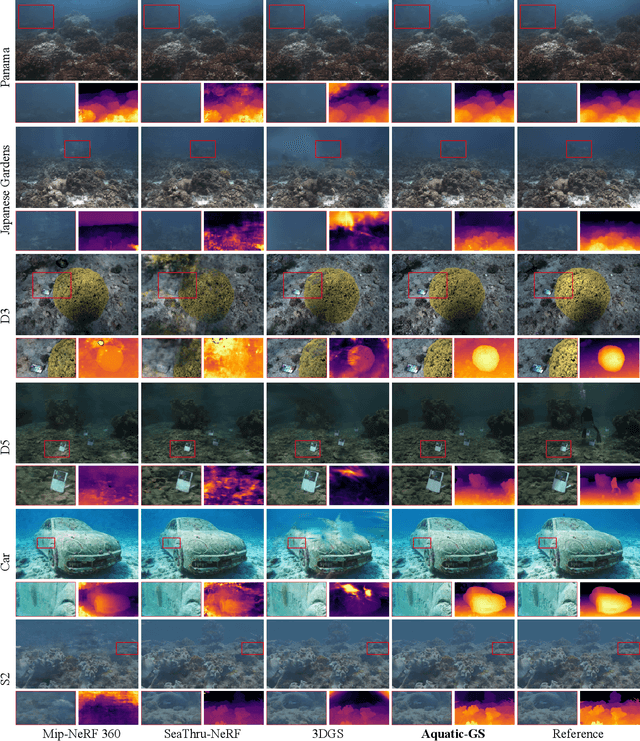
Representing underwater 3D scenes is a valuable yet complex task, as attenuation and scattering effects during underwater imaging significantly couple the information of the objects and the water. This coupling presents a significant challenge for existing methods in effectively representing both the objects and the water medium simultaneously. To address this challenge, we propose Aquatic-GS, a hybrid 3D representation approach for underwater scenes that effectively represents both the objects and the water medium. Specifically, we construct a Neural Water Field (NWF) to implicitly model the water parameters, while extending the latest 3D Gaussian Splatting (3DGS) to model the objects explicitly. Both components are integrated through a physics-based underwater image formation model to represent complex underwater scenes. Moreover, to construct more precise scene geometry and details, we design a Depth-Guided Optimization (DGO) mechanism that uses a pseudo-depth map as auxiliary guidance. After optimization, Aquatic-GS enables the rendering of novel underwater viewpoints and supports restoring the true appearance of underwater scenes, as if the water medium were absent. Extensive experiments on both simulated and real-world datasets demonstrate that Aquatic-GS surpasses state-of-the-art underwater 3D representation methods, achieving better rendering quality and real-time rendering performance with a 410x increase in speed. Furthermore, regarding underwater image restoration, Aquatic-GS outperforms representative dewatering methods in color correction, detail recovery, and stability. Our models, code, and datasets can be accessed at https://aquaticgs.github.io.