 Add to Chrome
 Add to Firefox
 Add to Edge
Generative Control as Optimization: Time Unconditional Flow Matching for Adaptive and Robust Robotic Control
Mar 18, 2026
Diffusion models and flow matching have become a cornerstone of robotic imitation learning, yet they suffer from a structural inefficiency where inference is often bound to a fixed integration schedule that is agnostic to state complexity. This paradigm forces the policy to expend the same computational budget on trivial motions as it does on complex tasks. We introduce Generative Control as Optimization (GeCO), a time-unconditional framework that transforms action synthesis from trajectory integration into iterative optimization. GeCO learns a stationary velocity field in the action-sequence space where expert behaviors form stable attractors. Consequently, test-time inference becomes an adaptive process that allocates computation based on convergence--exiting early for simple states while refining longer for difficult ones. Furthermore, this stationary geometry yields an intrinsic, training-free safety signal, as the field norm at the optimized action serves as a robust out-of-distribution (OOD) detector, remaining low for in-distribution states while significantly increasing for anomalies. We validate GeCO on standard simulation benchmarks and demonstrate seamless scaling to pi0-series Vision-Language-Action (VLA) models. As a plug-and-play replacement for standard flow-matching heads, GeCO improves success rates and efficiency with an optimization-native mechanism for safe deployment. Video and code can be found at https://hrh6666.github.io/GeCO/

Virtual Community: An Open World for Humans, Robots, and Society
Aug 20, 2025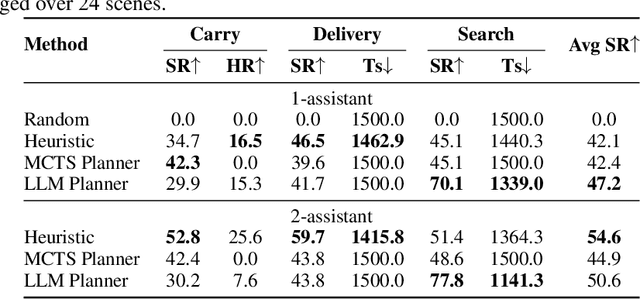
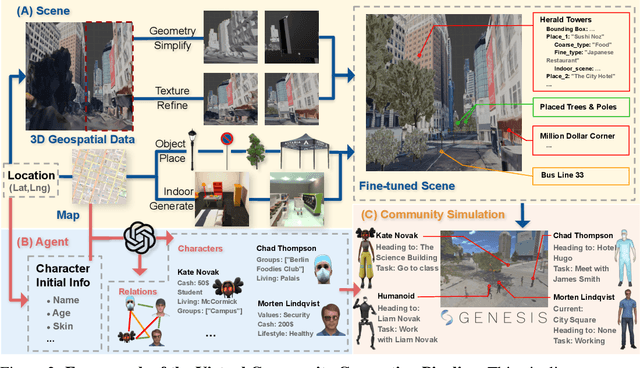
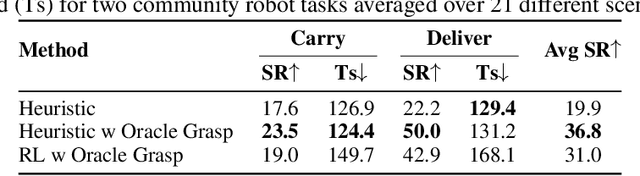

The rapid progress in AI and Robotics may lead to a profound societal transformation, as humans and robots begin to coexist within shared communities, introducing both opportunities and challenges. To explore this future, we present Virtual Community-an open-world platform for humans, robots, and society-built on a universal physics engine and grounded in real-world 3D scenes. With Virtual Community, we aim to study embodied social intelligence at scale: 1) How robots can intelligently cooperate or compete; 2) How humans develop social relations and build community; 3) More importantly, how intelligent robots and humans can co-exist in an open world. To support these, Virtual Community features: 1) An open-source multi-agent physics simulator that supports robots, humans, and their interactions within a society; 2) A large-scale, real-world aligned community generation pipeline, including vast outdoor space, diverse indoor scenes, and a community of grounded agents with rich characters and appearances. Leveraging Virtual Community, we propose two novel challenges. The Community Planning Challenge evaluates multi-agent reasoning and planning ability in open-world settings, such as cooperating to help agents with daily activities and efficiently connecting other agents. The Community Robot Challenge requires multiple heterogeneous robots to collaborate in solving complex open-world tasks. We evaluate various baselines on these tasks and demonstrate the challenges in both high-level open-world task planning and low-level cooperation controls. We hope that Virtual Community will unlock further study of human-robot coexistence within open-world environments.