 Add to Chrome
 Add to Firefox
 Add to Edge
Can we generate portable representations for clinical time series data using LLMs?
Mar 25, 2026
Deploying clinical ML is slow and brittle: models that work at one hospital often degrade under distribution shifts at the next. In this work, we study a simple question -- can large language models (LLMs) create portable patient embeddings i.e. representations of patients enable a downstream predictor built on one hospital to be used elsewhere with minimal-to-no retraining and fine-tuning. To do so, we map from irregular ICU time series onto concise natural language summaries using a frozen LLM, then embed each summary with a frozen text embedding model to obtain a fixed length vector capable of serving as input to a variety of downstream predictors. Across three cohorts (MIMIC-IV, HIRID, PPICU), on multiple clinically grounded forecasting and classification tasks, we find that our approach is simple, easy to use and competitive with in-distribution with grid imputation, self-supervised representation learning, and time series foundation models, while exhibiting smaller relative performance drops when transferring to new hospitals. We study the variation in performance across prompt design, with structured prompts being crucial to reducing the variance of the predictive models without altering mean accuracy. We find that using these portable representations improves few-shot learning and does not increase demographic recoverability of age or sex relative to baselines, suggesting little additional privacy risk. Our work points to the potential that LLMs hold as tools to enable the scalable deployment of production grade predictive models by reducing the engineering overhead.

Dialogue to Question Generation for Evidence-based Medical Guideline Agent Development
Mar 25, 2026Evidence-based medicine (EBM) is central to high-quality care, but remains difficult to implement in fast-paced primary care settings. Physicians face short consultations, increasing patient loads, and lengthy guideline documents that are impractical to consult in real time. To address this gap, we investigate the feasibility of using large language models (LLMs) as ambient assistants that surface targeted, evidence-based questions during physician-patient encounters. Our study focuses on question generation rather than question answering, with the aim of scaffolding physician reasoning and integrating guideline-based practice into brief consultations. We implemented two prompting strategies, a zero-shot baseline and a multi-stage reasoning variant, using Gemini 2.5 as the backbone model. We evaluated on a benchmark of 80 de-identified transcripts from real clinical encounters, with six experienced physicians contributing over 90 hours of structured review. Results indicate that while general-purpose LLMs are not yet fully reliable, they can produce clinically meaningful and guideline-relevant questions, suggesting significant potential to reduce cognitive burden and make EBM more actionable at the point of care.
* 9 pages. To appear in Proceedings of Machine Learning Research (PMLR), Machine Learning for Health (ML4H) Symposium 2025
ExOSITO: Explainable Off-Policy Learning with Side Information for Intensive Care Unit Blood Test Orders
Apr 24, 2025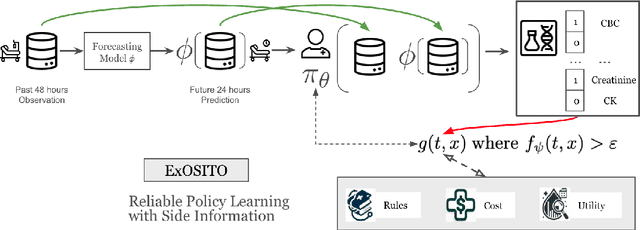
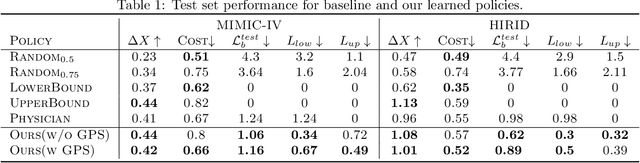
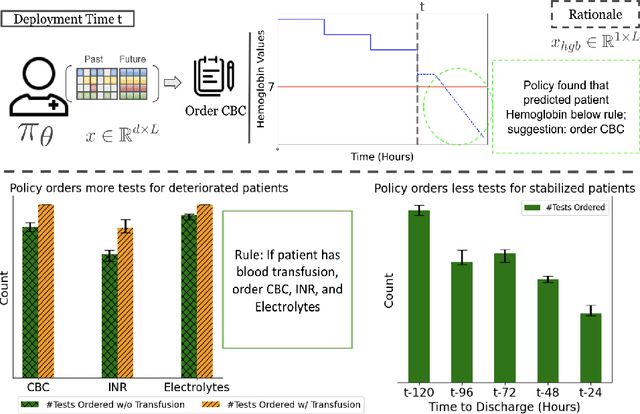

Ordering a minimal subset of lab tests for patients in the intensive care unit (ICU) can be challenging. Care teams must balance between ensuring the availability of the right information and reducing the clinical burden and costs associated with each lab test order. Most in-patient settings experience frequent over-ordering of lab tests, but are now aiming to reduce this burden on both hospital resources and the environment. This paper develops a novel method that combines off-policy learning with privileged information to identify the optimal set of ICU lab tests to order. Our approach, EXplainable Off-policy learning with Side Information for ICU blood Test Orders (ExOSITO) creates an interpretable assistive tool for clinicians to order lab tests by considering both the observed and predicted future status of each patient. We pose this problem as a causal bandit trained using offline data and a reward function derived from clinically-approved rules; we introduce a novel learning framework that integrates clinical knowledge with observational data to bridge the gap between the optimal and logging policies. The learned policy function provides interpretable clinical information and reduces costs without omitting any vital lab orders, outperforming both a physician's policy and prior approaches to this practical problem.
Measurement Scheduling for ICU Patients with Offline Reinforcement Learning
Feb 12, 2024Scheduling laboratory tests for ICU patients presents a significant challenge. Studies show that 20-40% of lab tests ordered in the ICU are redundant and could be eliminated without compromising patient safety. Prior work has leveraged offline reinforcement learning (Offline-RL) to find optimal policies for ordering lab tests based on patient information. However, new ICU patient datasets have since been released, and various advancements have been made in Offline-RL methods. In this study, we first introduce a preprocessing pipeline for the newly-released MIMIC-IV dataset geared toward time-series tasks. We then explore the efficacy of state-of-the-art Offline-RL methods in identifying better policies for ICU patient lab test scheduling. Besides assessing methodological performance, we also discuss the overall suitability and practicality of using Offline-RL frameworks for scheduling laboratory tests in ICU settings.
Matrix Multiplication: Verifying Strong Uniquely Solvable Puzzles
Dec 30, 2022Cohn and Umans proposed a framework for developing fast matrix multiplication algorithms based on the embedding computation in certain groups algebras. In subsequent work with Kleinberg and Szegedy, they connected this to the search for combinatorial objects called strong uniquely solvable puzzles (strong USPs). We begin a systematic computer-aided search for these objects. We develop and implement constraint-based algorithms build on reductions to $\mathrm{SAT}$ and $\mathrm{IP}$ to verify that puzzles are strong USPs, and to search for large strong USPs. We produce tight bounds on the maximum size of a strong USP for width $k \le 5$, construct puzzles of small width that are larger than previous work, and improve the upper bounds on strong USP size for $k \le 12$. Although our work only deals with puzzles of small-constant width, the strong USPs we find imply matrix multiplication algorithms that run in $O(n^\omega)$ time with exponent $\omega \le 2.66$. While our algorithms do not beat the fastest algorithms, our work provides evidence and, perhaps, a path to finding families of strong USPs that imply matrix multiplication algorithms that are more efficient than those currently known.