 Add to Chrome
 Add to Firefox
 Add to Edge
Towards Reliable Sequential Object Picking in Clutter: The Runner-up Solution to RGMC 2025
Jun 11, 2026
As a long-standing challenge in robotic manipulation, stable and efficient grasping in cluttered environments is of great importance in industrial settings. While recent studies have achieved relatively high success rates in grasping from clutter, there remain few mature solutions for more demanding tasks such as sequential object search and sorting. This work addresses sequential object picking in cluttered environments based on the Cluttered Environment Picking Benchmark (CEPB) and presents our solution to the Pick-in-Clutter track of the 10th Robotic Grasping and Manipulation Competition (RGMC) at ICRA 2025. The task poses several key challenges. First, it requires robust and collision-aware grasping with high success rates across a diverse set of objects, including both rigid and deformable ones. Second, it demands efficient search for target objects, which places stringent requirements on the decluttering and searching strategies of the solution. To address the above challenges, we design an integrated hardware-software pipeline that combines object recognition, decluttering, and multi-modal grasping. The main contributions include the hardware design of a multifunctional gripper and novel representations for object distribution and occlusion relationships in cluttered space. This pipeline enables efficient recognition, search, and sequential grasping of objects in clutter, demonstrating strong performance in both laboratory tests and competition scenarios, and ultimately achieving second place in the Pick-in-Clutter track of the RGMC 2025.

Theoretical Model Construction of Deformation-Force for Soft Grippers Part II: Displacement Control Based Intrinsic Force Sensing
Mar 22, 2023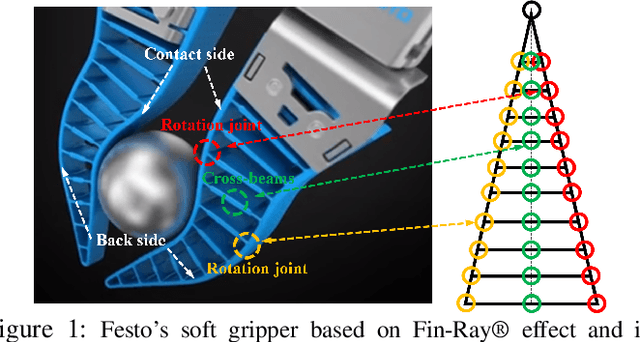
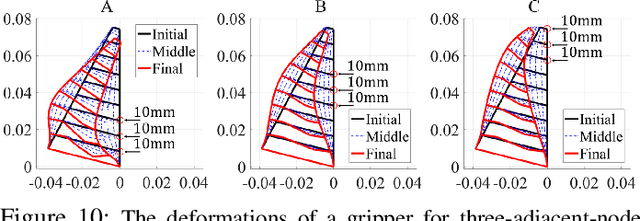
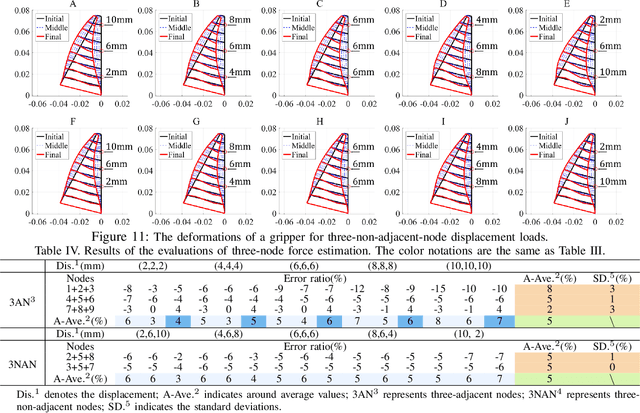
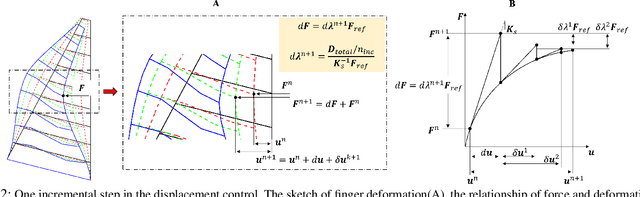
Compliant grasping is an essential capability for most robots in practical applications. For compliant robotic end-effectors that commonly appear in industrial or logistic scenarios, such as Fin-Ray gripper, it still remains challenging to build a bidirectional mathematical model that mutually maps the shape deformation and contact force. Part I of this article has constructed the force-displacement relationship for design optimization through the co-rotational theory with very few assumptions. In Part II, we further devise a detailed displacement-force mathematical model, enabling the compliant gripper to precisely estimate contact force sensor-free. Specifically, the proposed approach based on the co-rotational theory can calculate contact forces from deformations. The presented displacement-control algorithm elaborately investigates contact forces and provides force feedback for a force control system of a gripper, where deformation appears as displacements in contact points. Afterward, simulation experiments are conducted to evaluate the performance of the proposed model through comparisons with the finite-element analysis (FEA). Simulation results reveal that the proposed model accurately estimates contact force, with an average error of around 5% throughout all single/multiple node cases, regardless of various design parameters (Part I of this article is released in Google Drive).