 Add to Chrome
 Add to Firefox
 Add to Edge
AdaIAT: Adaptively Increasing Attention to Generated Text to Alleviate Hallucinations in LVLM
Mar 05, 2026
Hallucination has been a significant impediment to the development and application of current Large Vision-Language Models (LVLMs). To mitigate hallucinations, one intuitive and effective way is to directly increase attention weights to image tokens during inference. Although this effectively reduces the hallucination rate, it often induces repetitive descriptions. To address this, we first conduct an analysis of attention patterns and reveal that real object tokens tend to assign higher attention to the generated text than hallucinated ones. This inspires us to leverage the generated text, which contains instruction-related visual information and contextual knowledge, to alleviate hallucinations while maintaining linguistic coherence. We therefore propose Attention to Generated Text (IAT) and demonstrate that it significantly reduces the hallucination rate while avoiding repetitive descriptions. To prevent naive amplification from impairing the inherent prediction capabilities of LVLMs, we further explore Adaptive IAT (AdaIAT) that employs a layer-wise threshold to control intervention time and fine-grained amplification magnitude tailored to the characteristics of each attention head. Both analysis and experiments demonstrate the effectiveness of AdaIAT. Results of several LVLMs show that AdaIAT effectively alleviates hallucination (reducing hallucination rates $C_S$ and $C_I$ on LLaVA-1.5 by 35.8% and 37.1%, respectively) while preserving linguistic performance and prediction capability, achieving an attractive trade-off.

AdvAD: Exploring Non-Parametric Diffusion for Imperceptible Adversarial Attacks
Mar 12, 2025Imperceptible adversarial attacks aim to fool DNNs by adding imperceptible perturbation to the input data. Previous methods typically improve the imperceptibility of attacks by integrating common attack paradigms with specifically designed perception-based losses or the capabilities of generative models. In this paper, we propose Adversarial Attacks in Diffusion (AdvAD), a novel modeling framework distinct from existing attack paradigms. AdvAD innovatively conceptualizes attacking as a non-parametric diffusion process by theoretically exploring basic modeling approach rather than using the denoising or generation abilities of regular diffusion models requiring neural networks. At each step, much subtler yet effective adversarial guidance is crafted using only the attacked model without any additional network, which gradually leads the end of diffusion process from the original image to a desired imperceptible adversarial example. Grounded in a solid theoretical foundation of the proposed non-parametric diffusion process, AdvAD achieves high attack efficacy and imperceptibility with intrinsically lower overall perturbation strength. Additionally, an enhanced version AdvAD-X is proposed to evaluate the extreme of our novel framework under an ideal scenario. Extensive experiments demonstrate the effectiveness of the proposed AdvAD and AdvAD-X. Compared with state-of-the-art imperceptible attacks, AdvAD achieves an average of 99.9$\%$ (+17.3$\%$) ASR with 1.34 (-0.97) $l_2$ distance, 49.74 (+4.76) PSNR and 0.9971 (+0.0043) SSIM against four prevalent DNNs with three different architectures on the ImageNet-compatible dataset. Code is available at https://github.com/XianguiKang/AdvAD.
* Accept by NeurIPS 2024. Please cite this paper using the following format: J. Li, Z. He, A. Luo, J. Hu, Z. Wang, X. Kang*, "AdvAD: Exploring Non-Parametric Diffusion for Imperceptible Adversarial Attacks", the 38th Annual Conference on Neural Information Processing Systems (NeurIPS), Vancouver, Canada, Dec 9-15, 2024. Code: https://github.com/XianguiKang/AdvAD
PGD-Imp: Rethinking and Unleashing Potential of Classic PGD with Dual Strategies for Imperceptible Adversarial Attacks
Dec 15, 2024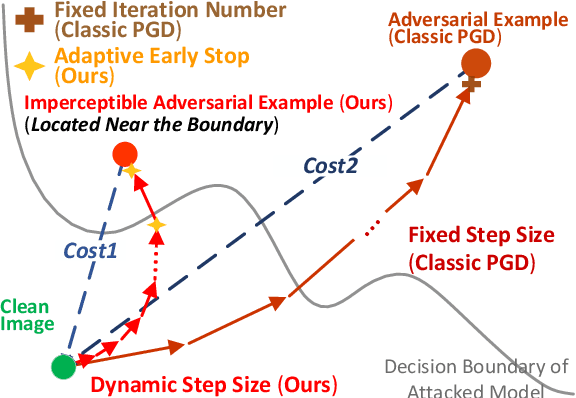
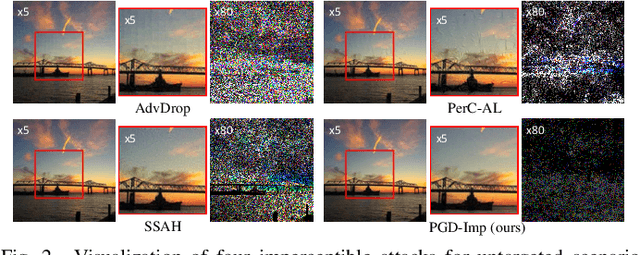
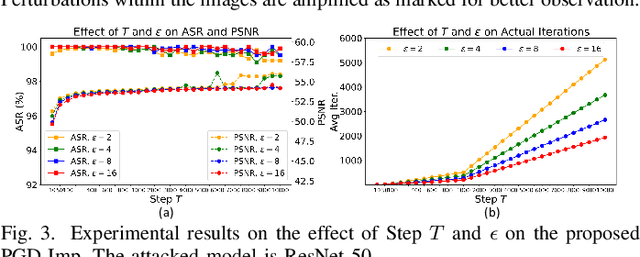
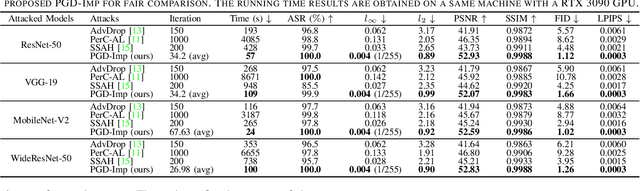
Imperceptible adversarial attacks have recently attracted increasing research interests. Existing methods typically incorporate external modules or loss terms other than a simple $l_p$-norm into the attack process to achieve imperceptibility, while we argue that such additional designs may not be necessary. In this paper, we rethink the essence of imperceptible attacks and propose two simple yet effective strategies to unleash the potential of PGD, the common and classical attack, for imperceptibility from an optimization perspective. Specifically, the Dynamic Step Size is introduced to find the optimal solution with minimal attack cost towards the decision boundary of the attacked model, and the Adaptive Early Stop strategy is adopted to reduce the redundant strength of adversarial perturbations to the minimum level. The proposed PGD-Imperceptible (PGD-Imp) attack achieves state-of-the-art results in imperceptible adversarial attacks for both untargeted and targeted scenarios. When performing untargeted attacks against ResNet-50, PGD-Imp attains 100$\%$ (+0.3$\%$) ASR, 0.89 (-1.76) $l_2$ distance, and 52.93 (+9.2) PSNR with 57s (-371s) running time, significantly outperforming existing methods.