 Add to Chrome
 Add to Firefox
 Add to Edge
A Benchmark for Multi-Party Negotiation Games from Real Negotiation Data
Mar 14, 2026
Many real-world multi-party negotiations unfold as sequences of binding, action-level commitments rather than a single final outcome. We introduce a benchmark for this under-studied regime featuring a configurable game generator that sweeps key structural properties such as incentive alignment, goal complexity, and payoff distribution. To evaluate decision-making, we test three value-function approximations - myopic reward, an optimistic upper bound, and a pessimistic lower bound - that act as biased lenses on deal evaluation. Through exact evaluation on small games and comparative evaluation on large, document-grounded instances derived from the Harvard Negotiation Challenge, we map the strategic regimes where each approximation succeeds or fails. We observe that different game structures demand different valuation strategies, motivating agents that learn robust state values and plan effectively over long horizons under binding commitments and terminal only rewards.

Learning Interpretable Fair Representations
Jun 24, 2024
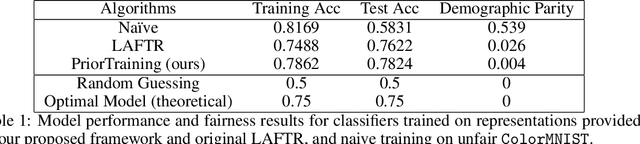


Numerous approaches have been recently proposed for learning fair representations that mitigate unfair outcomes in prediction tasks. A key motivation for these methods is that the representations can be used by third parties with unknown objectives. However, because current fair representations are generally not interpretable, the third party cannot use these fair representations for exploration, or to obtain any additional insights, besides the pre-contracted prediction tasks. Thus, to increase data utility beyond prediction tasks, we argue that the representations need to be fair, yet interpretable. We propose a general framework for learning interpretable fair representations by introducing an interpretable "prior knowledge" during the representation learning process. We implement this idea and conduct experiments with ColorMNIST and Dsprite datasets. The results indicate that in addition to being interpretable, our representations attain slightly higher accuracy and fairer outcomes in a downstream classification task compared to state-of-the-art fair representations.