 Add to Chrome
 Add to Firefox
 Add to Edge
EmoLoom-2B: Fast Base-Model Screening for Emotion Classification and VAD with Lexicon-Weak Supervision and KV-Off Evaluation
Jan 03, 2026
We introduce EmoLoom-2B, a lightweight and reproducible pipeline that turns small language models under 2B parameters into fast screening candidates for joint emotion classification and Valence-Arousal-Dominance prediction. To ensure protocol-faithful and fair evaluation, we unify data loading, training, and inference under a single JSON input-output contract and remove avoidable variance by adopting KV-off decoding as the default setting. We incorporate two orthogonal semantic regularizers: a VAD-preserving constraint that aligns generated text with target VAD triples, and a lightweight external appraisal classifier that provides training-time guidance on goal attainment, controllability, certainty, and fairness without injecting long rationales. To improve polarity sensitivity, we introduce Valence Flip augmentation based on mirrored emotional pairs. During supervised fine-tuning, we apply A/B mixture sampling with entropy-aware temperature scheduling to balance coverage and convergence. Using Qwen-1.8B-Chat as the base model, EmoLoom-2B achieves strong performance on GoEmotions and EmpatheticDialogues, and demonstrates robust cross-corpus generalization on DailyDialog. The proposed recipe is budget-aware, auditable, and re-entrant, serving as a dependable screening pass before heavier training or multimodal fusion.

DeepSeek-V3 Technical Report
Dec 27, 2024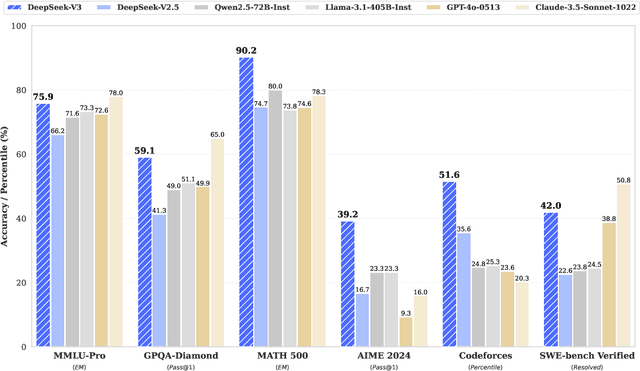


We present DeepSeek-V3, a strong Mixture-of-Experts (MoE) language model with 671B total parameters with 37B activated for each token. To achieve efficient inference and cost-effective training, DeepSeek-V3 adopts Multi-head Latent Attention (MLA) and DeepSeekMoE architectures, which were thoroughly validated in DeepSeek-V2. Furthermore, DeepSeek-V3 pioneers an auxiliary-loss-free strategy for load balancing and sets a multi-token prediction training objective for stronger performance. We pre-train DeepSeek-V3 on 14.8 trillion diverse and high-quality tokens, followed by Supervised Fine-Tuning and Reinforcement Learning stages to fully harness its capabilities. Comprehensive evaluations reveal that DeepSeek-V3 outperforms other open-source models and achieves performance comparable to leading closed-source models. Despite its excellent performance, DeepSeek-V3 requires only 2.788M H800 GPU hours for its full training. In addition, its training process is remarkably stable. Throughout the entire training process, we did not experience any irrecoverable loss spikes or perform any rollbacks. The model checkpoints are available at https://github.com/deepseek-ai/DeepSeek-V3.