 Add to Chrome
 Add to Firefox
 Add to Edge
Can LLMs Fool Graph Learning? Exploring Universal Adversarial Attacks on Text-Attributed Graphs
Mar 22, 2026
Text-attributed graphs (TAGs) enhance graph learning by integrating rich textual semantics and topological context for each node. While boosting expressiveness, they also expose new vulnerabilities in graph learning through text-based adversarial surfaces. Recent advances leverage diverse backbones, such as graph neural networks (GNNs) and pre-trained language models (PLMs), to capture both structural and textual information in TAGs. This diversity raises a key question: How can we design universal adversarial attacks that generalize across architectures to assess the security of TAG models? The challenge arises from the stark contrast in how different backbones-GNNs and PLMs-perceive and encode graph patterns, coupled with the fact that many PLMs are only accessible via APIs, limiting attacks to black-box settings. To address this, we propose BadGraph, a novel attack framework that deeply elicits large language models (LLMs) understanding of general graph knowledge to jointly perturb both node topology and textual semantics. Specifically, we design a target influencer retrieval module that leverages graph priors to construct cross-modally aligned attack shortcuts, thereby enabling efficient LLM-based perturbation reasoning. Experiments show that BadGraph achieves universal and effective attacks across GNN- and LLM-based reasoners, with up to a 76.3% performance drop, while theoretical and empirical analyses confirm its stealthy yet interpretable nature.

HeTa: Relation-wise Heterogeneous Graph Foundation Attack Model
Jun 09, 2025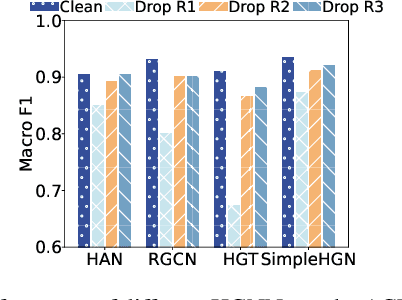
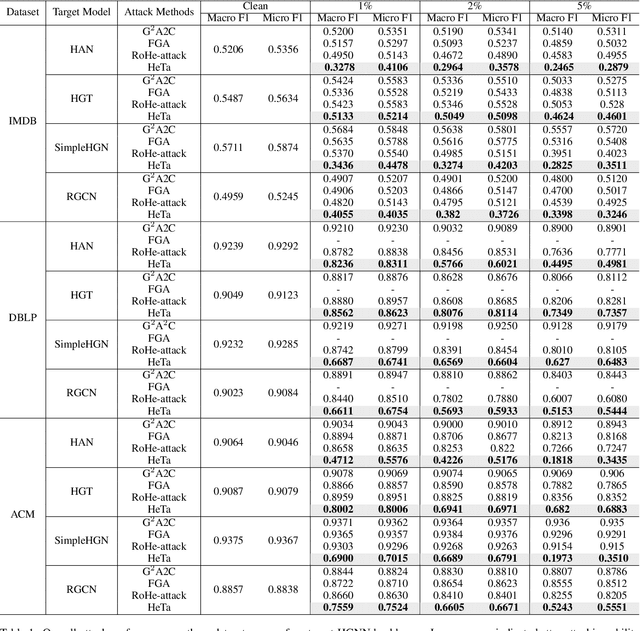

Heterogeneous Graph Neural Networks (HGNNs) are vulnerable, highlighting the need for tailored attacks to assess their robustness and ensure security. However, existing HGNN attacks often require complex retraining of parameters to generate specific perturbations for new scenarios. Recently, foundation models have opened new horizons for the generalization of graph neural networks by capturing shared semantics across various graph distributions. This leads us to ask:Can we design a foundation attack model for HGNNs that enables generalizable perturbations across different HGNNs, and quickly adapts to new heterogeneous graphs (HGs)? Empirical findings reveal that, despite significant differences in model design and parameter space, different HGNNs surprisingly share common vulnerability patterns from a relation-aware perspective. Therefore, we explore how to design foundation HGNN attack criteria by mining shared attack units. In this paper, we propose a novel relation-wise heterogeneous graph foundation attack model, HeTa. We introduce a foundation surrogate model to align heterogeneity and identify the importance of shared relation-aware attack units. Building on this, we implement a serialized relation-by-relation attack based on the identified relational weights. In this way, the perturbation can be transferred to various target HGNNs and easily fine-tuned for new HGs. Extensive experiments exhibit powerful attack performances and generalizability of our method.