 Add to Chrome
 Add to Firefox
 Add to Edge
TauFlow: Dynamic Causal Constraint for Complexity-Adaptive Lightweight Segmentation
Nov 10, 2025
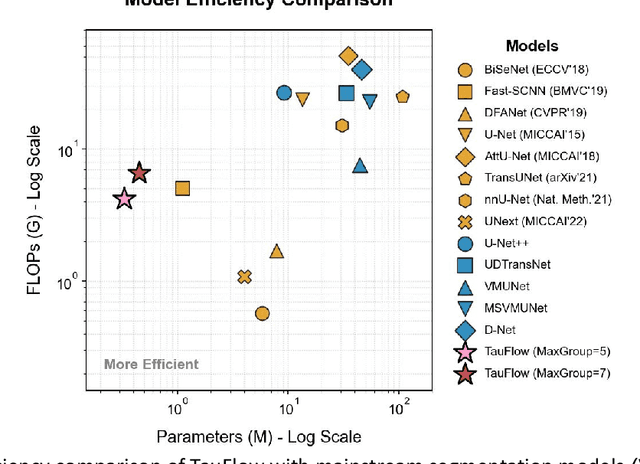
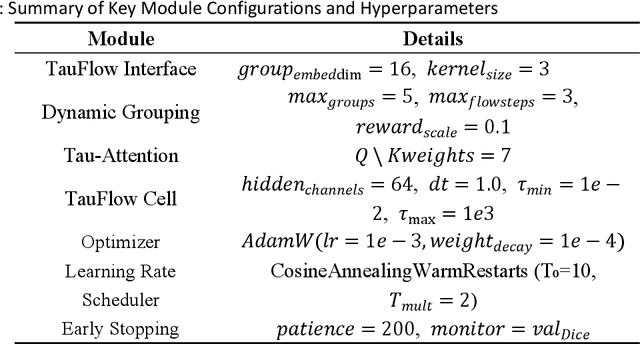
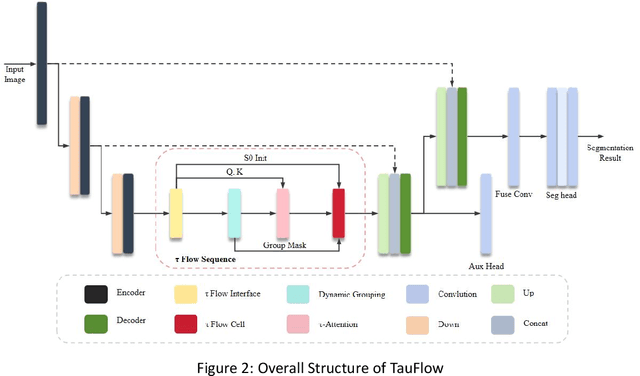
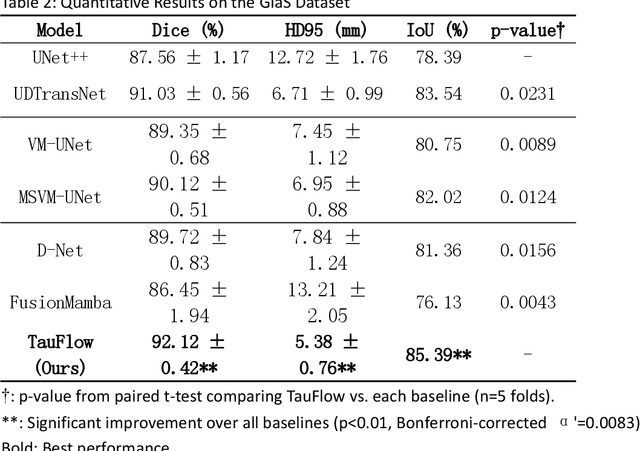
Deploying lightweight medical image segmentation models on edge devices presents two major challenges: 1) efficiently handling the stark contrast between lesion boundaries and background regions, and 2) the sharp drop in accuracy that occurs when pursuing extremely lightweight designs (e.g., <0.5M parameters). To address these problems, this paper proposes TauFlow, a novel lightweight segmentation model. The core of TauFlow is a dynamic feature response strategy inspired by brain-like mechanisms. This is achieved through two key innovations: the Convolutional Long-Time Constant Cell (ConvLTC), which dynamically regulates the feature update rate to "slowly" process low-frequency backgrounds and "quickly" respond to high-frequency boundaries; and the STDP Self-Organizing Module, which significantly mitigates feature conflicts between the encoder and decoder, reducing the conflict rate from approximately 35%-40% to 8%-10%.

UGOD: Uncertainty-Guided Differentiable Opacity and Soft Dropout for Enhanced Sparse-View 3DGS
Aug 07, 20253D Gaussian Splatting (3DGS) has become a competitive approach for novel view synthesis (NVS) due to its advanced rendering efficiency through 3D Gaussian projection and blending. However, Gaussians are treated equally weighted for rendering in most 3DGS methods, making them prone to overfitting, which is particularly the case in sparse-view scenarios. To address this, we investigate how adaptive weighting of Gaussians affects rendering quality, which is characterised by learned uncertainties proposed. This learned uncertainty serves two key purposes: first, it guides the differentiable update of Gaussian opacity while preserving the 3DGS pipeline integrity; second, the uncertainty undergoes soft differentiable dropout regularisation, which strategically transforms the original uncertainty into continuous drop probabilities that govern the final Gaussian projection and blending process for rendering. Extensive experimental results over widely adopted datasets demonstrate that our method outperforms rivals in sparse-view 3D synthesis, achieving higher quality reconstruction with fewer Gaussians in most datasets compared to existing sparse-view approaches, e.g., compared to DropGaussian, our method achieves 3.27\% PSNR improvements on the MipNeRF 360 dataset.