 Add to Chrome
 Add to Firefox
 Add to Edge
Improving Variable-Length Generation in Diffusion Language Models via Length Regularization
Feb 07, 2026
Diffusion Large Language Models (DLLMs) are inherently ill-suited for variable-length generation, as their inference is defined on a fixed-length canvas and implicitly assumes a known target length. When the length is unknown, as in realistic completion and infilling, naively comparing confidence across mask lengths becomes systematically biased, leading to under-generation or redundant continuations. In this paper, we show that this failure arises from an intrinsic lengthinduced bias in generation confidence estimates, leaving existing DLLMs without a robust way to determine generation length and making variablelength inference unreliable. To address this issue, we propose LR-DLLM, a length-regularized inference framework for DLLMs that treats generation length as an explicit variable and achieves reliable length determination at inference time. It decouples semantic compatibility from lengthinduced uncertainty through an explicit length regularization that corrects biased confidence estimates. Based on this, LR-DLLM enables dynamic expansion or contraction of the generation span without modifying the underlying DLLM or its training procedure. Experiments show that LRDLLM achieves 51.3% Pass@1 on HumanEvalInfilling under fully unknown lengths (+13.4% vs. DreamOn) and 51.5% average Pass@1 on four-language McEval (+14.3% vs. DreamOn).

DEER: Draft with Diffusion, Verify with Autoregressive Models
Dec 17, 2025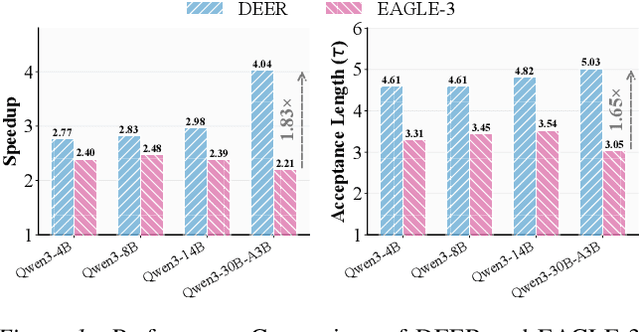
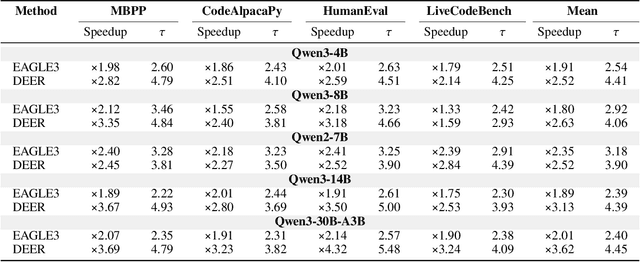
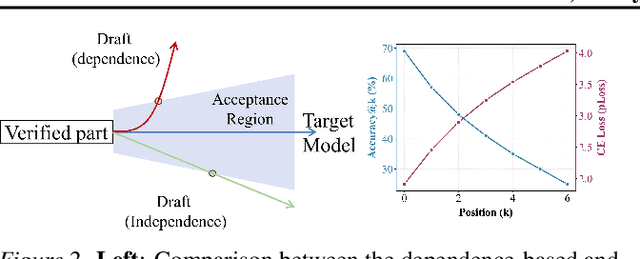
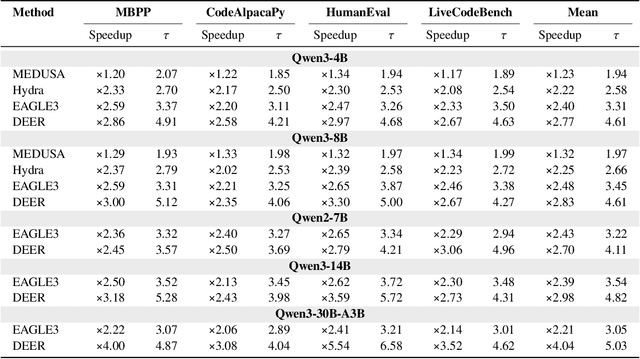
Efficiency, as a critical practical challenge for LLM-driven agentic and reasoning systems, is increasingly constrained by the inherent latency of autoregressive (AR) decoding. Speculative decoding mitigates this cost through a draft-verify scheme, yet existing approaches rely on AR draft models (a.k.a., drafters), which introduce two fundamental issues: (1) step-wise uncertainty accumulation leads to a progressive collapse of trust between the target model and the drafter, and (2) inherently sequential decoding of AR drafters. Together, these factors cause limited speedups. In this paper, we show that a diffusion large language model (dLLM) drafters can naturally overcome these issues through its fundamentally different probabilistic modeling and efficient parallel decoding strategy. Building on this insight, we introduce DEER, an efficient speculative decoding framework that drafts with diffusion and verifies with AR models. To enable high-quality drafting, DEER employs a two-stage training pipeline to align the dLLM-based drafters with the target AR model, and further adopts single-step decoding to generate long draft segments. Experiments show DEER reaches draft acceptance lengths of up to 32 tokens, far surpassing the 10 tokens achieved by EAGLE-3. Moreover, on HumanEval with Qwen3-30B-A3B, DEER attains a 5.54x speedup, while EAGLE-3 achieves only 2.41x. Code, model, demo, etc, will be available at https://czc726.github.io/DEER/