 Add to Chrome
 Add to Firefox
 Add to Edge
Adaptive Data Admission and Retention for Streaming Federated Learning
Jul 27, 2026
We study streaming federated learning with limited client memory, where newly generated training data incur time-varying sampling costs and must be selectively admitted and retained over time. We consider a joint server-side admission and client-side memory-management framework with the objective of minimizing the cumulative excess population risk under a sampling-cost budget and buffer constraints. We first derive a learning-error bound that explicitly captures the effects of instantaneous training sample size, distinct-sample growth, and reuse imbalance through a characterization of the effective sample size. Through a surrogate penalty obtained from this bound, we develop an Active-Constraint Drift-Plus-Penalty (ACDPP) policy that combines a structured client-side $K$-step retention rule with a server-side online admission rule and a time-varying rectangular admission region. We further present a sequence of comparison arguments, via an auxiliary constant-admission policy, that connects the ACDPP learning bound to a costless oracle benchmark. This yields explicit guarantees in terms of sublinear regret and sampling-cost violation, while the buffer-occupancy violation is controlled through offline selection of the retention horizon. Experiments on multiple datasets demonstrate that the proposed policy remains close to the oracle benchmark while satisfying the sampling-cost and buffer constraints.

Performance Analysis of Cell-Free Massive MIMO Systems with Asynchronous Reception
Oct 17, 2022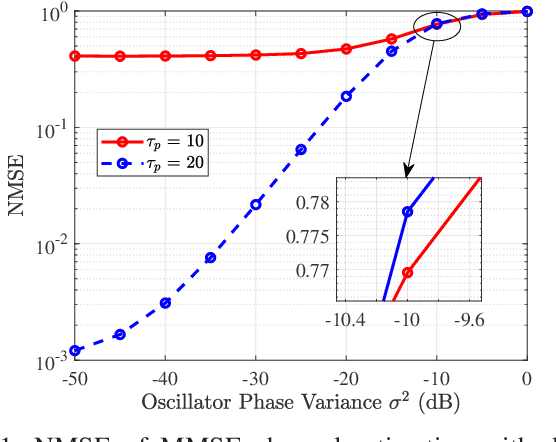
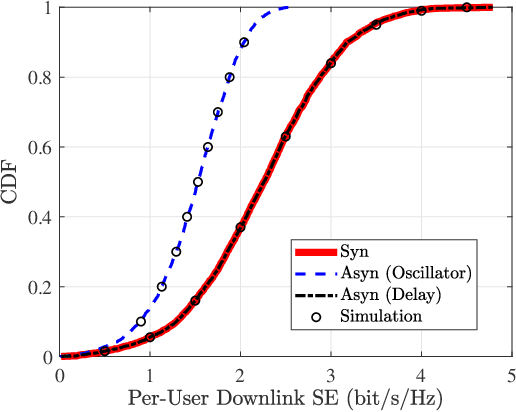
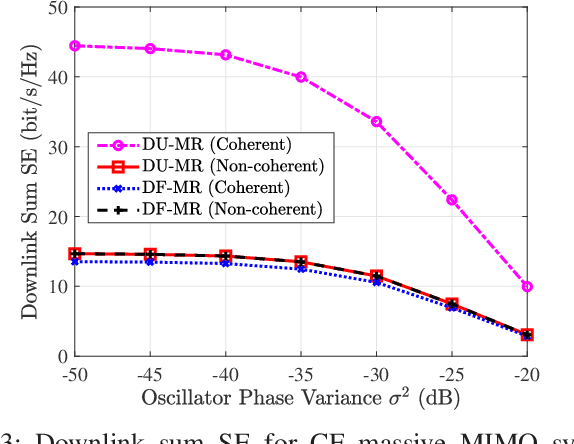
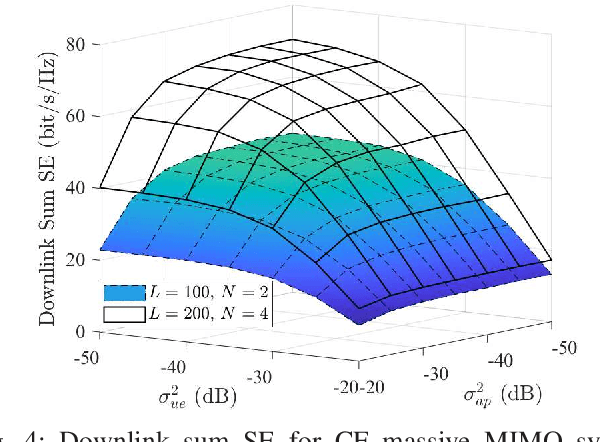
Cell-free (CF) massive multiple-input multiple-output (MIMO) is considered as a promising technology for achieving the ultimate performance limit. However, due to its distributed architecture and low-cost access points (APs), the signals received at user equipments (UEs) are most likely asynchronous. In this paper, we investigate the performance of CF massive MIMO systems with asynchronous reception, including both effects of delay and oscillator phases. Taking into account the imperfect channel state information caused by phase asynchronization and pilot contamination, we obtain novel and closed-form downlink spectral efficiency (SE) expressions with coherent and non-coherent data transmission schemes, respectively. Simulation results show that asynchronous reception destroys the orthogonality of pilots and coherent transmission of data, and thus results in poor system performance. In addition, getting a highly accurate delay phase is substantial for CF massive MIMO systems to achieve coherent transmission gain. Moreover, the oscillator phase of UEs has a larger effect on SE than that of the APs, because the latter can be significantly reduced by increasing the number of antennas.