 Add to Chrome
 Add to Firefox
 Add to Edge
Haptic Sorter: A Unified Planning Framework for Online Shape Estimation and Real-Time Pose Inference
May 29, 2026
Robotics manipulation usually assumes that the shape and pose of the object are known to the robot prior to motion planning. However, precise geometric information is not always available in practice, and pose inference suffers from sensor uncertainties and view occlusion. In this work, we propose a unified model-based geometric framework integrating robotic haptic perception, modeling, and manipulation planning. Our novelties involve: \textit{i)} Introducing Bayesian Optimization (BO) to guide the haptic exploration for object shape inference, where superellipses are used to approximate geometric boundary; \textit{ii)} Adaptive formulation of manipulation potential encoding object geometry for quasi-static robot-object interaction; \textit{iii)} Proposing an online Ordinary Differential Equation (ODE) for real-time pose inference based on model prediction and tactile feedback. We deploy our system on a 2D robotic sorting task, and vary object geometries to validate the robustness and generalizability of our framework in both simulation and a real-world multi-arm setup.

A Planning Framework for Stable Robust Multi-Contact Manipulation
Apr 03, 2025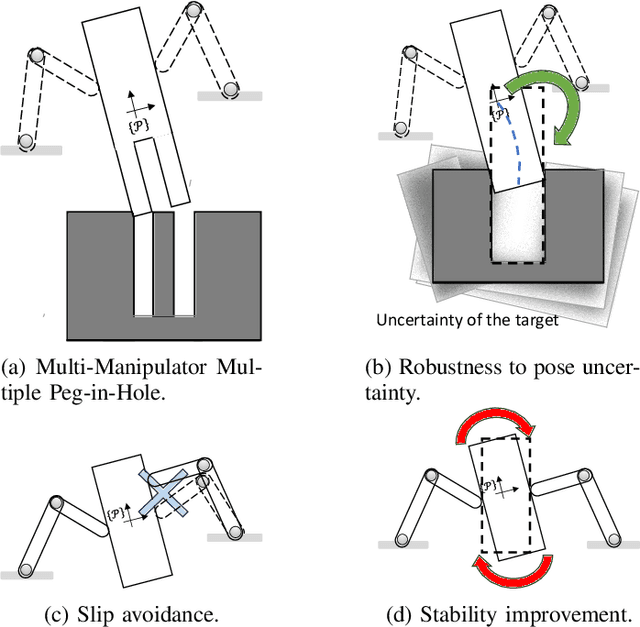
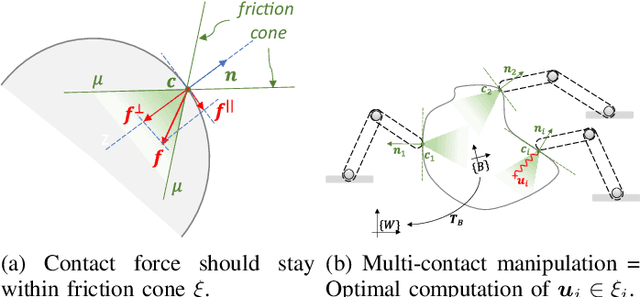
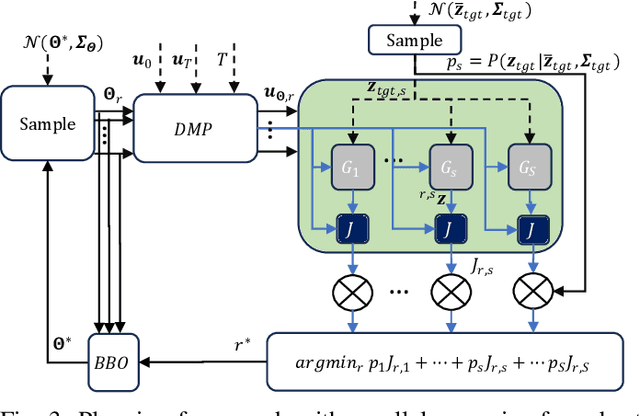
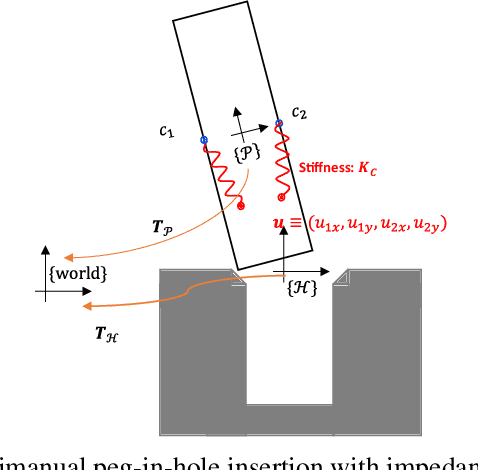
While modeling multi-contact manipulation as a quasi-static mechanical process transitioning between different contact equilibria, we propose formulating it as a planning and optimization problem, explicitly evaluating (i) contact stability and (ii) robustness to sensor noise. Specifically, we conduct a comprehensive study on multi-manipulator control strategies, focusing on dual-arm execution in a planar peg-in-hole task and extending it to the Multi-Manipulator Multiple Peg-in-Hole (MMPiH) problem to explore increased task complexity. Our framework employs Dynamic Movement Primitives (DMPs) to parameterize desired trajectories and Black-Box Optimization (BBO) with a comprehensive cost function incorporating friction cone constraints, squeeze forces, and stability considerations. By integrating parallel scenario training, we enhance the robustness of the learned policies. To evaluate the friction cone cost in experiments, we test the optimal trajectories computed for various contact surfaces, i.e., with different coefficients of friction. The stability cost is analytical explained and tested its necessity in simulation. The robustness performance is quantified through variations of hole pose and chamfer size in simulation and experiment. Results demonstrate that our approach achieves consistently high success rates in both the single peg-in-hole and multiple peg-in-hole tasks, confirming its effectiveness and generalizability. The video can be found at https://youtu.be/IU0pdnSd4tE.