 Add to Chrome
 Add to Firefox
 Add to Edge
Share First, Route What Remains: A Unified Framework for Token-Adaptive MoE Computation
Aug 11, 2026
Mixture-of-experts (MoE) models have recently moved beyond routing a fixed number of complete experts. Shared-expert designs preserve reusable knowledge, fine-grained methods vary computation within experts, and dynamic routers adapt the number of active experts. Yet these decisions are usually made independently, overlooking a basic dependency: extracting reusable computation changes both what remains and how much expert capacity the remainder needs. We study this dependency by decomposing sparsely upcycled feed-forward experts into key-value channels. Co-activated experts align at a subset of value positions; removing these positions changes expert preference; and greater shared coverage is associated with lower residual expert demand. These observations lead to one principle: share first, then route what remains. We instantiate it in UniF-MoE, a unified framework for token-adaptive MoE computation. Each expert is partitioned into aligned blocks. A shared-demand score sets the shared block count and pathway weight, key prototypes select the shared content, and the complementary demand determines the residual expert count through cumulative routing mass. A Gram regularizer separates and normalizes router embeddings, promoting diverse routing directions, sparse expert overlap, and a simple routing geometry. Experiments on DomainBed and GLUE show that this unified design improves predictive performance over representative static and dynamic MoEs while reducing activated computation, inference latency, and memory. Code is available at https://github.com/existence0420/UniF-MoE.

Incremental Self-training for Semi-supervised Learning
Apr 14, 2024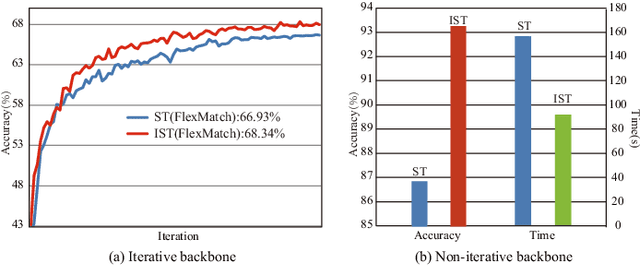
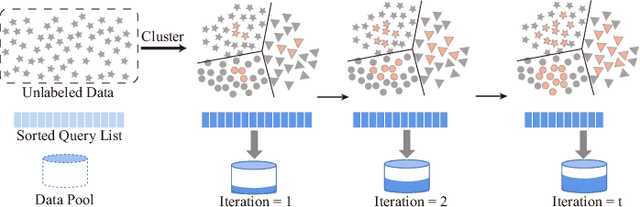
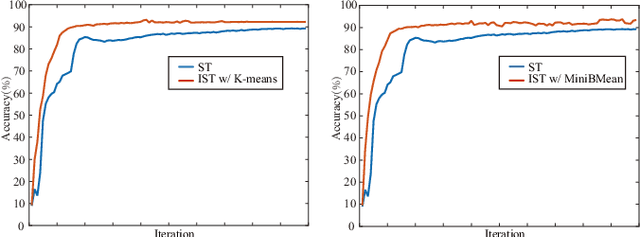
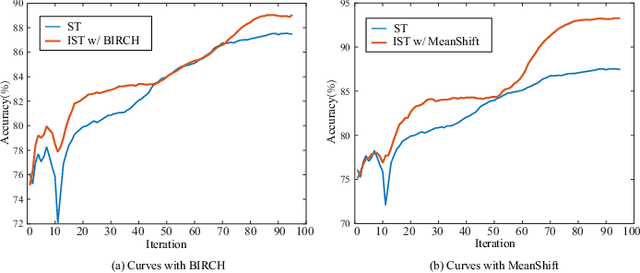
Semi-supervised learning provides a solution to reduce the dependency of machine learning on labeled data. As one of the efficient semi-supervised techniques, self-training (ST) has received increasing attention. Several advancements have emerged to address challenges associated with noisy pseudo-labels. Previous works on self-training acknowledge the importance of unlabeled data but have not delved into their efficient utilization, nor have they paid attention to the problem of high time consumption caused by iterative learning. This paper proposes Incremental Self-training (IST) for semi-supervised learning to fill these gaps. Unlike ST, which processes all data indiscriminately, IST processes data in batches and priority assigns pseudo-labels to unlabeled samples with high certainty. Then, it processes the data around the decision boundary after the model is stabilized, enhancing classifier performance. Our IST is simple yet effective and fits existing self-training-based semi-supervised learning methods. We verify the proposed IST on five datasets and two types of backbone, effectively improving the recognition accuracy and learning speed. Significantly, it outperforms state-of-the-art competitors on three challenging image classification tasks.
Siamese Labels Auxiliary Network(SiLaNet)
Mar 06, 2021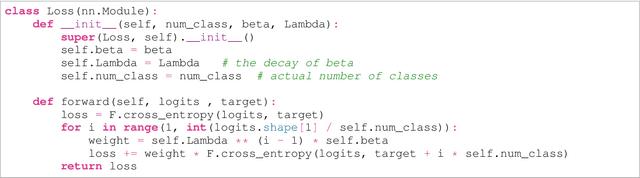
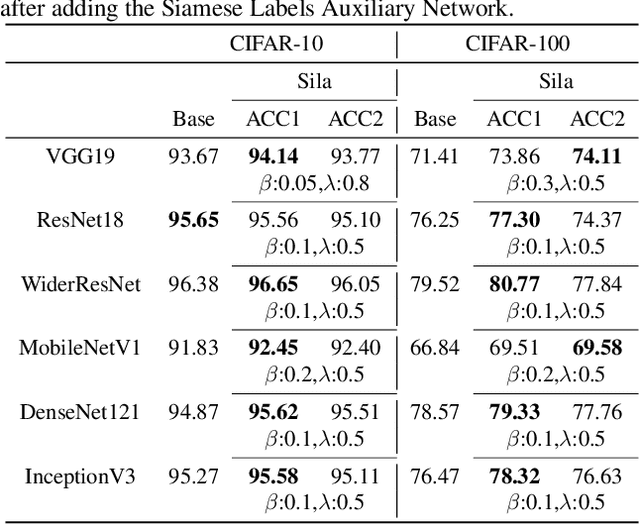
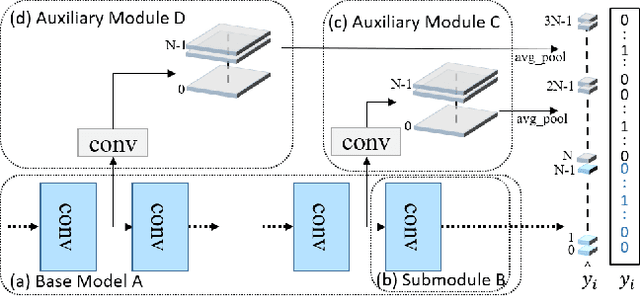
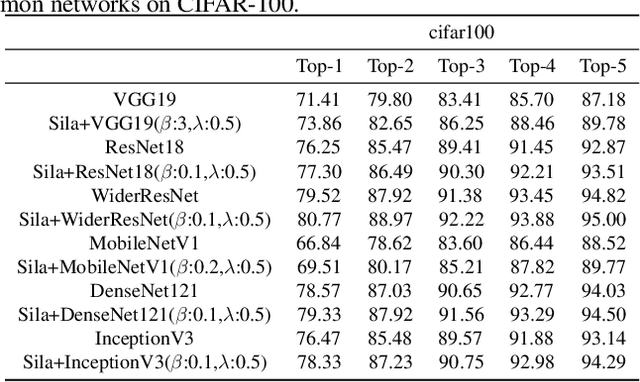
Auxiliary information attracts more and more attention in the area of machine learning. Attempts so far to include such auxiliary information in state-of-the-art learning process have often been based on simply appending these auxiliary features to the data level or feature level. In this paper, we intend to propose a novel training method with new options and architectures. Siamese labels, which were used in the training phase as auxiliary modules. While in the testing phase, the auxiliary module should be removed. Siamese label module makes it easier to train and improves the performance in testing process. In general, the main contributions can be summarized as, 1) Siamese Labels are firstly proposed as auxiliary information to improve the learning efficiency; 2) We establish a new architecture, Siamese Labels Auxiliary Network (SilaNet), which is to assist the training of the model; 3) Siamese Labels Auxiliary Network is applied to compress the model parameters by 50% and ensure the high accuracy at the same time. For the purpose of comparison, we tested the network on CIFAR-10 and CIFAR100 using some common models. The proposed SilaNet performs excellent efficiency both on the accuracy and robustness.
Approximation learning methods of Harmonic Mappings in relation to Hardy Spaces
May 24, 2017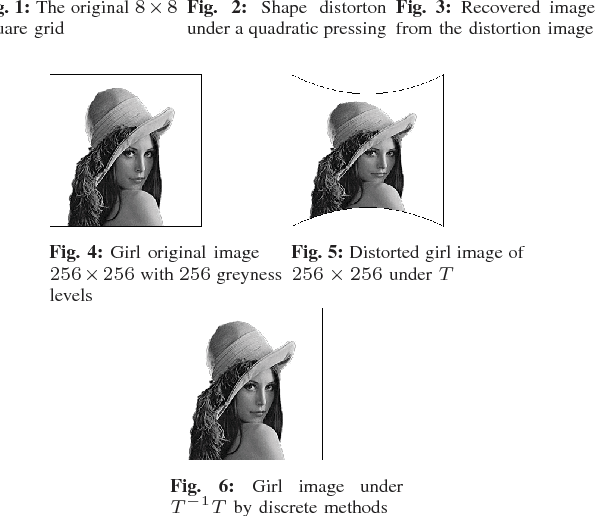

A new Hardy space Hardy space approach of Dirichlet type problem based on Tikhonov regularization and Reproducing Hilbert kernel space is discussed in this paper, which turns out to be a typical extremal problem located on the upper upper-high complex plane. If considering this in the Hardy space, the optimization operator of this problem will be highly simplified and an efficient algorithm is possible. This is mainly realized by the help of reproducing properties of the functions in the Hardy space of upper-high complex plane, and the detail algorithm is proposed. Moreover, harmonic mappings, which is a significant geometric transformation, are commonly used in many applications such as image processing, since it describes the energy minimization mappings between individual manifolds. Particularly, when we focus on the planer mappings between two Euclid planer regions, the harmonic mappings are exist and unique, which is guaranteed solidly by the existence of harmonic function. This property is attractive and simulation results are shown in this paper to ensure the capability of applications such as planer shape distortion and surface registration.