 Add to Chrome
 Add to Firefox
 Add to Edge
Observations and Remedies for Large Language Model Bias in Self-Consuming Performative Loop
Jan 08, 2026
The rapid advancement of large language models (LLMs) has led to growing interest in using synthetic data to train future models. However, this creates a self-consuming retraining loop, where models are trained on their own outputs and may cause performance drops and induce emerging biases. In real-world applications, previously deployed LLMs may influence the data they generate, leading to a dynamic system driven by user feedback. For example, if a model continues to underserve users from a group, less query data will be collected from this particular demographic of users. In this study, we introduce the concept of \textbf{S}elf-\textbf{C}onsuming \textbf{P}erformative \textbf{L}oop (\textbf{SCPL}) and investigate the role of synthetic data in shaping bias during these dynamic iterative training processes under controlled performative feedback. This controlled setting is motivated by the inaccessibility of real-world user preference data from dynamic production systems, and enables us to isolate and analyze feedback-driven bias evolution in a principled manner. We focus on two types of loops, including the typical retraining setting and the incremental fine-tuning setting, which is largely underexplored. Through experiments on three real-world tasks, we find that the performative loop increases preference bias and decreases disparate bias. We design a reward-based rejection sampling strategy to mitigate the bias, moving towards more trustworthy self-improving systems.

Stabilizing Self-Consuming Diffusion Models with Latent Space Filtering
Nov 16, 2025As synthetic data proliferates across the Internet, it is often reused to train successive generations of generative models. This creates a ``self-consuming loop" that can lead to training instability or \textit{model collapse}. Common strategies to address the issue -- such as accumulating historical training data or injecting fresh real data -- either increase computational cost or require expensive human annotation. In this paper, we empirically analyze the latent space dynamics of self-consuming diffusion models and observe that the low-dimensional structure of latent representations extracted from synthetic data degrade over generations. Based on this insight, we propose \textit{Latent Space Filtering} (LSF), a novel approach that mitigates model collapse by filtering out less realistic synthetic data from mixed datasets. Theoretically, we present a framework that connects latent space degradation to empirical observations. Experimentally, we show that LSF consistently outperforms existing baselines across multiple real-world datasets, effectively mitigating model collapse without increasing training cost or relying on human annotation.
Privacy-Aware Randomized Quantization via Linear Programming
Jun 01, 2024
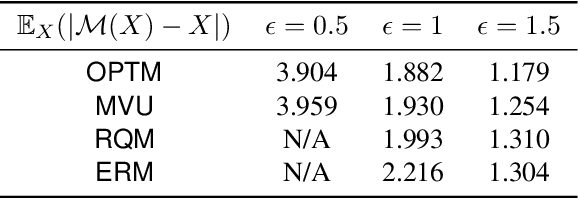

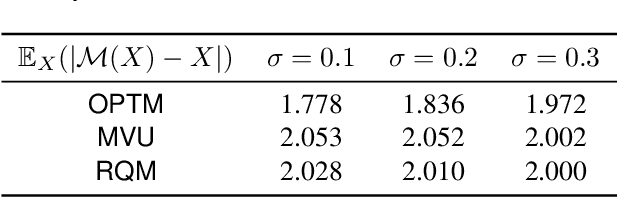
Differential privacy mechanisms such as the Gaussian or Laplace mechanism have been widely used in data analytics for preserving individual privacy. However, they are mostly designed for continuous outputs and are unsuitable for scenarios where discrete values are necessary. Although various quantization mechanisms were proposed recently to generate discrete outputs under differential privacy, the outcomes are either biased or have an inferior accuracy-privacy trade-off. In this paper, we propose a family of quantization mechanisms that is unbiased and differentially private. It has a high degree of freedom and we show that some existing mechanisms can be considered as special cases of ours. To find the optimal mechanism, we formulate a linear optimization that can be solved efficiently using linear programming tools. Experiments show that our proposed mechanism can attain a better privacy-accuracy trade-off compared to baselines.