 Add to Chrome
 Add to Firefox
 Add to Edge
Beyond Language: Format-Agnostic Reasoning Subspaces in Large Language Models
May 10, 2026
Large language models represent the same reasoning in vastly different surface forms -- English prose, Python code, mathematical notation -- yet whether they share a common internal substrate across these symbolic systems remains unknown. We introduce the TriForm Benchmark (18 concepts x 6 forms x 3 instances = 324 stimuli) and study five LLMs (1.6B-8B) across three architecture families. Using permutation-corrected RSA, cross-form probing, and activation patching, we find converging evidence for a Format-Agnostic Reasoning Subspace (FARS) in middle layers. We make FARS concrete: concept-centroid PCA extracts a 10-dimensional subspace that amplifies concept structure 3x while suppressing form information to near zero. Replacing only these 10 dimensions during cross-form patching preserves 90-96% of model output -- far exceeding both full activation replacement (44-56%) and variance-maximizing PCA (60-74%) -- while ablating them causes targeted disruption. FARS generalizes to held-out concepts and converges across architectures (CCA > 0.79 for all model pairs), providing within-modality evidence for the Platonic Representation Hypothesis. We further discover a declarative-procedural asymmetry: representations are far more compatible between prose and mathematics than between either and code, suggesting that the critical axis of divergence is not linguistic vs. formal but declarative vs. procedural.

Revisiting Clustering of Neural Bandits: Selective Reinitialization for Mitigating Loss of Plasticity
Jun 14, 2025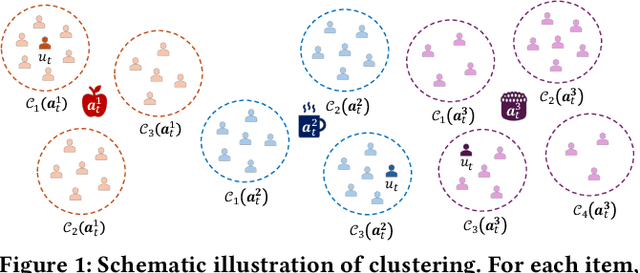
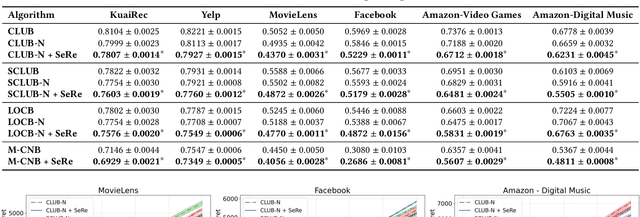
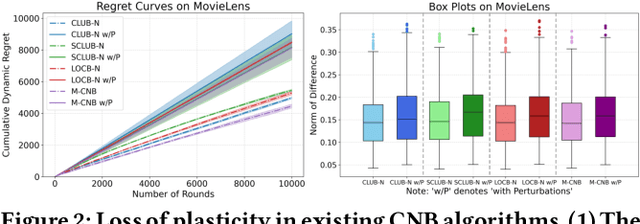
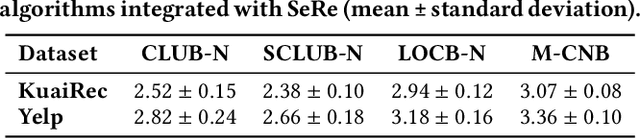
Clustering of Bandits (CB) methods enhance sequential decision-making by grouping bandits into clusters based on similarity and incorporating cluster-level contextual information, demonstrating effectiveness and adaptability in applications like personalized streaming recommendations. However, when extending CB algorithms to their neural version (commonly referred to as Clustering of Neural Bandits, or CNB), they suffer from loss of plasticity, where neural network parameters become rigid and less adaptable over time, limiting their ability to adapt to non-stationary environments (e.g., dynamic user preferences in recommendation). To address this challenge, we propose Selective Reinitialization (SeRe), a novel bandit learning framework that dynamically preserves the adaptability of CNB algorithms in evolving environments. SeRe leverages a contribution utility metric to identify and selectively reset underutilized units, mitigating loss of plasticity while maintaining stable knowledge retention. Furthermore, when combining SeRe with CNB algorithms, the adaptive change detection mechanism adjusts the reinitialization frequency according to the degree of non-stationarity, ensuring effective adaptation without unnecessary resets. Theoretically, we prove that SeRe enables sublinear cumulative regret in piecewise-stationary environments, outperforming traditional CNB approaches in long-term performances. Extensive experiments on six real-world recommendation datasets demonstrate that SeRe-enhanced CNB algorithms can effectively mitigate the loss of plasticity with lower regrets, improving adaptability and robustness in dynamic settings.