 Add to Chrome
 Add to Firefox
 Add to Edge
Efficient Low-Resource Language Adaptation via Multi-Source Dynamic Logit Fusion
Apr 20, 2026
Adapting large language models (LLMs) to low-resource languages (LRLs) is constrained by the scarcity of task data and computational resources. Although Proxy Tuning offers a logit-level strategy for introducing scaling effects, it often fails in LRL settings because the large model's weak LRL competence might overwhelm the knowledge of specialized smaller models. We thus propose TriMix, a test-time logit fusion framework that dynamically balances capabilities from three different sources: LRL competence from a continually pretrained small model, task competence from high-resource language instruction tuning, and the scaling benefits of large models. It is data- and compute-efficient, requiring no LRL task annotations, and only continual pretraining on a small model. Experiments across four model families and eight LRLs show that TriMix consistently outperforms single-model baselines and Proxy Tuning. Our analysis reveals that prioritizing the small LRL-specialized model's logits is crucial for success, challenging the prevalent large-model-dominant assumption.

MiLiC-Eval: Benchmarking Multilingual LLMs for China's Minority Languages
Mar 03, 2025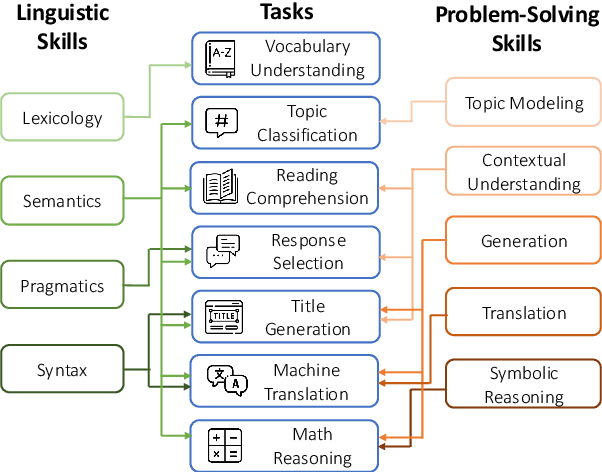
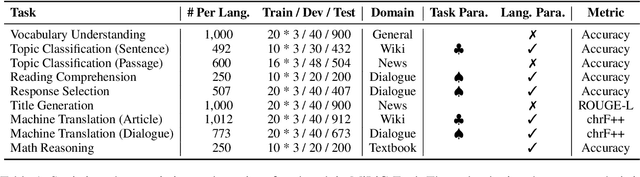
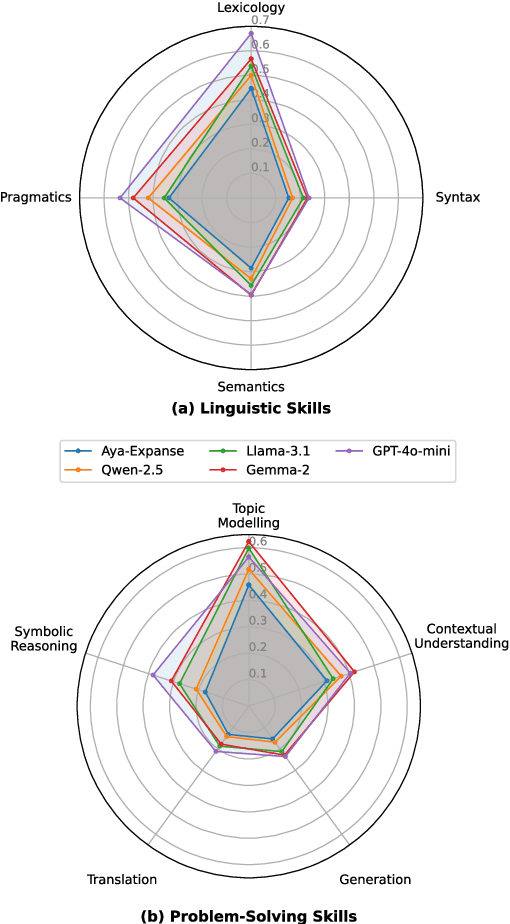
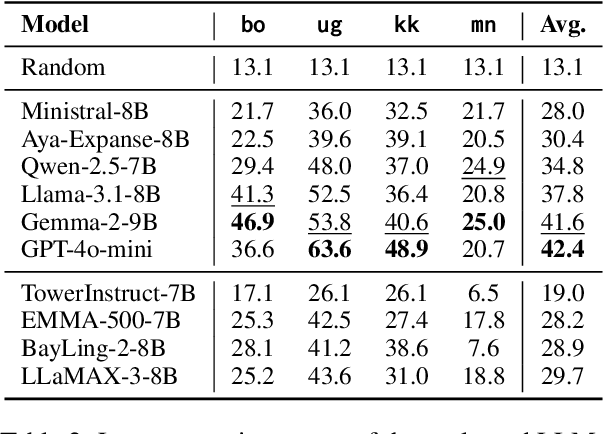
Large language models (LLMs) excel in high-resource languages but struggle with low-resource languages (LRLs), particularly those spoken by minority communities in China, such as Tibetan, Uyghur, Kazakh, and Mongolian. To systematically track the progress in these languages, we introduce MiLiC-Eval, a benchmark designed for minority languages in China, featuring 24K instances across 9 tasks. MiLiC-Eval focuses on underrepresented writing systems and provides a fine-grained assessment of linguistic and problem-solving skills. Our evaluation reveals that LLMs perform poorly on syntax-intensive tasks and multi-script languages. We further demonstrate how MiLiC-Eval can help advance LRL research in handling diverse writing systems and understanding the process of language adaptation.