 Add to Chrome
 Add to Firefox
 Add to Edge
CLIP Based Region-Aware Feature Fusion for Automated BBPS Scoring in Colonoscopy Images
Dec 23, 2025
Accurate assessment of bowel cleanliness is essential for effective colonoscopy procedures. The Boston Bowel Preparation Scale (BBPS) offers a standardized scoring system but suffers from subjectivity and inter-observer variability when performed manually. In this paper, to support robust training and evaluation, we construct a high-quality colonoscopy dataset comprising 2,240 images from 517 subjects, annotated with expert-agreed BBPS scores. We propose a novel automated BBPS scoring framework that leverages the CLIP model with adapter-based transfer learning and a dedicated fecal-feature extraction branch. Our method fuses global visual features with stool-related textual priors to improve the accuracy of bowel cleanliness evaluation without requiring explicit segmentation. Extensive experiments on both our dataset and the public NERTHU dataset demonstrate the superiority of our approach over existing baselines, highlighting its potential for clinical deployment in computer-aided colonoscopy analysis.

Dynamic Adapter with Semantics Disentangling for Cross-lingual Cross-modal Retrieval
Dec 18, 2024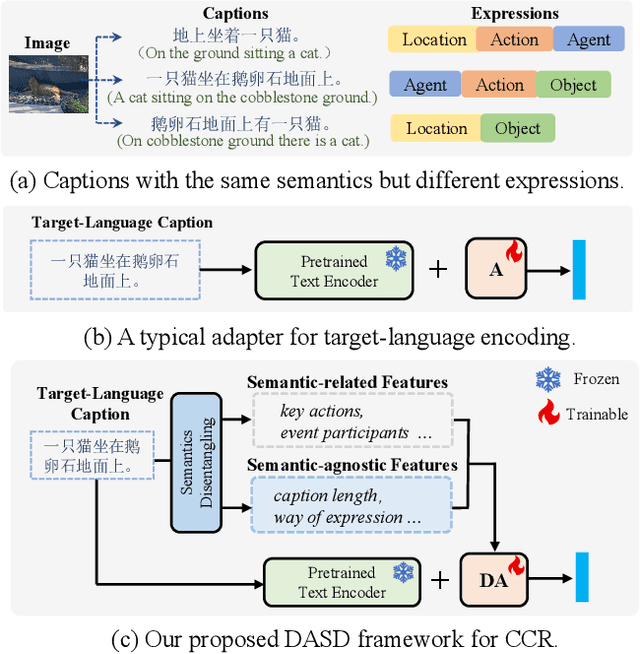


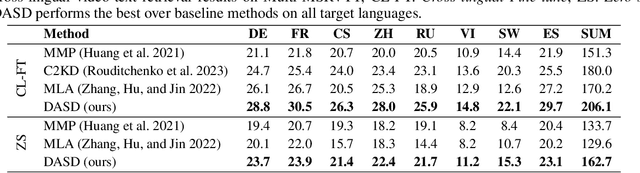
Existing cross-modal retrieval methods typically rely on large-scale vision-language pair data. This makes it challenging to efficiently develop a cross-modal retrieval model for under-resourced languages of interest. Therefore, Cross-lingual Cross-modal Retrieval (CCR), which aims to align vision and the low-resource language (the target language) without using any human-labeled target-language data, has gained increasing attention. As a general parameter-efficient way, a common solution is to utilize adapter modules to transfer the vision-language alignment ability of Vision-Language Pretraining (VLP) models from a source language to a target language. However, these adapters are usually static once learned, making it difficult to adapt to target-language captions with varied expressions. To alleviate it, we propose Dynamic Adapter with Semantics Disentangling (DASD), whose parameters are dynamically generated conditioned on the characteristics of the input captions. Considering that the semantics and expression styles of the input caption largely influence how to encode it, we propose a semantic disentangling module to extract the semantic-related and semantic-agnostic features from the input, ensuring that generated adapters are well-suited to the characteristics of input caption. Extensive experiments on two image-text datasets and one video-text dataset demonstrate the effectiveness of our model for cross-lingual cross-modal retrieval, as well as its good compatibility with various VLP models.