 Add to Chrome
 Add to Firefox
 Add to Edge
RAG-KT: Cross-platform Explainable Knowledge Tracing with Multi-view Fusion Retrieval Generation
Apr 13, 2026
Knowledge Tracing (KT) infers a student's knowledge state from past interactions to predict future performance. Conventional Deep Learning (DL)-based KT models are typically tied to platform-specific identifiers and latent representations, making them hard to transfer and interpret. Large Language Model (LLM)-based methods can be either ungrounded under prompting or overly domain-dependent under fine-tuning. In addition, most existing KT methods are developed and evaluated under a same-distribution assumption. In real deployments, educational data often arise from heterogeneous platforms with substantial distribution shift, which often degrades generalization. To this end, we propose RAG-KT, a retrieval-augmented paradigm that frames cross-platform KT as reliable context constrained inference with LLMs. It builds a unified multi-source structured context with cross-source alignment via Question Group abstractions and retrieves complementary rich and reliable context for each prediction, enabling grounded prediction and interpretable diagnosis. Experiments on three public KT benchmarks demonstrate consistent gains in accuracy and robustness, including strong performance under cross-platform conditions.

MAGE-KT: Multi-Agent Graph-Enhanced Knowledge Tracing with Subgraph Retrieval and Asymmetric Fusion
Jan 23, 2026Knowledge Tracing (KT) aims to model a student's learning trajectory and predict performance on the next question. A key challenge is how to better represent the relationships among students, questions, and knowledge concepts (KCs). Recently, graph-based KT paradigms have shown promise for this problem. However, existing methods have not sufficiently explored inter-concept relations, often inferred solely from interaction sequences. In addition, the scale and heterogeneity of KT graphs make full-graph encoding both computationally both costly and noise-prone, causing attention to bleed into student-irrelevant regions and degrading the fidelity of inter-KC relations. To address these issues, we propose a novel framework: Multi-Agent Graph-Enhanced Knowledge Tracing (MAGE-KT). It constructs a multi-view heterogeneous graph by combining a multi-agent KC relation extractor and a student-question interaction graph, capturing complementary semantic and behavioral signals. Conditioned on the target student's history, it retrieves compact, high-value subgraphs and integrates them using an Asymmetric Cross-attention Fusion Module to enhance prediction while avoiding attention diffusion and irrelevant computation. Experiments on three widely used KT datasets show substantial improvements in KC-relation accuracy and clear gains in next-question prediction over existing methods.
Advancing Multimodal Teacher Sentiment Analysis:The Large-Scale T-MED Dataset & The Effective AAM-TSA Model
Dec 23, 2025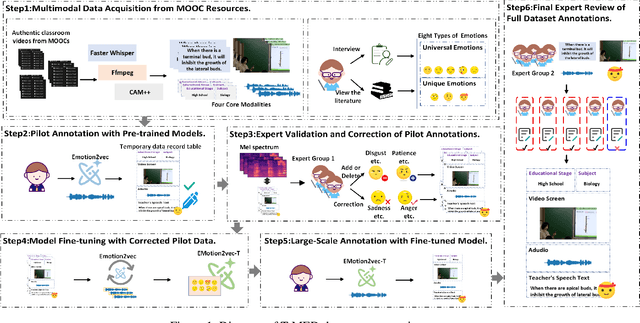
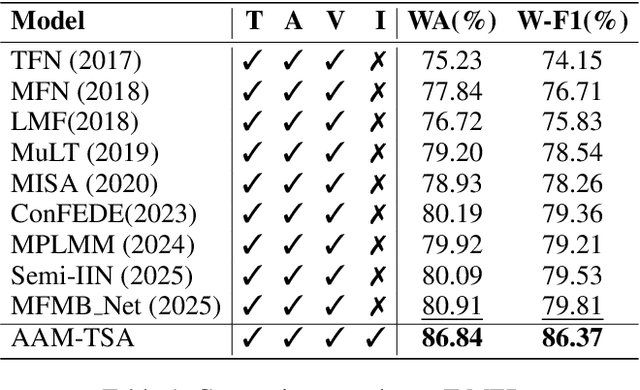

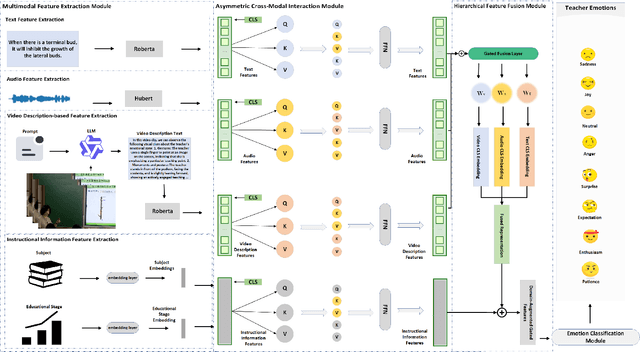
Teachers' emotional states are critical in educational scenarios, profoundly impacting teaching efficacy, student engagement, and learning achievements. However, existing studies often fail to accurately capture teachers' emotions due to the performative nature and overlook the critical impact of instructional information on emotional expression.In this paper, we systematically investigate teacher sentiment analysis by building both the dataset and the model accordingly. We construct the first large-scale teacher multimodal sentiment analysis dataset, T-MED.To ensure labeling accuracy and efficiency, we employ a human-machine collaborative labeling process.The T-MED dataset includes 14,938 instances of teacher emotional data from 250 real classrooms across 11 subjects ranging from K-12 to higher education, integrating multimodal text, audio, video, and instructional information.Furthermore, we propose a novel asymmetric attention-based multimodal teacher sentiment analysis model, AAM-TSA.AAM-TSA introduces an asymmetric attention mechanism and hierarchical gating unit to enable differentiated cross-modal feature fusion and precise emotional classification. Experimental results demonstrate that AAM-TSA significantly outperforms existing state-of-the-art methods in terms of accuracy and interpretability on the T-MED dataset.
HISE-KT: Synergizing Heterogeneous Information Networks and LLMs for Explainable Knowledge Tracing with Meta-Path Optimization
Nov 19, 2025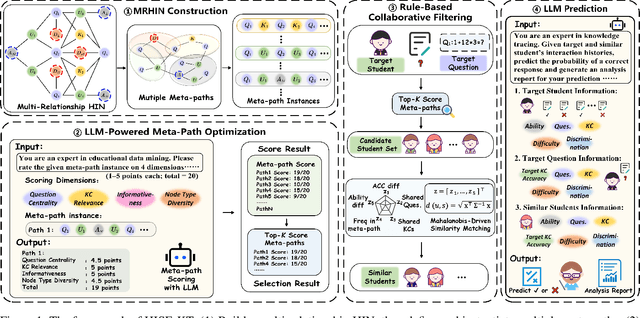
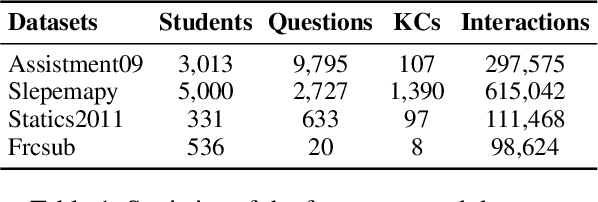
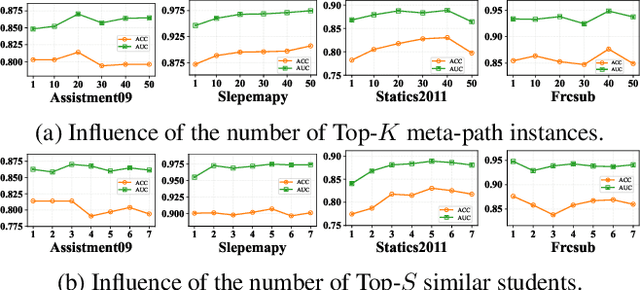
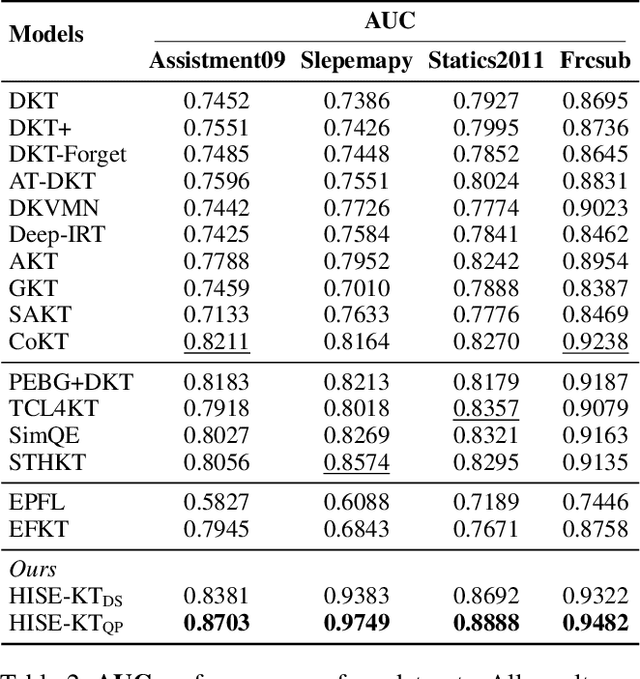
Knowledge Tracing (KT) aims to mine students' evolving knowledge states and predict their future question-answering performance. Existing methods based on heterogeneous information networks (HINs) are prone to introducing noises due to manual or random selection of meta-paths and lack necessary quality assessment of meta-path instances. Conversely, recent large language models (LLMs)-based methods ignore the rich information across students, and both paradigms struggle to deliver consistently accurate and evidence-based explanations. To address these issues, we propose an innovative framework, HIN-LLM Synergistic Enhanced Knowledge Tracing (HISE-KT), which seamlessly integrates HINs with LLMs. HISE-KT first builds a multi-relationship HIN containing diverse node types to capture the structural relations through multiple meta-paths. The LLM is then employed to intelligently score and filter meta-path instances and retain high-quality paths, pioneering automated meta-path quality assessment. Inspired by educational psychology principles, a similar student retrieval mechanism based on meta-paths is designed to provide a more valuable context for prediction. Finally, HISE-KT uses a structured prompt to integrate the target student's history with the retrieved similar trajectories, enabling the LLM to generate not only accurate predictions but also evidence-backed, explainable analysis reports. Experiments on four public datasets show that HISE-KT outperforms existing KT baselines in both prediction performance and interpretability.
Modeling Balanced Explicit and Implicit Relations with Contrastive Learning for Knowledge Concept Recommendation in MOOCs
Feb 13, 2024


The knowledge concept recommendation in Massive Open Online Courses (MOOCs) is a significant issue that has garnered widespread attention. Existing methods primarily rely on the explicit relations between users and knowledge concepts on the MOOC platforms for recommendation. However, there are numerous implicit relations (e.g., shared interests or same knowledge levels between users) generated within the users' learning activities on the MOOC platforms. Existing methods fail to consider these implicit relations, and these relations themselves are difficult to learn and represent, causing poor performance in knowledge concept recommendation and an inability to meet users' personalized needs. To address this issue, we propose a novel framework based on contrastive learning, which can represent and balance the explicit and implicit relations for knowledge concept recommendation in MOOCs (CL-KCRec). Specifically, we first construct a MOOCs heterogeneous information network (HIN) by modeling the data from the MOOC platforms. Then, we utilize a relation-updated graph convolutional network and stacked multi-channel graph neural network to represent the explicit and implicit relations in the HIN, respectively. Considering that the quantity of explicit relations is relatively fewer compared to implicit relations in MOOCs, we propose a contrastive learning with prototypical graph to enhance the representations of both relations to capture their fruitful inherent relational knowledge, which can guide the propagation of students' preferences within the HIN. Based on these enhanced representations, to ensure the balanced contribution of both towards the final recommendation, we propose a dual-head attention mechanism for balanced fusion. Experimental results demonstrate that CL-KCRec outperforms several state-of-the-art baselines on real-world datasets in terms of HR, NDCG and MRR.