 Add to Chrome
 Add to Firefox
 Add to Edge
On the Cost and Benefit of Chain of Thought: A Learning-Theoretic Perspective
May 20, 2026
We develop a learning-theoretic framework for understanding Chain of Thought (CoT). We model CoT as the interaction between an answer map and a chain rule that generates intermediate questions autoregressively, and define the reasoning risk of a hypothesis under this interaction. Our first result is a tight canonical decomposition of this risk into two terms with opposing roles: an oracle-trajectory risk (OTR), which captures the benefit of CoT and reduces to a target-domain risk in a domain adaptation problem, and a trajectory-mismatch risk (TMR), which captures the cost of CoT through error accumulation along mismatched reasoning trajectories. We then show that this cost is unavoidable without structure: if any one of the loss, the hypothesis answer map, or the chain rule lacks stability, the TMR can be arbitrarily large even when the OTR is zero and the hypothesis is uniformly close to the ground truth. Conversely, under stability, we prove a tight upper bound on the TMR governed by an exact amplification factor that identifies bounded, linear, and exponential error-growth regimes. Together, these results give a precise theory of when CoT helps, when it hurts, and what controls the transition between the two.

On the Hardness of Unsupervised Domain Adaptation: Optimal Learners and Information-Theoretic Perspective
Jul 09, 2025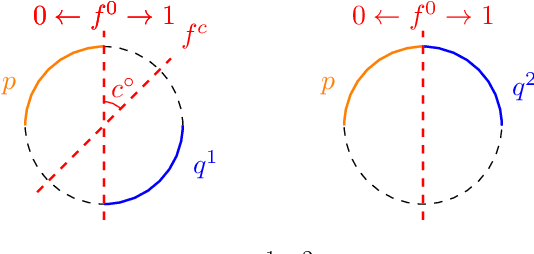
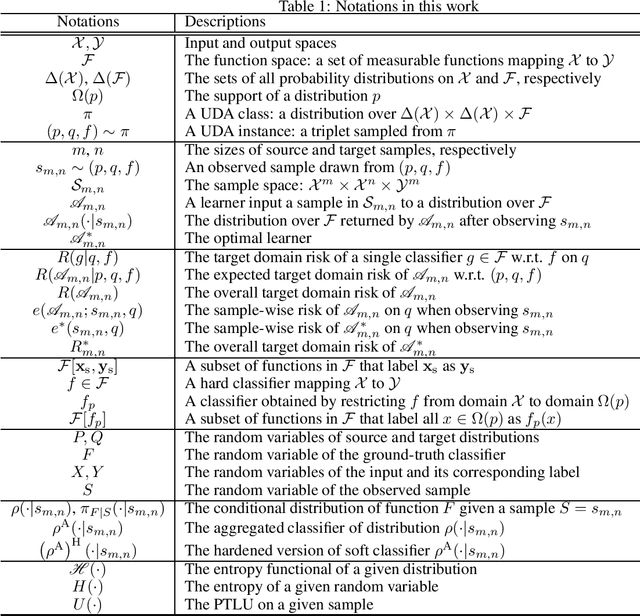
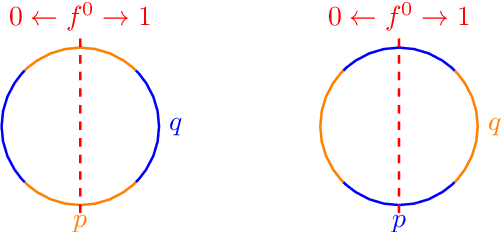

This paper studies the hardness of unsupervised domain adaptation (UDA) under covariate shift. We model the uncertainty that the learner faces by a distribution $\pi$ in the ground-truth triples $(p, q, f)$ -- which we call a UDA class -- where $(p, q)$ is the source -- target distribution pair and $f$ is the classifier. We define the performance of a learner as the overall target domain risk, averaged over the randomness of the ground-truth triple. This formulation couples the source distribution, the target distribution and the classifier in the ground truth, and deviates from the classical worst-case analyses, which pessimistically emphasize the impact of hard but rare UDA instances. In this formulation, we precisely characterize the optimal learner. The performance of the optimal learner then allows us to define the learning difficulty for the UDA class and for the observed sample. To quantify this difficulty, we introduce an information-theoretic quantity -- Posterior Target Label Uncertainty (PTLU) -- along with its empirical estimate (EPTLU) from the sample , which capture the uncertainty in the prediction for the target domain. Briefly, PTLU is the entropy of the predicted label in the target domain under the posterior distribution of ground-truth classifier given the observed source and target samples. By proving that such a quantity serves to lower-bound the risk of any learner, we suggest that these quantities can be used as proxies for evaluating the hardness of UDA learning. We provide several examples to demonstrate the advantage of PTLU, relative to the existing measures, in evaluating the difficulty of UDA learning.
Adversarial Defenses via Vector Quantization
May 23, 2023Building upon Randomized Discretization, we develop two novel adversarial defenses against white-box PGD attacks, utilizing vector quantization in higher dimensional spaces. These methods, termed pRD and swRD, not only offer a theoretical guarantee in terms of certified accuracy, they are also shown, via abundant experiments, to perform comparably or even superior to the current art of adversarial defenses. These methods can be extended to a version that allows further training of the target classifier and demonstrates further improved performance.