 Add to Chrome
 Add to Firefox
 Add to Edge
SpectraFlow: Unifying Structural Pretraining and Frequency Adaptation for Medical Image Segmentation
May 14, 2026
Medical image segmentation remains challenging in low-data regimes, where scarce annotations often yield poor generalization and ambiguous boundaries with missing fine structures. Recent self-supervised pretraining has improved transferability, but it often exhibits a texture bias. In contrast, accurate segmentation is inherently geometry-aware and depends on both topological consistency and precise boundary preservation. To address this problem, we propose a two-stage framework that couples structure-aware encoder pretraining with boundary-oriented decoding. In Stage-1, we aim to learn structure-aware representations for downstream segmentation in low-data regimes. To this end, we propose Mixed-Domain MeanFlow Pretraining, which aligns images and binary masks in a shared latent space through latent transport regression, where masks act as conditional structural guidance rather than prediction targets, making the pretraining task-agnostic. To further improve training stability under scarce supervision, we incorporate a lightweight Dispersive Loss to prevent representation collapse. In Stage-2, we fine-tune the pretrained encoder with a lightweight decoder that combines Direct Attentional Fusion for adaptive cross-scale gating and Frequency-Directional Dynamic Convolution for high-frequency boundary refinement under appearance variation. Experiments on ISIC-2016, Kvasir-SEG, and GlaS demonstrate consistent gains over state-of-the-art methods, with improved robustness in low-data settings and sharper boundary delineation.

Med-DisSeg: Dispersion-Driven Representation Learning for Fine-Grained Medical Image Segmentation
May 14, 2026Accurate medical image segmentation is fundamental to precision medicine, yet robust delineation remains challenging under heterogeneous appearances, ambiguous boundaries, and large anatomical variability. Similar intensity and texture patterns between targets and surrounding tissues often lead to blurred activations and unreliable separation. We attribute these failures to representation collapse during encoding and insufficient fine grained multi scale decoding. To address these issues, we propose Med DisSeg, a dispersion driven medical image segmentation framework that jointly improves representation learning and anatomical delineation. Med DisSeg combines a lightweight Dispersive Loss with adaptive attention for fine grained structure segmentation. The Dispersive Loss enlarges inter sample margins by treating in batch hidden representations as negative pairs, producing well dispersed and boundary aware embeddings with negligible overhead. Based on these enhanced representations, the encoder strengthens structure sensitive responses, while the decoder performs adaptive multi scale calibration to preserve complementary local texture and global shape information. Extensive experiments on five datasets spanning three imaging modalities demonstrate consistent state of the art performance. Moreover, Med DisSeg achieves competitive results on multi organ CT segmentation, supporting its robustness and cross task applicability.
EchoMimic: Lifelike Audio-Driven Portrait Animations through Editable Landmark Conditions
Jul 11, 2024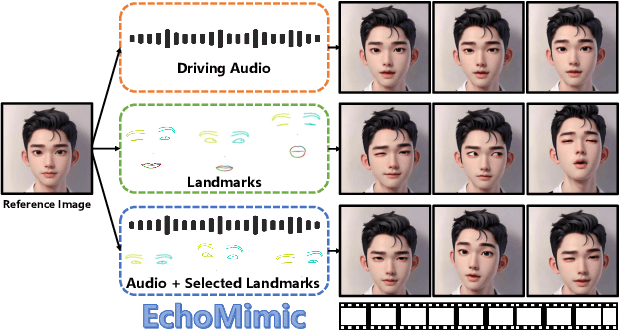
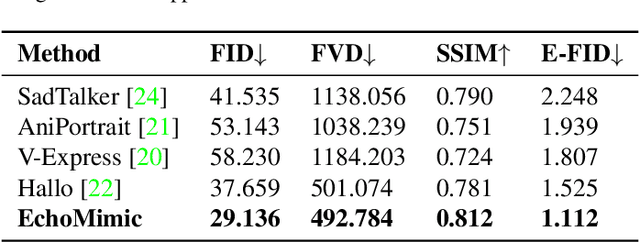
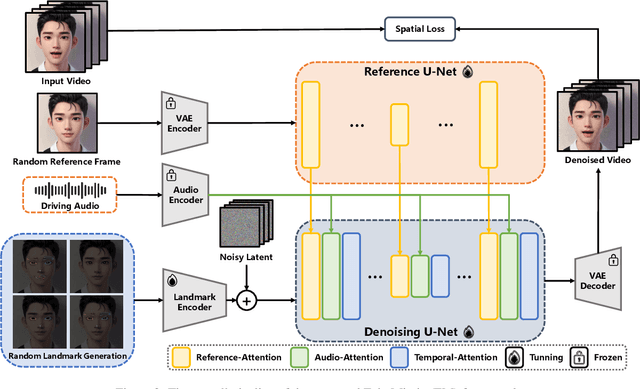
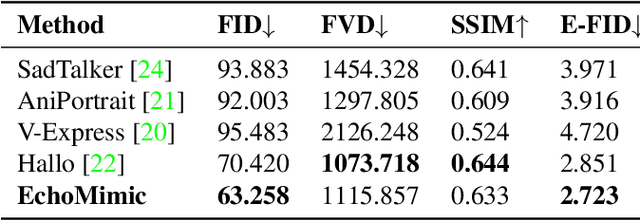
The area of portrait image animation, propelled by audio input, has witnessed notable progress in the generation of lifelike and dynamic portraits. Conventional methods are limited to utilizing either audios or facial key points to drive images into videos, while they can yield satisfactory results, certain issues exist. For instance, methods driven solely by audios can be unstable at times due to the relatively weaker audio signal, while methods driven exclusively by facial key points, although more stable in driving, can result in unnatural outcomes due to the excessive control of key point information. In addressing the previously mentioned challenges, in this paper, we introduce a novel approach which we named EchoMimic. EchoMimic is concurrently trained using both audios and facial landmarks. Through the implementation of a novel training strategy, EchoMimic is capable of generating portrait videos not only by audios and facial landmarks individually, but also by a combination of both audios and selected facial landmarks. EchoMimic has been comprehensively compared with alternative algorithms across various public datasets and our collected dataset, showcasing superior performance in both quantitative and qualitative evaluations. Additional visualization and access to the source code can be located on the EchoMimic project page.
SpeedUpNet: A Plug-and-Play Hyper-Network for Accelerating Text-to-Image Diffusion Models
Dec 20, 2023Text-to-image diffusion models (SD) exhibit significant advancements while requiring extensive computational resources. Though many acceleration methods have been proposed, they suffer from generation quality degradation or extra training cost generalizing to new fine-tuned models. To address these limitations, we propose a novel and universal Stable-Diffusion (SD) acceleration module called SpeedUpNet(SUN). SUN can be directly plugged into various fine-tuned SD models without extra training. This technique utilizes cross-attention layers to learn the relative offsets in the generated image results between negative and positive prompts achieving classifier-free guidance distillation with negative prompts controllable, and introduces a Multi-Step Consistency (MSC) loss to ensure a harmonious balance between reducing inference steps and maintaining consistency in the generated output. Consequently, SUN significantly reduces the number of inference steps to just 4 steps and eliminates the need for classifier-free guidance. It leads to an overall speedup of more than 10 times for SD models compared to the state-of-the-art 25-step DPM-solver++, and offers two extra advantages: (1) classifier-free guidance distillation with controllable negative prompts and (2) seamless integration into various fine-tuned Stable-Diffusion models without training. The effectiveness of the SUN has been verified through extensive experimentation. Project Page: https://williechai.github.io/speedup-plugin-for-stable-diffusions.github.io