 Add to Chrome
 Add to Firefox
 Add to Edge
Fairness-Aware Graph Representation Learning with Limited Demographic Information
Nov 18, 2025
Ensuring fairness in Graph Neural Networks is fundamental to promoting trustworthy and socially responsible machine learning systems. In response, numerous fair graph learning methods have been proposed in recent years. However, most of them assume full access to demographic information, a requirement rarely met in practice due to privacy, legal, or regulatory restrictions. To this end, this paper introduces a novel fair graph learning framework that mitigates bias in graph learning under limited demographic information. Specifically, we propose a mechanism guided by partial demographic data to generate proxies for demographic information and design a strategy that enforces consistent node embeddings across demographic groups. In addition, we develop an adaptive confidence strategy that dynamically adjusts each node's contribution to fairness and utility based on prediction confidence. We further provide theoretical analysis demonstrating that our framework, FairGLite, achieves provable upper bounds on group fairness metrics, offering formal guarantees for bias mitigation. Through extensive experiments on multiple datasets and fair graph learning frameworks, we demonstrate the framework's effectiveness in both mitigating bias and maintaining model utility.

AI Fairness Beyond Complete Demographics: Current Achievements and Future Directions
Nov 17, 2025Fairness in artificial intelligence (AI) has become a growing concern due to discriminatory outcomes in AI-based decision-making systems. While various methods have been proposed to mitigate bias, most rely on complete demographic information, an assumption often impractical due to legal constraints and the risk of reinforcing discrimination. This survey examines fairness in AI when demographics are incomplete, addressing the gap between traditional approaches and real-world challenges. We introduce a novel taxonomy of fairness notions in this setting, clarifying their relationships and distinctions. Additionally, we summarize existing techniques that promote fairness beyond complete demographics and highlight open research questions to encourage further progress in the field.
FairAIED: Navigating Fairness, Bias, and Ethics in Educational AI Applications
Jul 26, 2024
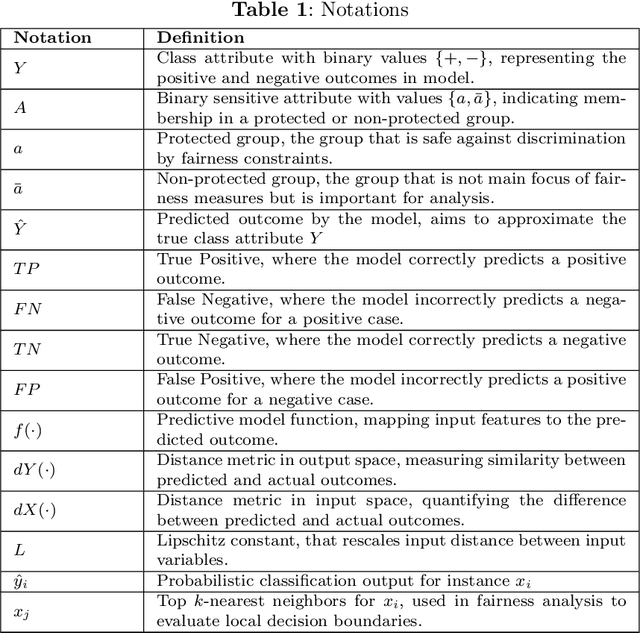

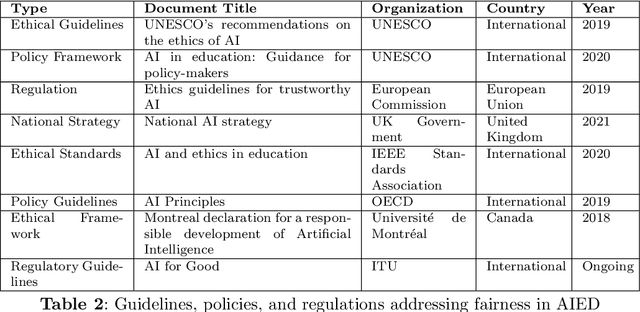
The integration of Artificial Intelligence (AI) into education has transformative potential, providing tailored learning experiences and creative instructional approaches. However, the inherent biases in AI algorithms hinder this improvement by unintentionally perpetuating prejudice against specific demographics, especially in human-centered applications like education. This survey delves deeply into the developing topic of algorithmic fairness in educational contexts, providing a comprehensive evaluation of the diverse literature on fairness, bias, and ethics in AI-driven educational applications. It identifies the common forms of biases, such as data-related, algorithmic, and user-interaction, that fundamentally undermine the accomplishment of fairness in AI teaching aids. By outlining existing techniques for mitigating these biases, ranging from varied data gathering to algorithmic fairness interventions, the survey emphasizes the critical role of ethical considerations and legal frameworks in shaping a more equitable educational environment. Furthermore, it guides readers through the complexities of fairness measurements, methods, and datasets, shedding light on the way to bias reduction. Despite these gains, this survey highlights long-standing issues, such as achieving a balance between fairness and accuracy, as well as the need for diverse datasets. Overcoming these challenges and ensuring the ethical and fair use of AI's promise in education call for a collaborative, interdisciplinary approach.