 Add to Chrome
 Add to Firefox
 Add to Edge
B-Spline Embedded Structure Learning for 3D Tooth Segmentation
Aug 18, 2026
Accurate 3D tooth segmentation forms the cornerstone of digital dentistry, yet it remains a formidable challenge due to the inherent intricacy of real-world dentitions, such as crowding, misaligned teeth and high morphological similarity between adjacent teeth. To resolve this, we present B-Spline Embedded Structure Learning, a novel framework that distills the inherent sequential arrangement of teeth into a continuous structural constraint to regularize representation space. Our approach parameterizes the global dental topology by fitting a parametric B-spline trajectory to tooth centers, assigning each point a continuous structural embedding that forces the shared backbone to capture global arch organization. To fully exploit these embedded priors, we introduce a Structure-Aware Dynamic Classifier (SADC) to substitute rigid static templates with adaptive, case-calibrated decision boundaries. SADC regularizes dynamic prototype pooling via a localized Gaussian proximity gate and contextually co-evolves them through an attention block modeling spatial relations and bilateral symmetries across teeth. Extensive evaluations on the 3DTeethSeg22 benchmark demonstrate that our method establishes a new state-of-the-art accuracy with exceptional structural robustness and efficiency in computational overhead, markedly enhancing the model's capacity to handle complex dental configurations.

3DTeethSAM: Taming SAM2 for 3D Teeth Segmentation
Dec 12, 2025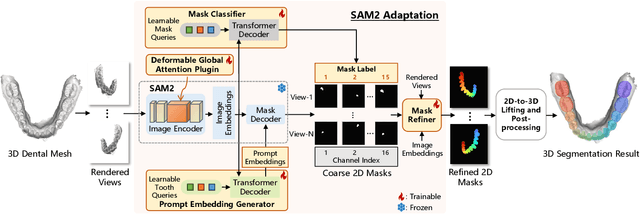
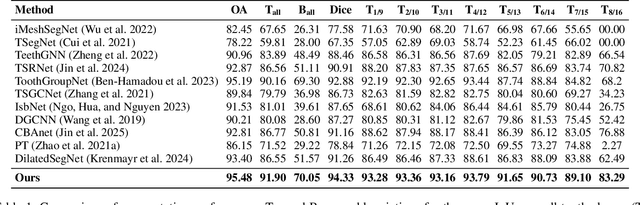
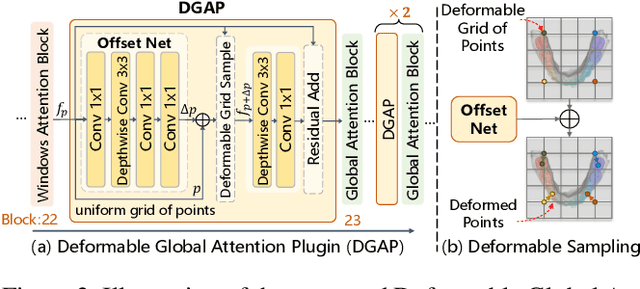
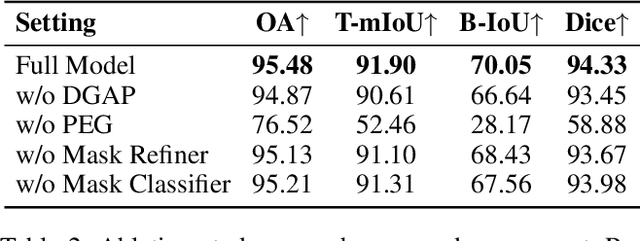
3D teeth segmentation, involving the localization of tooth instances and their semantic categorization in 3D dental models, is a critical yet challenging task in digital dentistry due to the complexity of real-world dentition. In this paper, we propose 3DTeethSAM, an adaptation of the Segment Anything Model 2 (SAM2) for 3D teeth segmentation. SAM2 is a pretrained foundation model for image and video segmentation, demonstrating a strong backbone in various downstream scenarios. To adapt SAM2 for 3D teeth data, we render images of 3D teeth models from predefined views, apply SAM2 for 2D segmentation, and reconstruct 3D results using 2D-3D projections. Since SAM2's performance depends on input prompts and its initial outputs often have deficiencies, and given its class-agnostic nature, we introduce three light-weight learnable modules: (1) a prompt embedding generator to derive prompt embeddings from image embeddings for accurate mask decoding, (2) a mask refiner to enhance SAM2's initial segmentation results, and (3) a mask classifier to categorize the generated masks. Additionally, we incorporate Deformable Global Attention Plugins (DGAP) into SAM2's image encoder. The DGAP enhances both the segmentation accuracy and the speed of the training process. Our method has been validated on the 3DTeethSeg benchmark, achieving an IoU of 91.90% on high-resolution 3D teeth meshes, establishing a new state-of-the-art in the field.