 Add to Chrome
 Add to Firefox
 Add to Edge
Exploring Boundary-Aware Spatial-Frequency Fusion for Camouflaged Object Detection
Apr 20, 2026
Camouflaged Object Detection is challenging due to the high degree of similarity between camouflaged objects and their surrounding backgrounds. Current COD methods mainly rely on edge extraction in the spatial domain and local pixel-level information, neglecting the importance of global structural features. Additionally, they fail to effectively leverage the importance of phase spectrum information within frequency domain features. To this end, we propose a COD framework BASFNet based on boundary-aware frequency domain and spatial domain fusion.This method uses dual guided integration of frequency domain and spatial domain features. A phase-spectrum-based frequency-enhanced edge exploration module (FEEM) and a spatial core segmentation module (SCSM) are introduced to jointly capture the boundary and object features of camouflaged objects. These features are then effectively integrated through a spatial-frequency fusion interaction module (SFFIM). Furthermore, the boundary detection is further optimized through an boundary-aware training strategy. BASFNet outperforms existing state-of-the-art methods on three benchmark datasets, validating the effectiveness of the fusion of frequency and spatial domain information in COD tasks.

FGML-DG: Feynman-Inspired Cognitive Science Paradigm for Cross-Domain Medical Image Segmentation
Apr 12, 2026In medical image segmentation across multiple modalities (e.g., MRI, CT, etc.) and heterogeneous data sources (e.g., different hospitals and devices), Domain Generalization (DG) remains a critical challenge in AI-driven healthcare. This challenge primarily arises from domain shifts, imaging variations, and patient diversity, which often lead to degraded model performance in unseen domains. To address these limitations, we identify key issues in existing methods, including insufficient simplification of complex style features, inadequate reuse of domain knowledge, and a lack of feedback-driven optimization. To tackle these problems, inspired by Feynman's learning techniques in educational psychology, this paper introduces a cognitive science-inspired meta-learning paradigm for medical image domain generalization segmentation. We propose, for the first time, a cognitive-inspired Feynman-Guided Meta-Learning framework for medical image domain generalization segmentation (FGML-DG), which mimics human cognitive learning processes to enhance model learning and knowledge transfer. Specifically, we first leverage the 'concept understanding' principle from Feynman's learning method to simplify complex features across domains into style information statistics, achieving precise style feature alignment. Second, we design a meta-style memory and recall method (MetaStyle) to emulate the human memory system's utilization of past knowledge. Finally, we incorporate a Feedback-Driven Re-Training strategy (FDRT), which mimics Feynman's emphasis on targeted relearning, enabling the model to dynamically adjust learning focus based on prediction errors. Experimental results demonstrate that our method outperforms other existing domain generalization approaches on two challenging medical image domain generalization tasks.
Short-term Load Forecasting with Dense Average Network
Dec 17, 2019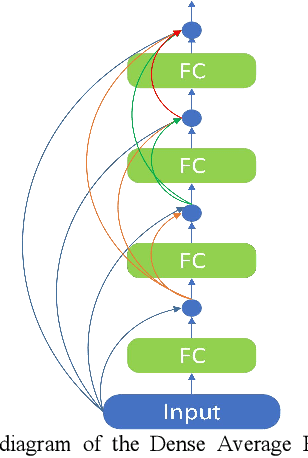
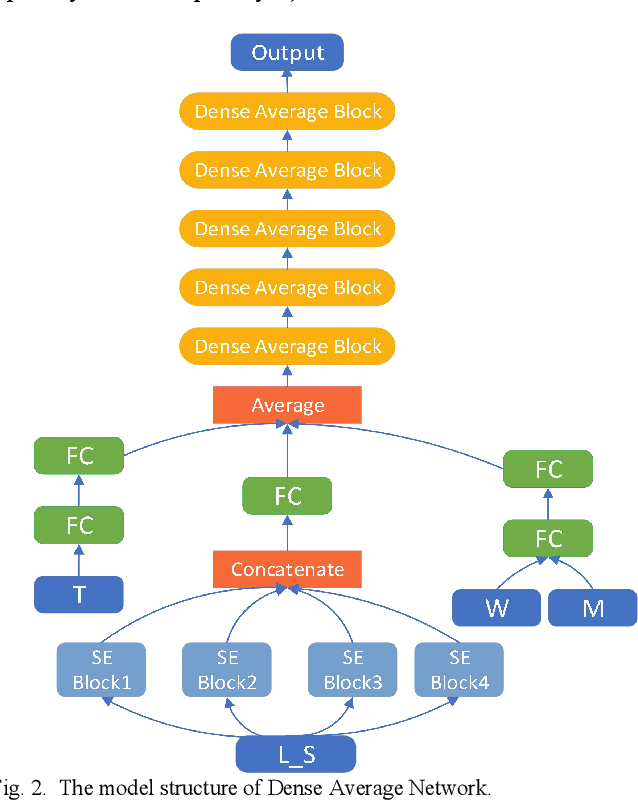
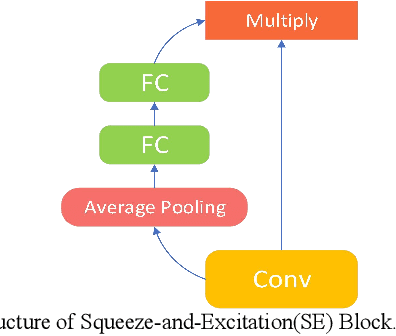
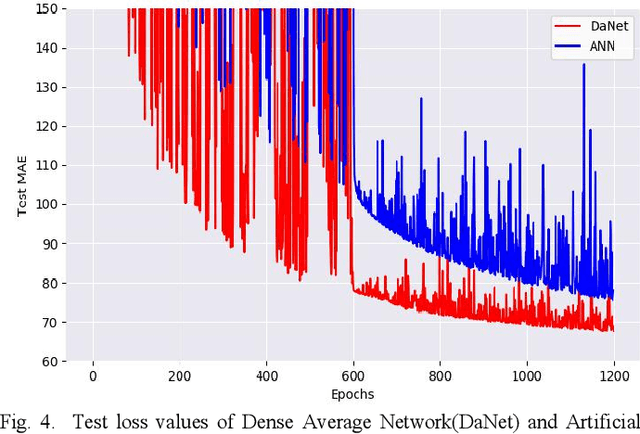
Short-trem Load forecasting is of great significance to power system. In this paper, we propose a new connection, Dense Average connection, in which the outputs of all previous layers are averaged as the input of the next layer in a feedforward method.Compared with fully connected layer, the Dense Average connection does not introduce new training parameters.Based on the Dense Average connection,we build the Dense Average Network for load forecasting. In two public datasets and one real dataset, we verify the validity of the model.Compared with ANN, our proposed model has better convergence and prediction effect.Meanwhile, we use the ensemble method to further improve the prediction effect. In order to verify the reliability of the model, we also disturb the input of the model to different degrees. Experimental results show that the proposed model is very robust.