 Add to Chrome
 Add to Firefox
 Add to Edge
Cross-Slice Knowledge Transfer via Masked Multi-Modal Heterogeneous Graph Contrastive Learning for Spatial Gene Expression Inference
Mar 24, 2026
While spatial transcriptomics (ST) has advanced our understanding of gene expression in tissue context, its high experimental cost limits its large-scale application. Predicting ST from pathology images is a promising, cost-effective alternative, but existing methods struggle to capture complex cross-slide spatial relationships. To address the challenge, we propose SpaHGC, a multi-modal heterogeneous graph-based model that captures both intra-slice and inter-slice spot-spot relationships from histology images. It integrates local spatial context within the target slide and cross-slide similarities computed from image embeddings extracted by a pathology foundation model. These embeddings enable inter-slice knowledge transfer, and SpaHGC further incorporates Masked Graph Contrastive Learning to enhance feature representation and transfer spatial gene expression knowledge from reference to target slides, enabling it to model complex spatial dependencies and significantly improve prediction accuracy. We conducted comprehensive benchmarking on seven matched histology-ST datasets from different platforms, tissues, and cancer subtypes. The results demonstrate that SpaHGC significantly outperforms the existing nine state-of-the-art methods across all evaluation metrics. Additionally, the predictions are significantly enriched in multiple cancer-related pathways, thereby highlighting its strong biological relevance and application potential.

High-Resolution Spatial Transcriptomics from Histology Images using HisToSGE
Jul 30, 2024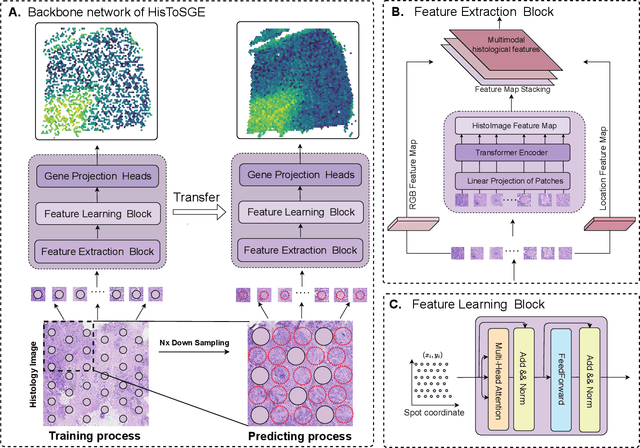

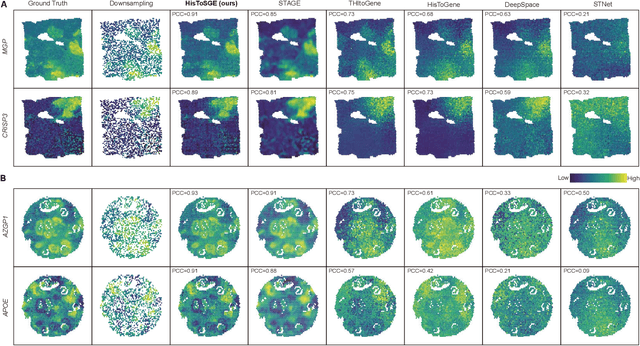
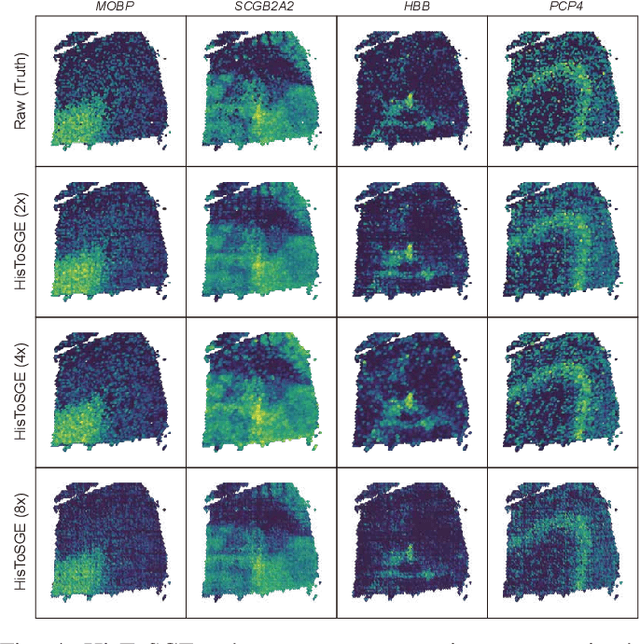
Spatial transcriptomics (ST) is a groundbreaking genomic technology that enables spatial localization analysis of gene expression within tissue sections. However, it is significantly limited by high costs and sparse spatial resolution. An alternative, more cost-effective strategy is to use deep learning methods to predict high-density gene expression profiles from histological images. However, existing methods struggle to capture rich image features effectively or rely on low-dimensional positional coordinates, making it difficult to accurately predict high-resolution gene expression profiles. To address these limitations, we developed HisToSGE, a method that employs a Pathology Image Large Model (PILM) to extract rich image features from histological images and utilizes a feature learning module to robustly generate high-resolution gene expression profiles. We evaluated HisToSGE on four ST datasets, comparing its performance with five state-of-the-art baseline methods. The results demonstrate that HisToSGE excels in generating high-resolution gene expression profiles and performing downstream tasks such as spatial domain identification. All code and public datasets used in this paper are available at https://github.com/wenwenmin/HisToSGE and https://zenodo.org/records/12792163.
Multimodal contrastive learning for spatial gene expression prediction using histology images
Jul 11, 2024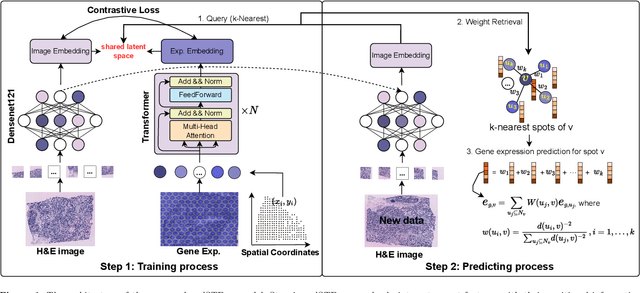
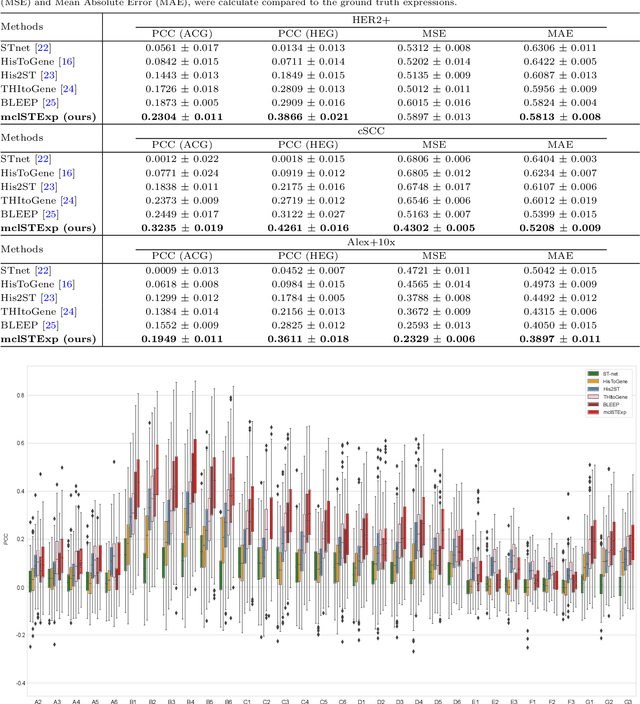
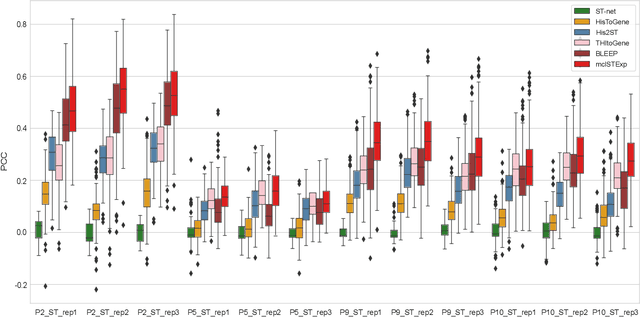
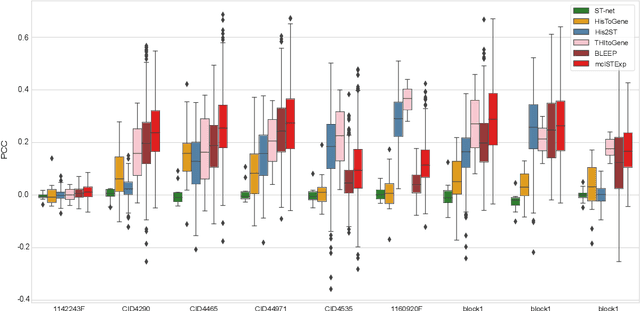
In recent years, the advent of spatial transcriptomics (ST) technology has unlocked unprecedented opportunities for delving into the complexities of gene expression patterns within intricate biological systems. Despite its transformative potential, the prohibitive cost of ST technology remains a significant barrier to its widespread adoption in large-scale studies. An alternative, more cost-effective strategy involves employing artificial intelligence to predict gene expression levels using readily accessible whole-slide images (WSIs) stained with Hematoxylin and Eosin (H\&E). However, existing methods have yet to fully capitalize on multimodal information provided by H&E images and ST data with spatial location. In this paper, we propose \textbf{mclSTExp}, a multimodal contrastive learning with Transformer and Densenet-121 encoder for Spatial Transcriptomics Expression prediction. We conceptualize each spot as a "word", integrating its intrinsic features with spatial context through the self-attention mechanism of a Transformer encoder. This integration is further enriched by incorporating image features via contrastive learning, thereby enhancing the predictive capability of our model. Our extensive evaluation of \textbf{mclSTExp} on two breast cancer datasets and a skin squamous cell carcinoma dataset demonstrates its superior performance in predicting spatial gene expression. Moreover, mclSTExp has shown promise in interpreting cancer-specific overexpressed genes, elucidating immune-related genes, and identifying specialized spatial domains annotated by pathologists. Our source code is available at https://github.com/shizhiceng/mclSTExp.