 Add to Chrome
 Add to Firefox
 Add to Edge
Mamba-Assisted Non-Markovian Closure for Reduced-Order Modeling
Jun 03, 2026
Reduced-order modeling of high-dimensional dynamical systems is often hindered by the non-Markovian closure term that represents the effect of unresolved variables on the resolved dynamics. Inspired by the Mori--Zwanzig formalism, in which the closure takes the form of a memory functional of the resolved trajectory, we recast closure modeling as a sequence modeling problem and propose the Mamba-Assisted Closure (MAC) framework: a Mamba-based sequence model, trained to predict the closure from the resolved trajectory, is coupled with the reduced-order governing equations through a numerical integrator to advance the resolved variables in time. A key feature of the framework is its exploitation of the dual representation of state-space models -- the model is trained in a sequence-to-sequence fashion via the convolutional form, and deployed for step-by-step autoregressive rollout via the recurrent form, yielding both efficient long-trajectory training and constant per-step inference cost. On the viscous Burgers' equation and the chaotic two-scale Lorenz '96 system, the MAC model substantially outperforms the Markovian reduced-order model, the GRU-based sequence model, and the Wilks method in predictive accuracy and long-time rollout stability.

Robustness of graph embedding methods for community detection
May 01, 2024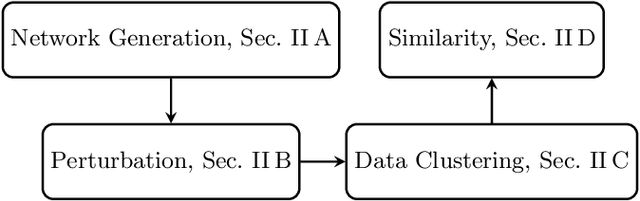
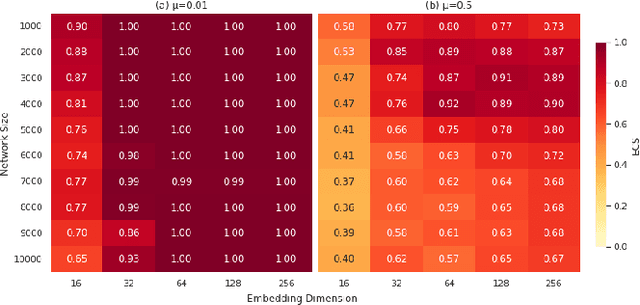
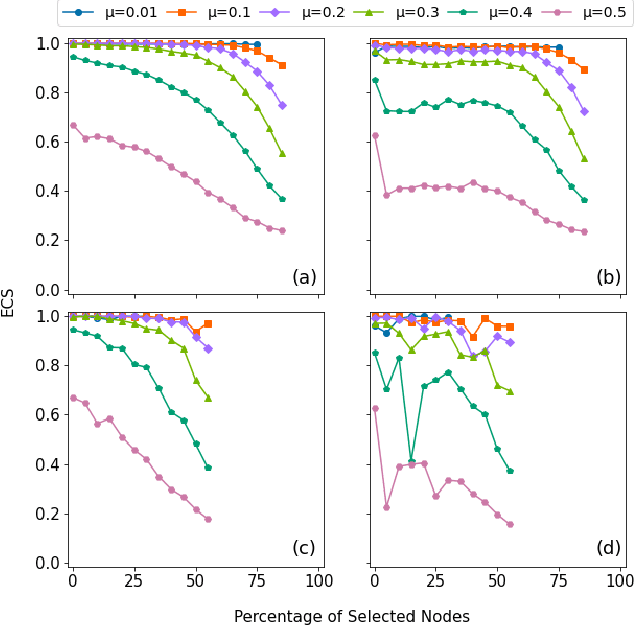
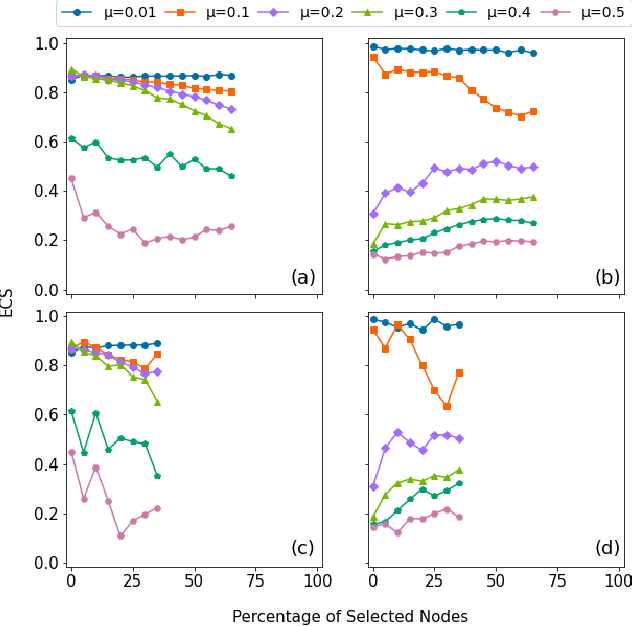
This study investigates the robustness of graph embedding methods for community detection in the face of network perturbations, specifically edge deletions. Graph embedding techniques, which represent nodes as low-dimensional vectors, are widely used for various graph machine learning tasks due to their ability to capture structural properties of networks effectively. However, the impact of perturbations on the performance of these methods remains relatively understudied. The research considers state-of-the-art graph embedding methods from two families: matrix factorization (e.g., LE, LLE, HOPE, M-NMF) and random walk-based (e.g., DeepWalk, LINE, node2vec). Through experiments conducted on both synthetic and real-world networks, the study reveals varying degrees of robustness within each family of graph embedding methods. The robustness is found to be influenced by factors such as network size, initial community partition strength, and the type of perturbation. Notably, node2vec and LLE consistently demonstrate higher robustness for community detection across different scenarios, including networks with degree and community size heterogeneity. These findings highlight the importance of selecting an appropriate graph embedding method based on the specific characteristics of the network and the task at hand, particularly in scenarios where robustness to perturbations is crucial.