 Add to Chrome
 Add to Firefox
 Add to Edge
ANNLib: A Development Framework for Efficient Approximate Nearest Neighbor Search
Jul 20, 2026
Approximate Nearest Neighbor Search (ANNS) plays a pivotal role in modern deep learning pipelines. Recently, many ANNS systems have been proposed to either provide broad functionality or reach high performance. However, it is yet difficult to achieve both with minimal programming efforts. We propose ANNLib to address the gap. ANNLib is a library that provides a programming framework for achieving high performance and flexible functionality in ANNS systems, based on popular graph-based ANNS algorithms. We carefully decouple and independently optimize both the algorithm and the data structure components of an ANNS system. In addition, we integrate state-of-the-art algorithms and data structures into ANNLib as modules, along with our new designs. Users can choose combinations of components to implement sophisticated settings with high performance, such as filter search, fully dynamic updates, and historical queries on snapshots. Our experiments show that our new solution provides a simple interface for various applications and achieves comparable or even better performance than previous work, specifically for each application.

Scaling Graph-Based ANNS Algorithms to Billion-Size Datasets: A Comparative Analysis
May 07, 2023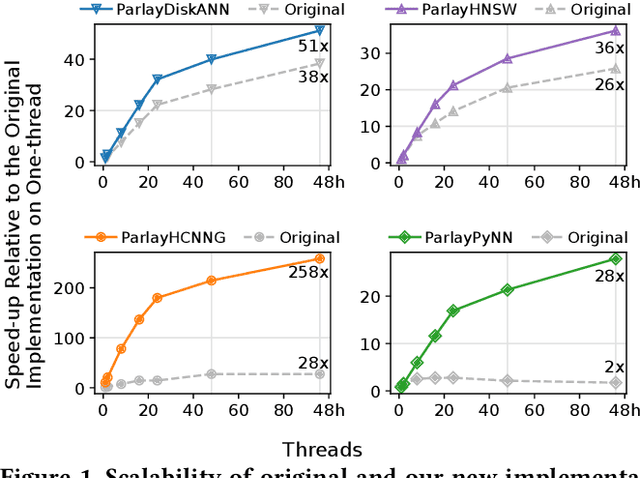
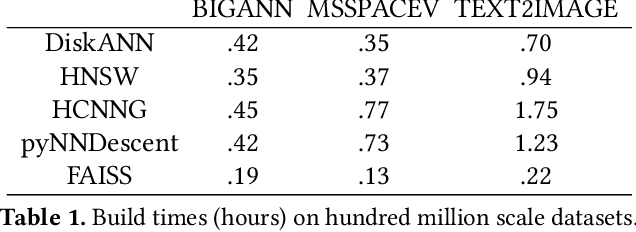
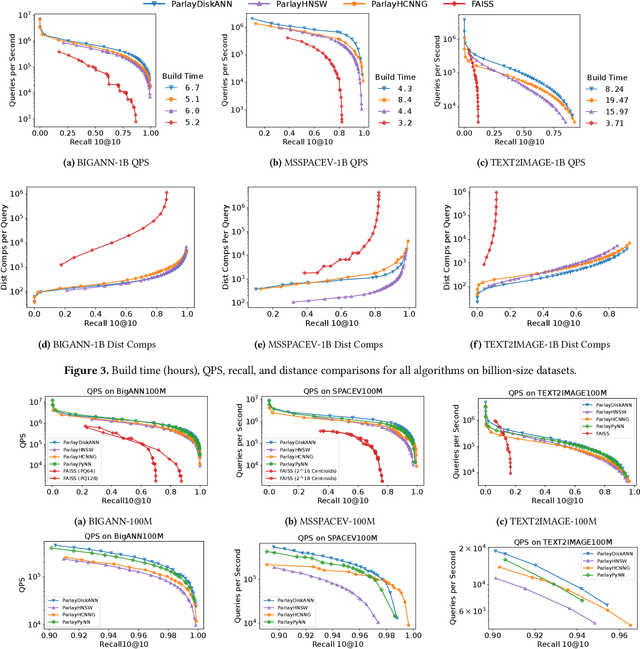
Algorithms for approximate nearest-neighbor search (ANNS) have been the topic of significant recent interest in the research community. However, evaluations of such algorithms are usually restricted to a small number of datasets with millions or tens of millions of points, whereas real-world applications require algorithms that work on the scale of billions of points. Furthermore, existing evaluations of ANNS algorithms are typically heavily focused on measuring and optimizing for queries-per second (QPS) at a given accuracy, which can be hardware-dependent and ignores important metrics such as build time. In this paper, we propose a set of principled measures for evaluating ANNS algorithms which refocuses on their scalability to billion-size datasets. These measures include ability to be efficiently parallelized, build times, and scaling relationships as dataset size increases. We also expand on the QPS measure with machine-agnostic measures such as the number of distance computations per query, and we evaluate ANNS data structures on their accuracy in more demanding settings required in modern applications, such as evaluating range queries and running on out-of-distribution data. We optimize four graph-based algorithms for the billion-scale setting, and in the process provide a general framework for making many incremental ANNS graph algorithms lock-free. We use our framework to evaluate the aforementioned graph-based ANNS algorithms as well as two alternative approaches.