 Add to Chrome
 Add to Firefox
 Add to Edge
CDH-Bench: A Commonsense-Driven Hallucination Benchmark for Evaluating Visual Fidelity in Vision-Language Models
Apr 01, 2026
Vision-language models (VLMs) achieve strong performance on many benchmarks, yet a basic reliability question remains underexplored: when visual evidence conflicts with commonsense, do models follow what is shown or what commonsense suggests? A characteristic failure in this setting is that the model overrides visual evidence and outputs the commonsense alternative. We term this phenomenon \textbf{commonsense-driven hallucination} (CDH). To evaluate it, we introduce \textbf{CDH-Bench}, a benchmark designed to create explicit \textbf{visual evidence--commonsense conflicts}. CDH-Bench covers three dimensions: \textit{counting anomalies}, \textit{relational anomalies}, and \textit{attribute anomalies}. We evaluate frontier VLMs under \textit{binary Question Answering (QA)} and \textit{multiple-choice QA}, and report metrics including \textit{Counterfactual Accuracy} (CF-Acc), \textit{Commonsense Accuracy} (CS-Acc), \textit{Counterfactual Accuracy Drop} (CFAD), \textit{Commonsense Collapse Rate} (CCR), and \textit{Relative Prior Dependency} (RPD). Results show that even strong models remain vulnerable to prior-driven normalization under visual evidence--commonsense conflict. CDH-Bench provides a controlled diagnostic of visual fidelity under visual evidence--commonsense conflict.

BAMBO: Construct Ability and Efficiency LLM Pareto Set via Bayesian Adaptive Multi-objective Block-wise Optimization
Dec 12, 2025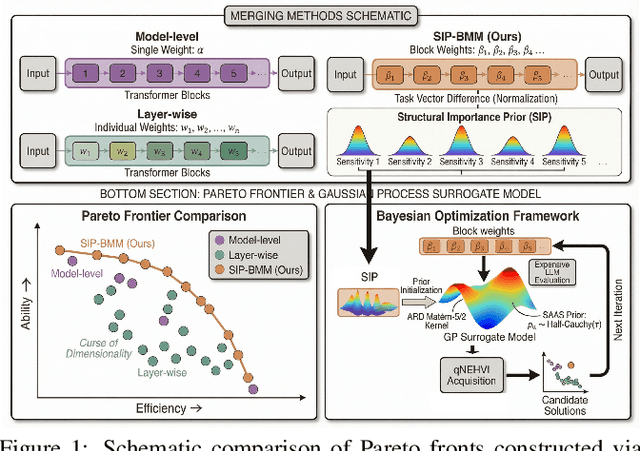

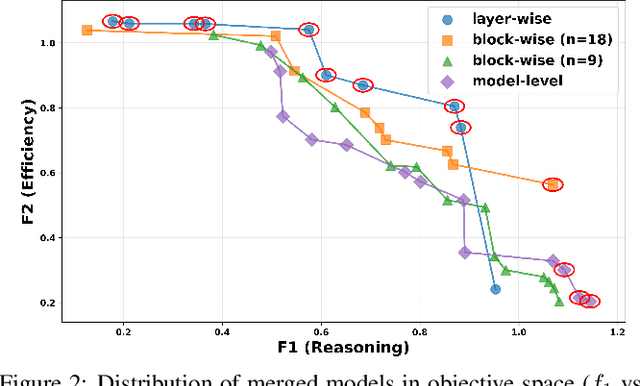
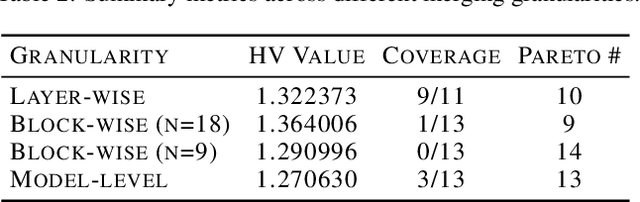
Constructing a Pareto set is pivotal for navigating the capability-efficiency trade-offs in Large Language Models (LLMs); however, existing merging techniques remain inadequate for this task. Coarse-grained, model-level methods yield only a sparse set of suboptimal solutions, while fine-grained, layer-wise approaches suffer from the "curse of dimensionality," rendering the search space computationally intractable. To resolve this dichotomy, we propose BAMBO (Bayesian Adaptive Multi-objective Block-wise Optimization), a novel framework that automatically constructs the LLM Pareto set. BAMBO renders the search tractable by introducing a Hybrid Optimal Block Partitioning strategy. Formulated as a 1D clustering problem, this strategy leverages a dynamic programming approach to optimally balance intra-block homogeneity and inter-block information distribution, thereby dramatically reducing dimensionality without sacrificing critical granularity. The entire process is automated within an evolutionary loop driven by the q-Expected Hypervolume Improvement (qEHVI) acquisition function. Experiments demonstrate that BAMBO discovers a superior and more comprehensive Pareto frontier than baselines, enabling agile model selection tailored to diverse operational constraints. Code is available at: https://github.com/xin8coder/BAMBO.