 Add to Chrome
 Add to Firefox
 Add to Edge
When Model Priors Conflict with Visual Evidence: Mitigating Commonsense-Driven Hallucinations by Selective Prior Calibration
Jul 31, 2026
In vision--language models, commonsense-driven hallucination (CDH) occurs when a model's commonsense prior overrides clear visual evidence of an atypical state. For example, a model may report that a visibly six-fingered hand has five fingers. We show that these errors are systematically directed: when a model answers a question about a counterfactual (CF) image incorrectly, its answer often coincides with the candidate it prefers without access to the image. Suppressing this prior indiscriminately can repair CF errors, but may also disrupt correct answers on matched commonsense (CS) images, where the same prior is helpful. We therefore propose Selective Prior Calibration (SPC), which subtracts candidate-level prior-preference estimates from image-conditioned scores with an instance-dependent strength and revises the original prediction only when the resulting score pattern strongly supports an alternative. Extensive experiments demonstrate that SPC substantially improves accuracy on CF images while largely preserving accuracy on matched CS images. Furthermore, these gains generalize across CDH categories, candidate-answer permutations, and other conflict benchmarks, while SPC rarely alters predictions on benchmarks without such conflicts.

SentAttack: A Sentence-Level Black-Box Adversarial Attack Method for Dense Retrieval Models
Jul 03, 2026Retrieval-Augmented Generation (RAG) systems typically consist of a dense retrieval (DR) model for initial retrieval and a neural ranking model (NRM) for re-ranking.Existing robustness studies in RAG mainly focus on NRMs, while adversarial attacks on DR models are mostly limited to word-level perturbations.For low-ranked target documents that are irrelevant to the query, simple word-level attacks are insufficient to mislead DR models into substantially promoting their rankings.To solve these problems, we propose SentAttack, a sentence-level black-box adversarial attack method for DR models.SentAttack is designed as a two-stage method.In the first stage, SentAttack interacts with the black-box RAG system via iterative retrieval to collect ranked documents and ranking information for training a surrogate DR model.In the second stage, SentAttack uses the surrogate DR model to encode and cluster documents relevant to the target query, yielding multiple cluster centroids.These centroids are concatenated with the target document at the sentence level to form an initial set of adversarial candidates.SentAttack then optimizes these candidates using a query- and centroid-guided objective combined with gradient-guided beam search.Extensive experiments demonstrate that SentAttack outperforms existing adversarial attacks on DR models, with especially strong performance on low-ranked target documents.
Rethinking Backdoor Adversarial Unlearning through the Lens of Catastrophic Forgetting in Continual Learning
Jun 12, 2026Existing studies reveal that current backdoor defenses exhibit limited robustness and often fail against specific types of attacks. More concerningly, prevailing safety tuning strategies tend to provide only superficial safety protection, as they fall short of completely eliminating the backdoor effects. In this work, we present a novel formulation of backdoor learning and unlearning as a sequential, three-stage process from a continual learning perspective. Within this framework, we formally define complete backdoor unlearning and further derive the necessary conditions for achieving it based on the mechanism of catastrophic forgetting. Guided by these insights, we propose Blind Inversion-Backdoor Adversarial Unlearning (BI-BAU), which formulates the generation of adversarial examples satisfying the unlearning conditions as a blind inversion problem. We solve this by integrating the bi-level optimization process of adversarial training into an Expectation-Maximization (EM) algorithm framework to optimize the maximum a posteriori (MAP) objective. Furthermore, BI-BAU is extended to untargeted adversarial scenarios with unknown target classes, as well as to multi-modal contrastive learning tasks, enhancing its applicability to real-world deployment scenarios where pre-trained models may be compromised. Extensive experiments demonstrate that our method exhibits general applicability across a wide spectrum of backdoor attacks and can effectively and thoroughly eliminate the backdoor effects from a backdoor model.
From Parameters to Feature Space: Task Arithmetic for Backdoor Mitigation in Model Merging
Jun 10, 2026Model merging (MM) has gained significant attention as a cost-effective approach to integrate multiple task-specific models into a unified model. However, recent work reveals that MM is highly susceptible to backdoor attacks. Existing defenses based on task arithmetic often fail to eliminate backdoors without substantially degrading clean-task performance, owing to their reliance on direct parameter-space editing. To address this gap, we propose Linear Feature Path Minimization (LFPM), a backdoor mitigation framework for model merging, which introduces an anti-backdoor task vector into the backdoored merged model. Unlike prior approaches, LFPM formulates the backdoor robustness of the merged model from a unified feature-space perspective under the Cross-Task Linearity (CTL) framework, which leverages the approximate linearity of features across tasks. This perspective guides the optimization of the anti-backdoor task to suppress backdoors while preserving clean-task performance. Furthermore, we introduce an effective optimization mechanism based on gradient accumulation and loss path-integral, ensuring robust backdoor suppression along the interpolation path. Extensive experiments demonstrate that LFPM consistently exhibits strong robustness against backdoor attacks in both full fine-tuning and Parameter-Efficient Fine-Tuning (PEFT) settings.
CDH-Bench: A Commonsense-Driven Hallucination Benchmark for Evaluating Visual Fidelity in Vision-Language Models
Apr 01, 2026Vision-language models (VLMs) achieve strong performance on many benchmarks, yet a basic reliability question remains underexplored: when visual evidence conflicts with commonsense, do models follow what is shown or what commonsense suggests? A characteristic failure in this setting is that the model overrides visual evidence and outputs the commonsense alternative. We term this phenomenon \textbf{commonsense-driven hallucination} (CDH). To evaluate it, we introduce \textbf{CDH-Bench}, a benchmark designed to create explicit \textbf{visual evidence--commonsense conflicts}. CDH-Bench covers three dimensions: \textit{counting anomalies}, \textit{relational anomalies}, and \textit{attribute anomalies}. We evaluate frontier VLMs under \textit{binary Question Answering (QA)} and \textit{multiple-choice QA}, and report metrics including \textit{Counterfactual Accuracy} (CF-Acc), \textit{Commonsense Accuracy} (CS-Acc), \textit{Counterfactual Accuracy Drop} (CFAD), \textit{Commonsense Collapse Rate} (CCR), and \textit{Relative Prior Dependency} (RPD). Results show that even strong models remain vulnerable to prior-driven normalization under visual evidence--commonsense conflict. CDH-Bench provides a controlled diagnostic of visual fidelity under visual evidence--commonsense conflict.
BAMBO: Construct Ability and Efficiency LLM Pareto Set via Bayesian Adaptive Multi-objective Block-wise Optimization
Dec 12, 2025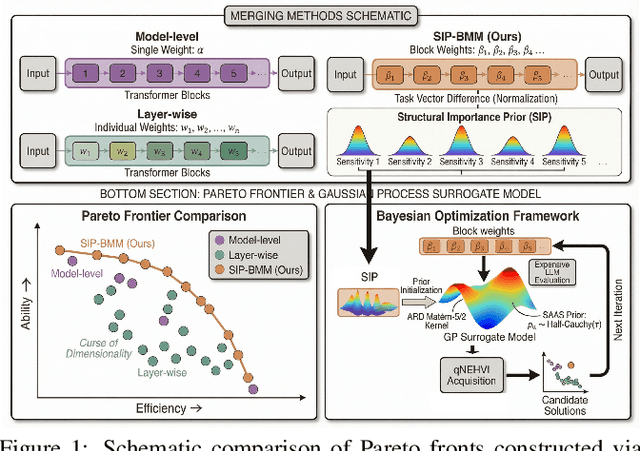

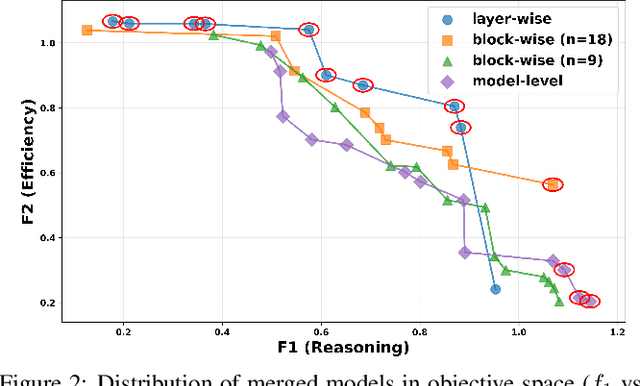
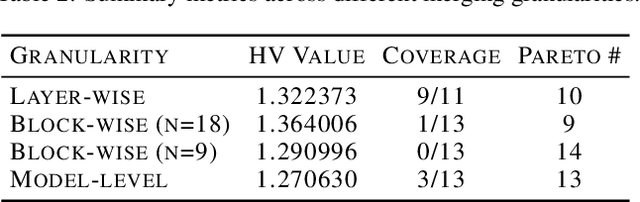
Constructing a Pareto set is pivotal for navigating the capability-efficiency trade-offs in Large Language Models (LLMs); however, existing merging techniques remain inadequate for this task. Coarse-grained, model-level methods yield only a sparse set of suboptimal solutions, while fine-grained, layer-wise approaches suffer from the "curse of dimensionality," rendering the search space computationally intractable. To resolve this dichotomy, we propose BAMBO (Bayesian Adaptive Multi-objective Block-wise Optimization), a novel framework that automatically constructs the LLM Pareto set. BAMBO renders the search tractable by introducing a Hybrid Optimal Block Partitioning strategy. Formulated as a 1D clustering problem, this strategy leverages a dynamic programming approach to optimally balance intra-block homogeneity and inter-block information distribution, thereby dramatically reducing dimensionality without sacrificing critical granularity. The entire process is automated within an evolutionary loop driven by the q-Expected Hypervolume Improvement (qEHVI) acquisition function. Experiments demonstrate that BAMBO discovers a superior and more comprehensive Pareto frontier than baselines, enabling agile model selection tailored to diverse operational constraints. Code is available at: https://github.com/xin8coder/BAMBO.
Community-based 3-SAT Formulas with a Predefined Solution
Feb 26, 2019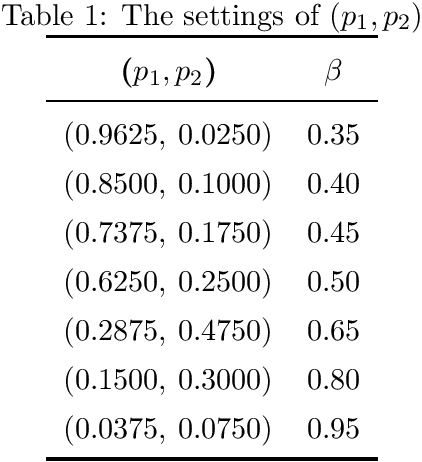
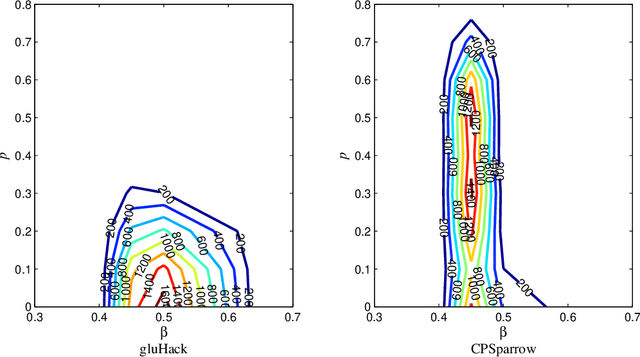
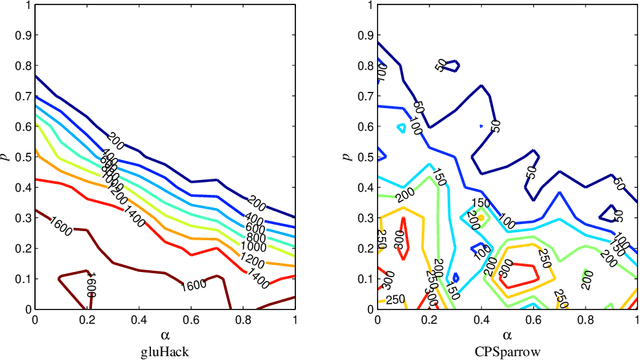
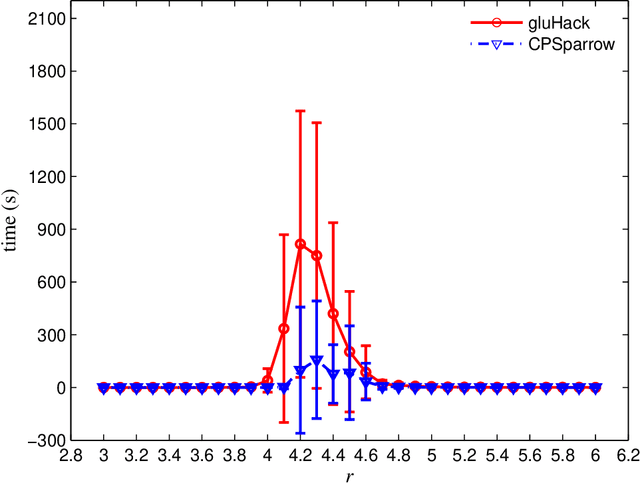
It is crucial to generate crafted SAT formulas with predefined solutions for the testing and development of SAT solvers since many SAT formulas from real-world applications have solutions. Although some generating algorithms have been proposed to generate SAT formulas with predefined solutions, community structures of SAT formulas are not considered. We propose a 3-SAT formula generating algorithm that not only guarantees the existence of a predefined solution, but also simultaneously considers community structures and clause distributions. The proposed 3-SAT formula generating algorithm controls the quality of community structures through controlling (1) the number of clauses whose variables have a common community, which we call intra-community clauses, and (2) the number of variables that only belong to one community, which we call intra-community variables. To study the combined effect of community structures and clause distributions on the hardness of SAT formulas, we measure solving runtimes of two solvers, gluHack (a leading CDCL solver) and CPSparrow (a leading SLS solver), on the generated SAT formulas under different groups of parameter settings. Through extensive experiments, we obtain some noteworthy observations on the SAT formulas generated by the proposed algorithm: (1) The community structure has little or no effects on the hardness of SAT formulas with regard to CPSparrow but a strong effect with regard to gluHack. (2) Only when the proportion of true literals in a SAT formula in terms of the predefined solution is 0.5, SAT formulas are hard-to-solve with regard to gluHack; when this proportion is below 0.5, SAT formulas are hard-to-solve with regard to CPSparrow. (3) When the ratio of the number of clauses to that of variables is around 4.25, the SAT formulas are hard-to-solve with regard to both gluHack and CPSparrow.