 Add to Chrome
 Add to Firefox
 Add to Edge
Abstraction Generation for Generalized Planning with Pretrained Large Language Models
Feb 11, 2026
Qualitative Numerical Planning (QNP) serves as an important abstraction model for generalized planning (GP), which aims to compute general plans that solve multiple instances at once. Recent works show that large language models (LLMs) can function as generalized planners. This work investigates whether LLMs can serve as QNP abstraction generators for GP problems and how to fix abstractions via automated debugging. We propose a prompt protocol: input a GP domain and training tasks to LLMs, prompting them to generate abstract features and further abstract the initial state, action set, and goal into QNP problems. An automated debugging method is designed to detect abstraction errors, guiding LLMs to fix abstractions. Experiments demonstrate that under properly guided by automated debugging, some LLMs can generate useful QNP abstractions.

Automatic Verification of Sound Abstractions for Generalized Planning
May 24, 2022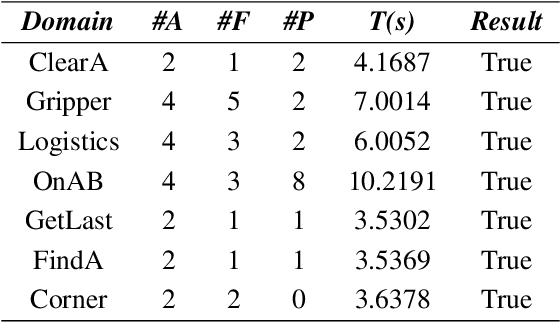
Generalized planning studies the computation of general solutions for a set of planning problems. Computing general solutions with correctness guarantee has long been a key issue in generalized planning. Abstractions are widely used to solve generalized planning problems. Solutions of sound abstractions are those with correctness guarantees for generalized planning problems. Recently, Cui et al. proposed a uniform abstraction framework for generalized planning. They gave the model-theoretic definitions of sound and complete abstractions for generalized planning problems. In this paper, based on Cui et al.'s work, we explore automatic verification of sound abstractions for generalized planning. We firstly present the proof-theoretic characterization for sound abstraction. Then, based on the characterization, we give a sufficient condition for sound abstractions which is first-order verifiable. To implement it, we exploit regression extensions, and develop methods to handle counting and transitive closure. Finally, we implement a sound abstraction verification system and report experimental results on several domains.