 Add to Chrome
 Add to Firefox
 Add to Edge
Near-sensor Computing for Rapid Visuotactile Perception
Aug 06, 2026
Visuotactile sensors reconstruct dense contact geometry from measured surface gradients, but host-based processing increases power consumption and introduces data-transfer delays and variable scheduling latency, limiting the sensing and response speed of robotic systems. To address these limitations, we implement a near-sensor computing framework that includes a spectral Poisson solver as a fully streaming hardware pipeline. The computational core logic has an estimated power consumption of 347 mW and achieves high throughput without data-dependent branching or iterative convergence, thereby providing deterministic latency. Operating at 166 MHz, the pipeline produces the first depth value of each 128x128 frame 35,107 cycles after receiving the first input pixel, corresponding to a fixed latency of 0.211 ms. Across 15 contact geometries, the reconstructed depths differ from a double-precision reference by 0.17 % of the peak contact depth. On-chip decisions based on these reconstructions close a robot protective reflex loop in 28.3 +/- 4.9 ms, compared with 169.9 +/- 27.8 ms for an equivalent host-based loop using the same actuator. These results demonstrate that near-sensor reconstruction can provide accurate, energy-efficient, and deterministic tactile geometry on timescales suitable for rapid robotic contact responses.

HumanFT: A Human-like Fingertip Multimodal Visuo-Tactile Sensor
Oct 14, 2024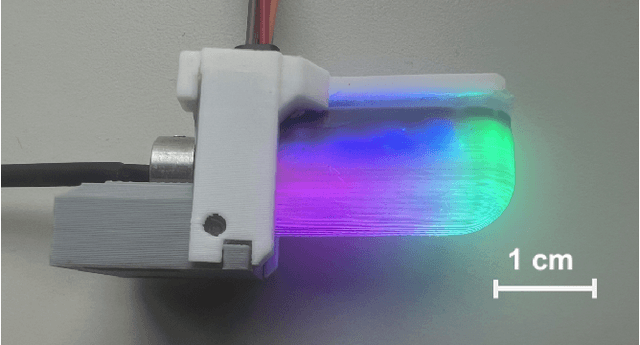
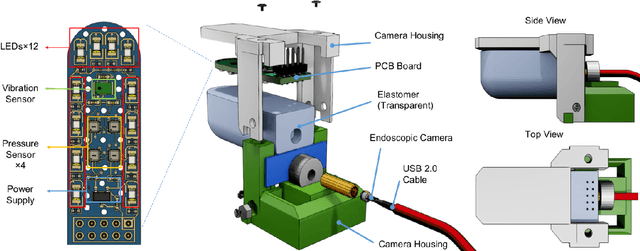
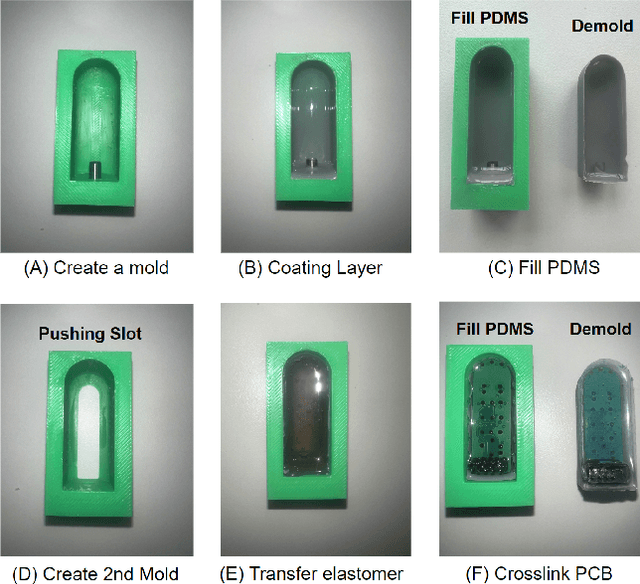
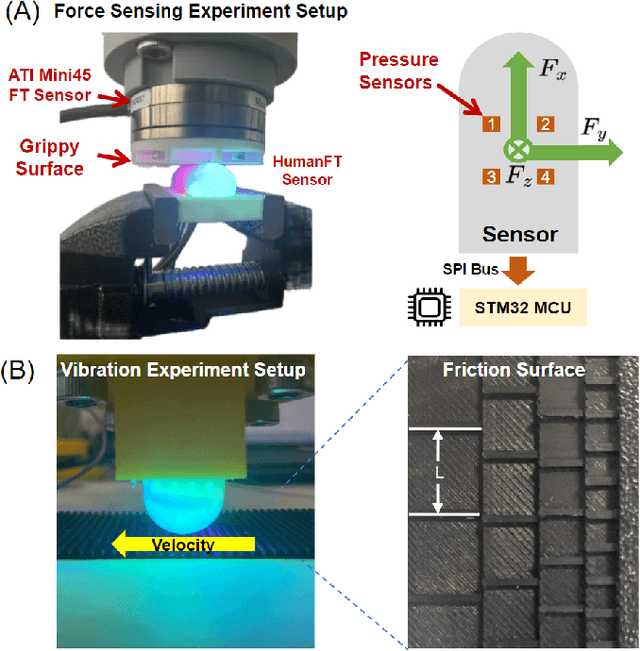
Tactile sensors play a crucial role in enabling robots to interact effectively and safely with objects in everyday tasks. In particular, visuotactile sensors have seen increasing usage in two and three-fingered grippers due to their high-quality feedback. However, a significant gap remains in the development of sensors suitable for humanoid robots, especially five-fingered dexterous hands. One reason is because of the challenges in designing and manufacturing sensors that are compact in size. In this paper, we propose HumanFT, a multimodal visuotactile sensor that replicates the shape and functionality of a human fingertip. To bridge the gap between human and robotic tactile sensing, our sensor features real-time force measurements, high-frequency vibration detection, and overtemperature alerts. To achieve this, we developed a suite of fabrication techniques for a new type of elastomer optimized for force propagation and temperature sensing. Besides, our sensor integrates circuits capable of sensing pressure and vibration. These capabilities have been validated through experiments. The proposed design is simple and cost-effective to fabricate. We believe HumanFT can enhance humanoid robots' perception by capturing and interpreting multimodal tactile information.