 Add to Chrome
 Add to Firefox
 Add to Edge
NLiPsCalib: An Efficient Calibration Framework for High-Fidelity 3D Reconstruction of Curved Visuotactile Sensors
Mar 10, 2026
Recent advances in visuotactile sensors increasingly employ biomimetic curved surfaces to enhance sensorimotor capabilities. Although such curved visuotactile sensors enable more conformal object contact, their perceptual quality is often degraded by non-uniform illumination, which reduces reconstruction accuracy and typically necessitates calibration. Existing calibration methods commonly rely on customized indenters and specialized devices to collect large-scale photometric data, but these processes are expensive and labor-intensive. To overcome these calibration challenges, we present NLiPsCalib, a physics-consistent and efficient calibration framework for curved visuotactile sensors. NLiPsCalib integrates controllable near-field light sources and leverages Near-Light Photometric Stereo (NLiPs) to estimate contact geometry, simplifying calibration to just a few simple contacts with everyday objects. We further introduce NLiPsTac, a controllable-light-source tactile sensor developed to validate our framework. Experimental results demonstrate that our approach enables high-fidelity 3D reconstruction across diverse curved form factors with a simple calibration procedure. We emphasize that our approach lowers the barrier to developing customized visuotactile sensors of diverse geometries, thereby making visuotactile sensing more accessible to the broader community.

HumanFT: A Human-like Fingertip Multimodal Visuo-Tactile Sensor
Oct 14, 2024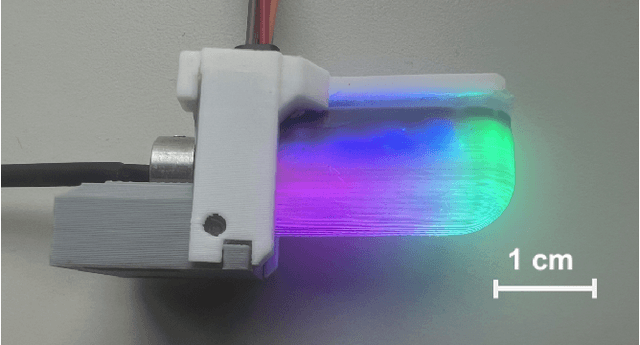
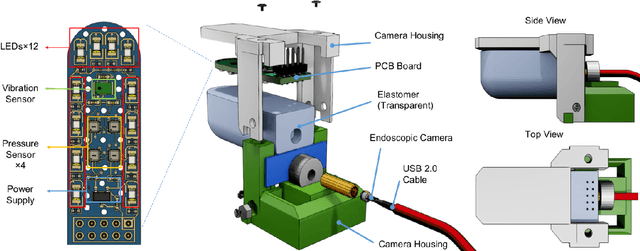
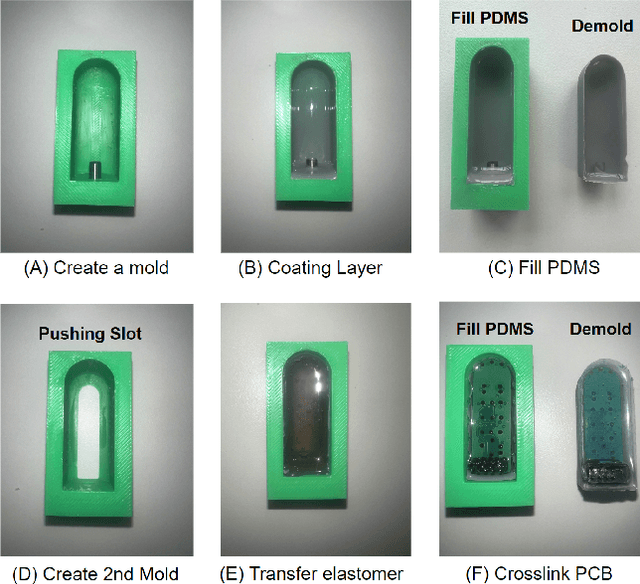
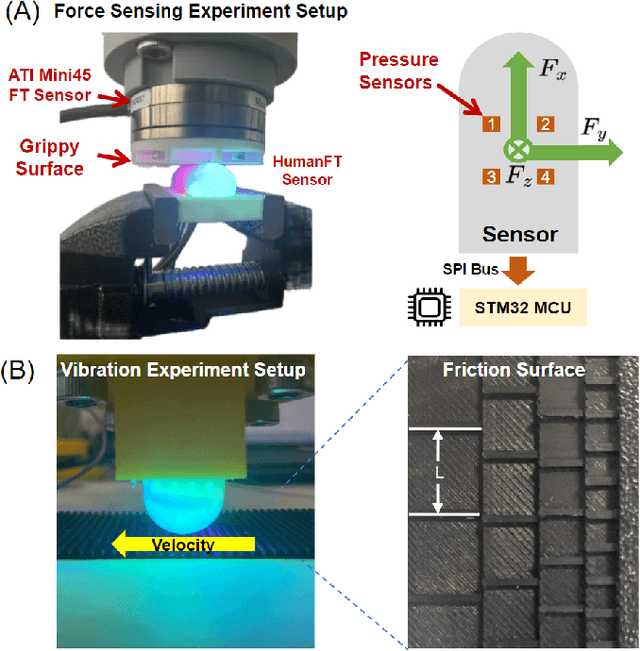
Tactile sensors play a crucial role in enabling robots to interact effectively and safely with objects in everyday tasks. In particular, visuotactile sensors have seen increasing usage in two and three-fingered grippers due to their high-quality feedback. However, a significant gap remains in the development of sensors suitable for humanoid robots, especially five-fingered dexterous hands. One reason is because of the challenges in designing and manufacturing sensors that are compact in size. In this paper, we propose HumanFT, a multimodal visuotactile sensor that replicates the shape and functionality of a human fingertip. To bridge the gap between human and robotic tactile sensing, our sensor features real-time force measurements, high-frequency vibration detection, and overtemperature alerts. To achieve this, we developed a suite of fabrication techniques for a new type of elastomer optimized for force propagation and temperature sensing. Besides, our sensor integrates circuits capable of sensing pressure and vibration. These capabilities have been validated through experiments. The proposed design is simple and cost-effective to fabricate. We believe HumanFT can enhance humanoid robots' perception by capturing and interpreting multimodal tactile information.