 Add to Chrome
 Add to Firefox
 Add to Edge
Enhancing Quantum Machine Learning with Anyons
Jun 15, 2026
The power of quantum computing and quantum machine learning relies on harnessing uniquely quantum phenomena as computational resources. While superposition, coherence and entanglement have been central to this effort, the role of particle exchange statistics remains largely unexplored. Here, we introduce a quantum kernel framework that unifies bosonic, fermionic, and anyonic (fractional) exchange statistics within a single learning paradigm. We study this family of kernels from three perspectives. At the representation level, Haar-averaged effective-dimension analysis shows that fractional exchange phases access feature-space directions inaccessible to the purely symmetric or antisymmetric limits. At the level of kernel geometry, the corresponding Gram matrices show greater separation from the distinguishable-particle baseline and reduced label-dependent model complexity. Finally, on learning benchmarks, anyonic kernels consistently outperform their bosonic and fermionic counterparts, with stronger target alignment and more favorable class geometry. Together, these findings show that exchange statistics reshape the structure and geometry of quantum feature space, leading to enhanced learning performance. Our work identifies particle exchange statistics as an overlooked computational ingredient for quantum machine learning and provides the first systematic comparison of quantum learning models across exchange phases.

Scalable Quantum Error Mitigation with Neighbor-Informed Learning
Dec 14, 2025Noise in quantum hardware is the primary obstacle to realizing the transformative potential of quantum computing. Quantum error mitigation (QEM) offers a promising pathway to enhance computational accuracy on near-term devices, yet existing methods face a difficult trade-off between performance, resource overhead, and theoretical guarantees. In this work, we introduce neighbor-informed learning (NIL), a versatile and scalable QEM framework that unifies and strengthens existing methods such as zero-noise extrapolation (ZNE) and probabilistic error cancellation (PEC), while offering improved flexibility, accuracy, efficiency, and robustness. NIL learns to predict the ideal output of a target quantum circuit from the noisy outputs of its structurally related ``neighbor'' circuits. A key innovation is our 2-design training method, which generates training data for our machine learning model. In contrast to conventional learning-based QEM protocols that create training circuits by replacing non-Clifford gates with uniformly random Clifford gates, our approach achieves higher accuracy and efficiency, as demonstrated by both theoretical analysis and numerical simulation. Furthermore, we prove that the required size of the training set scales only \emph{logarithmically} with the total number of neighbor circuits, enabling NIL to be applied to problems involving large-scale quantum circuits. Our work establishes a theoretically grounded and practically efficient framework for QEM, paving a viable path toward achieving quantum advantage on noisy hardware.
Taming Barren Plateaus in Arbitrary Parameterized Quantum Circuits without Sacrificing Expressibility
Nov 18, 2025Quantum algorithms based on parameterized quantum circuits (PQCs) have enabled a wide range of applications on near-term quantum devices. However, existing PQC architectures face several challenges, among which the ``barren plateaus" phenomenon is particularly prominent. In such cases, the loss function concentrates exponentially with increasing system size, thereby hindering effective parameter optimization. To address this challenge, we propose a general and hardware-efficient method for eliminating barren plateaus in an arbitrary PQC. Specifically, our approach achieves this by inserting a layer of easily implementable quantum channels into the original PQC, each channel requiring only one ancilla qubit and four additional gates, yielding a modified PQC (MPQC) that is provably at least as expressive as the original PQC and, under mild assumptions, is guaranteed to be free from barren plateaus. Furthermore, by appropriately adjusting the structure of MPQCs, we rigorously prove that any parameter in the original PQC can be made trainable. Importantly, the absence of barren plateaus in MPQCs is robust against realistic noise, making our approach directly applicable to current noisy intermediate-scale quantum (NISQ) hardware. Numerically, we demonstrate the practicality of our method by modifying a commonly used PQC for thermal-state preparation. The results show that {barren plateaus are effectively eliminated} in this class of circuits with up to 100 qubits and 2400 layers, whereas the original ansatz suffers from severe gradient vanishing.
Variational Optimization for Quantum Problems using Deep Generative Networks
Apr 28, 2024
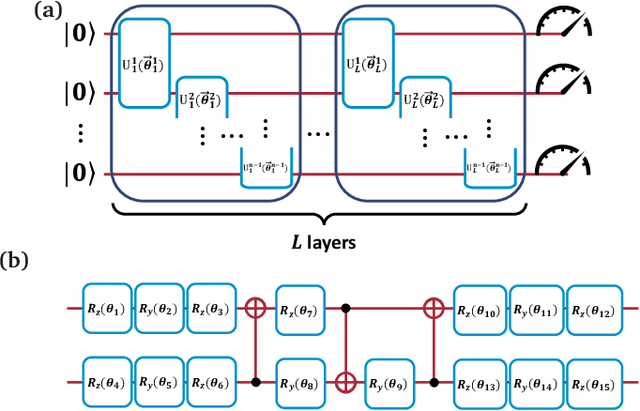


Optimization is one of the keystones of modern science and engineering. Its applications in quantum technology and machine learning helped nurture variational quantum algorithms and generative AI respectively. We propose a general approach to design variational optimization algorithms based on generative models: the Variational Generative Optimization Network (VGON). To demonstrate its broad applicability, we apply VGON to three quantum tasks: finding the best state in an entanglement-detection protocol, finding the ground state of a 1D quantum spin model with variational quantum circuits, and generating degenerate ground states of many-body quantum Hamiltonians. For the first task, VGON greatly reduces the optimization time compared to stochastic gradient descent while generating nearly optimal quantum states. For the second task, VGON alleviates the barren plateau problem in variational quantum circuits. For the final task, VGON can identify the degenerate ground state spaces after a single stage of training and generate a variety of states therein.
Quantifying Unknown Quantum Entanglement via a Hybrid Quantum-Classical Machine Learning Framework
Apr 25, 2022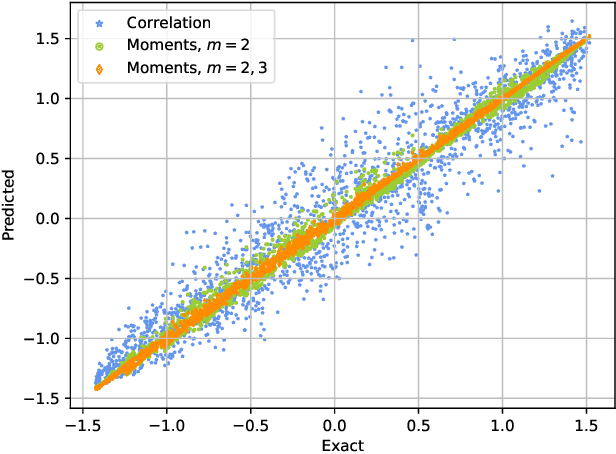
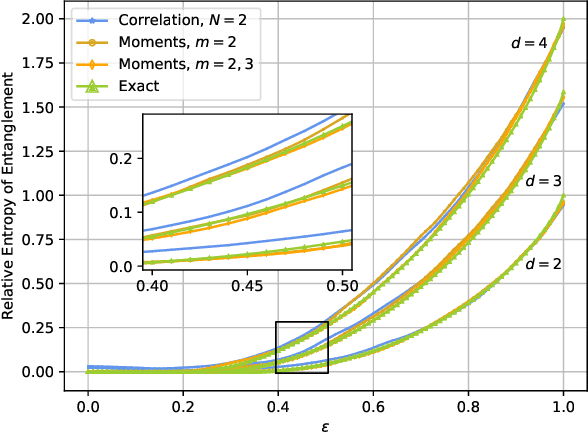
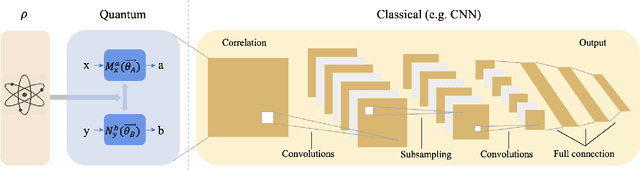
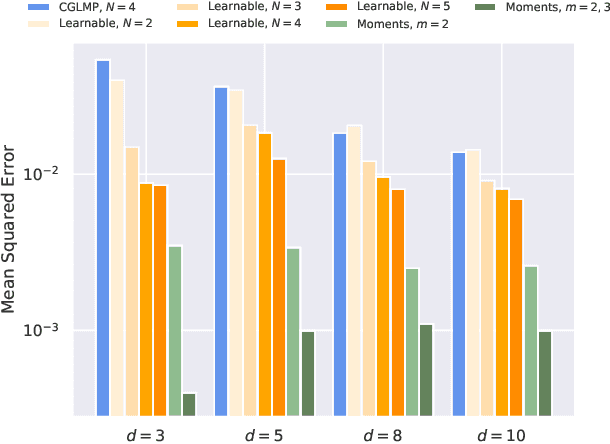
Quantifying unknown quantum entanglement experimentally is a difficult task, but also becomes more and more necessary because of the fast development of quantum engineering. Machine learning provides practical solutions to this fundamental problem, where one has to train a proper machine learning model to predict entanglement measures of unknown quantum states based on experimentally measurable data, say moments or correlation data produced by local measurements. In this paper, we compare the performance of these two different machine learning approaches systematically. Particularly, we first show that the approach based on moments enjoys a remarkable advantage over that based on correlation data, though the cost of measuring moments is much higher. Next, since correlation data is much easier to obtain experimentally, we try to better its performance by proposing a hybrid quantum-classical machine learning framework for this problem, where the key is to train optimal local measurements to generate more informative correlation data. Our numerical simulations show that the new framework brings us comparable performance with the approach based on moments to quantify unknown entanglement. Our work implies that it is already practical to fulfill such tasks on near-term quantum devices.