 Add to Chrome
 Add to Firefox
 Add to Edge
Scalable Quantum Error Mitigation with Neighbor-Informed Learning
Dec 14, 2025
Noise in quantum hardware is the primary obstacle to realizing the transformative potential of quantum computing. Quantum error mitigation (QEM) offers a promising pathway to enhance computational accuracy on near-term devices, yet existing methods face a difficult trade-off between performance, resource overhead, and theoretical guarantees. In this work, we introduce neighbor-informed learning (NIL), a versatile and scalable QEM framework that unifies and strengthens existing methods such as zero-noise extrapolation (ZNE) and probabilistic error cancellation (PEC), while offering improved flexibility, accuracy, efficiency, and robustness. NIL learns to predict the ideal output of a target quantum circuit from the noisy outputs of its structurally related ``neighbor'' circuits. A key innovation is our 2-design training method, which generates training data for our machine learning model. In contrast to conventional learning-based QEM protocols that create training circuits by replacing non-Clifford gates with uniformly random Clifford gates, our approach achieves higher accuracy and efficiency, as demonstrated by both theoretical analysis and numerical simulation. Furthermore, we prove that the required size of the training set scales only \emph{logarithmically} with the total number of neighbor circuits, enabling NIL to be applied to problems involving large-scale quantum circuits. Our work establishes a theoretically grounded and practically efficient framework for QEM, paving a viable path toward achieving quantum advantage on noisy hardware.

Variational Optimization for Quantum Problems using Deep Generative Networks
Apr 28, 2024
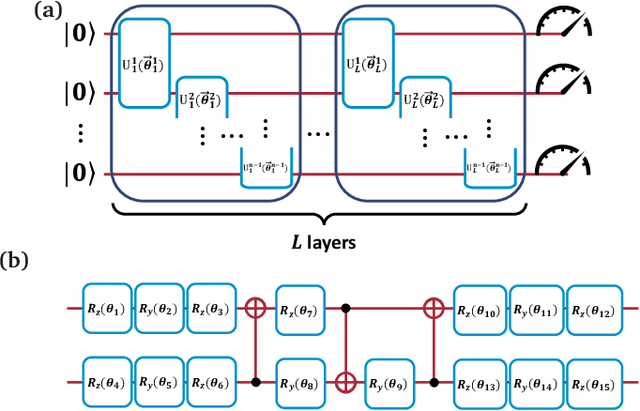


Optimization is one of the keystones of modern science and engineering. Its applications in quantum technology and machine learning helped nurture variational quantum algorithms and generative AI respectively. We propose a general approach to design variational optimization algorithms based on generative models: the Variational Generative Optimization Network (VGON). To demonstrate its broad applicability, we apply VGON to three quantum tasks: finding the best state in an entanglement-detection protocol, finding the ground state of a 1D quantum spin model with variational quantum circuits, and generating degenerate ground states of many-body quantum Hamiltonians. For the first task, VGON greatly reduces the optimization time compared to stochastic gradient descent while generating nearly optimal quantum states. For the second task, VGON alleviates the barren plateau problem in variational quantum circuits. For the final task, VGON can identify the degenerate ground state spaces after a single stage of training and generate a variety of states therein.
Quantifying Unknown Quantum Entanglement via a Hybrid Quantum-Classical Machine Learning Framework
Apr 25, 2022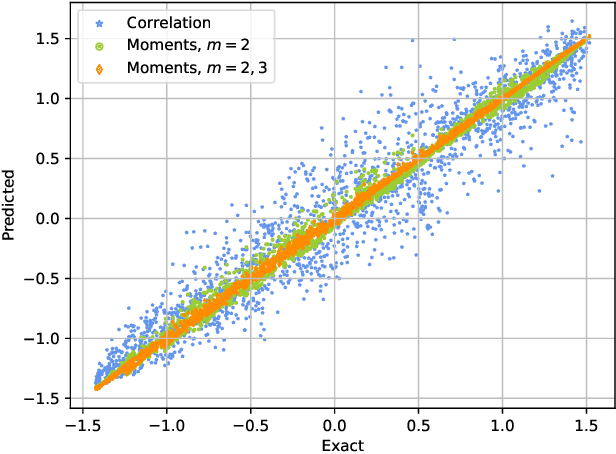
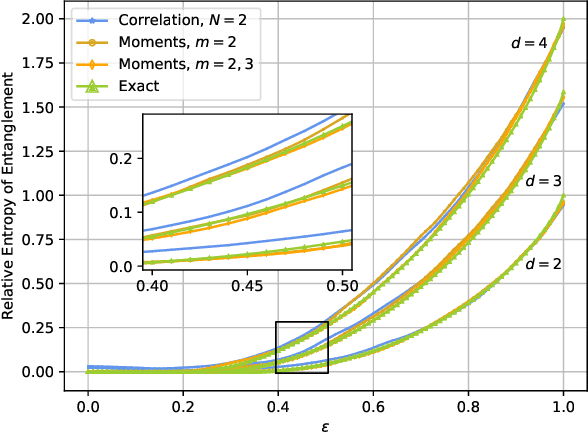
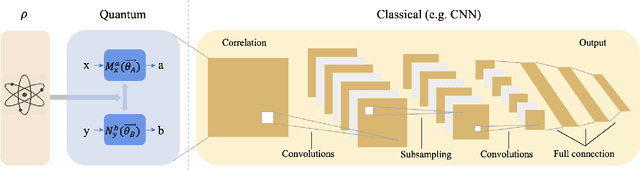
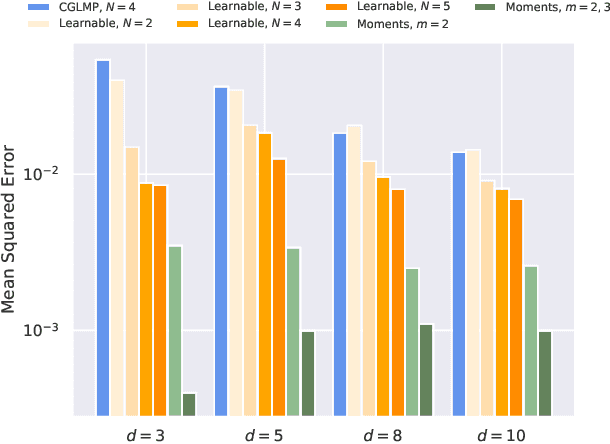
Quantifying unknown quantum entanglement experimentally is a difficult task, but also becomes more and more necessary because of the fast development of quantum engineering. Machine learning provides practical solutions to this fundamental problem, where one has to train a proper machine learning model to predict entanglement measures of unknown quantum states based on experimentally measurable data, say moments or correlation data produced by local measurements. In this paper, we compare the performance of these two different machine learning approaches systematically. Particularly, we first show that the approach based on moments enjoys a remarkable advantage over that based on correlation data, though the cost of measuring moments is much higher. Next, since correlation data is much easier to obtain experimentally, we try to better its performance by proposing a hybrid quantum-classical machine learning framework for this problem, where the key is to train optimal local measurements to generate more informative correlation data. Our numerical simulations show that the new framework brings us comparable performance with the approach based on moments to quantify unknown entanglement. Our work implies that it is already practical to fulfill such tasks on near-term quantum devices.