 Add to Chrome
 Add to Firefox
 Add to Edge
DRGBT-1K: A Large-scale High-quality Benchmark for Dynamic RGBT Tracking
Jul 22, 2026
Dynamic RGBT (DRGBT) tracking aims to continuously localize a target when the available sensing modalities and observation platforms vary over time. Compared with conventional RGBT tracking with fixed RGBT inputs and a fixed observation platform, DRGBT tracking is more consistent with real-world collaborative perception systems, where targets may be observed by heterogeneous sensors from different viewpoints. However, existing benchmarks are still insufficient for systematically evaluating tracker robustness under real dynamic modality variations and cross-platform transitions. To address this limitation, we make the following contributions. 1) We construct DRGBT-1K, a large-scale high-quality benchmark for DRGBT tracking. It contains 1,045 sequences captured entirely in real-world scenarios and 795K RGBT frame pairs collected using UAVs and handheld RGBT devices, encompassing diverse real-world scenes, pronounced viewpoint changes, modality variations, and target appearance discontinuities. 2) We provide comprehensive annotations for fine-grained evaluation, including dense bounding boxes, target category labels, challenge attributes, frame-level modality labels and platform labels. DRGBT-1K covers 24 target categories, more than 15 scene types and 15 challenge attributes. 3) We establish a comprehensive benchmark by evaluating 20 representative multimodal tracking methods, including conventional RGBT trackers, modality-missing RGBT trackers, and DRGBT trackers under a unified evaluation protocol. 4) We release an unaligned version of DRGBT-1K and derive UGVT-1K to support broader research on unaligned multimodal tracking and UAV-ground collaborative tracking. 5) We develop an online evaluation platform for DRGBT-1K and provide a leaderboard that collects all methods evaluated on this benchmark.

Dynamic Disentangled Fusion Network for RGBT Tracking
Dec 11, 2024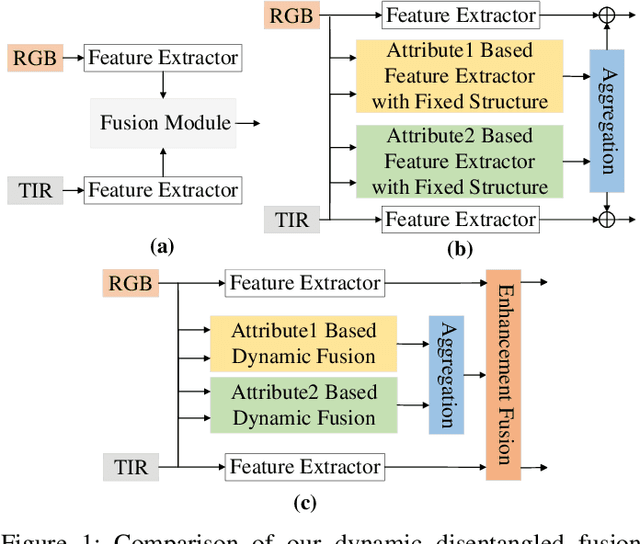
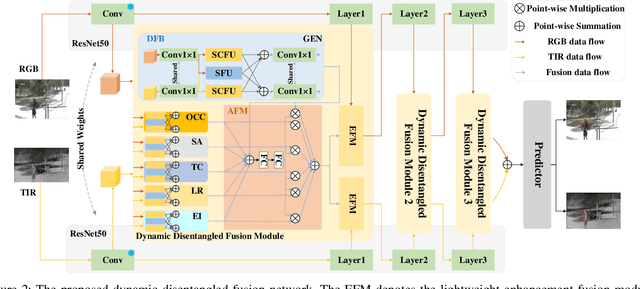
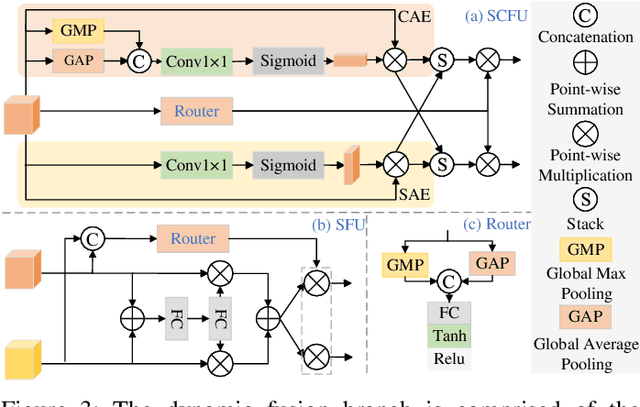
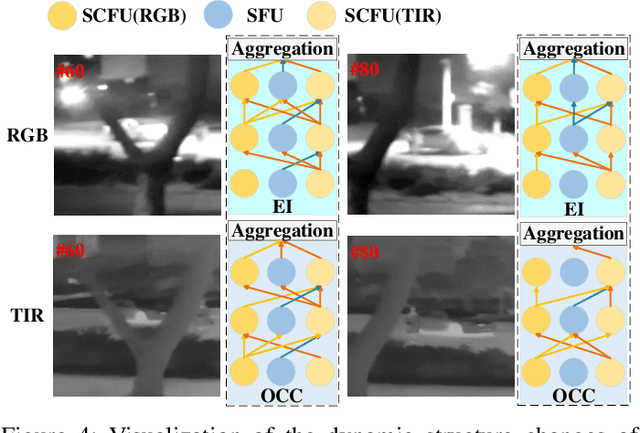
RGBT tracking usually suffers from various challenging factors of low resolution, similar appearance, extreme illumination, thermal crossover and occlusion, to name a few. Existing works often study complex fusion models to handle challenging scenarios, but can not well adapt to various challenges, which might limit tracking performance. To handle this problem, we propose a novel Dynamic Disentangled Fusion Network called DDFNet, which disentangles the fusion process into several dynamic fusion models via the challenge attributes to adapt to various challenging scenarios, for robust RGBT tracking. In particular, we design six attribute-based fusion models to integrate RGB and thermal features under the six challenging scenarios respectively.Since each fusion model is to deal with the corresponding challenges, such disentangled fusion scheme could increase the fusion capacity without the dependence on large-scale training data. Considering that every challenging scenario also has different levels of difficulty, we propose to optimize the combination of multiple fusion units to form each attribute-based fusion model in a dynamic manner, which could well adapt to the difficulty of the corresponding challenging scenario. To address the issue that which fusion models should be activated in the tracking process, we design an adaptive aggregation fusion module to integrate all features from attribute-based fusion models in an adaptive manner with a three-stage training algorithm. In addition, we design an enhancement fusion module to further strengthen the aggregated feature and modality-specific features. Experimental results on benchmark datasets demonstrate the effectiveness of our DDFNet against other state-of-the-art methods.