 Add to Chrome
 Add to Firefox
 Add to Edge
Faster Synchronous On-Policy RL via Straggler-Aware Group Sizing
Jun 01, 2026
Synchronous reinforcement learning methods such as Group Relative Policy Optimization (GRPO) provide stable and reproducible on-policy training, but they are highly vulnerable to stragglers, a single unusually long rollout can delay reward computation and parameter updates for the entire group. This problem becomes more severe as group size increases, creating a tension between the benefits of larger groups and the wall-clock cost of synchronization stalls. We propose Straggler-Aware Group Control (SAGC), a dynamic group-size controller that adapts the training group online based on observed rollout behavior. SAGC formulates group-size selection as an online constrained optimization problem, seeking to retain the benefits of larger groups while controlling the long-term rate of straggler events. Across synchronous GRPO and DAPO training, and on top of both vanilla and strong engineered baselines, SAGC consistently reduces straggler incidence and improves wall-clock efficiency while achieving competitive or better training reward. We further show that these gains transfer to final model quality: SAGC is competitive with or better than the strongest static group-size baseline on downstream reasoning benchmarks, and often produces shorter outputs without any explicit length penalty. These results position dynamic group control as a practical way to make synchronous on-policy RL more efficient and robust.

Deep Unfolding for Iterative Stripe Noise Removal
Sep 27, 2022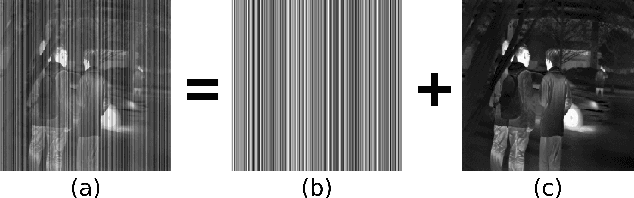

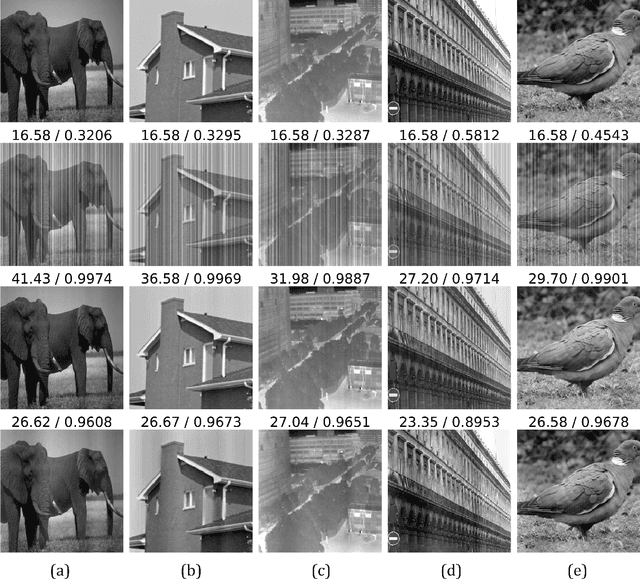
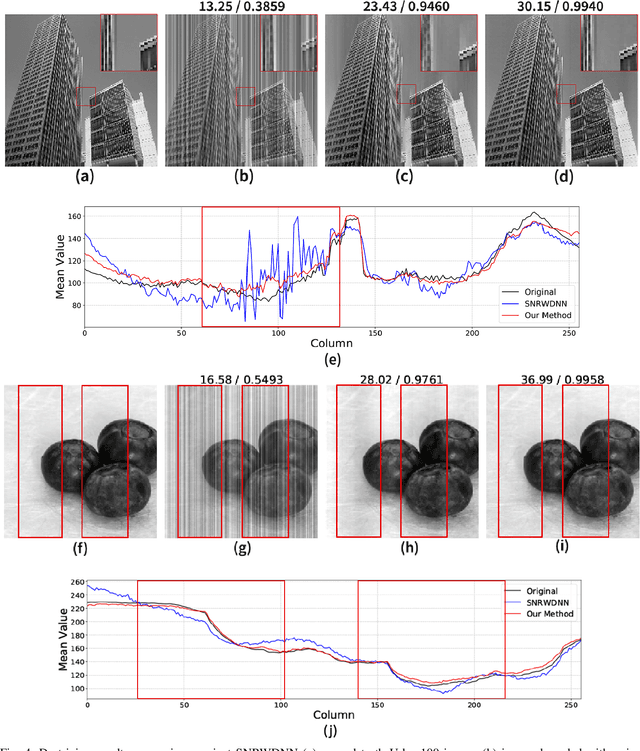
The non-uniform photoelectric response of infrared imaging systems results in fixed-pattern stripe noise being superimposed on infrared images, which severely reduces image quality. As the applications of degraded infrared images are limited, it is crucial to effectively preserve original details. Existing image destriping methods struggle to concurrently remove all stripe noise artifacts, preserve image details and structures, and balance real-time performance. In this paper we propose a novel algorithm for destriping degraded images, which takes advantage of neighbouring column signal correlation to remove independent column stripe noise. This is achieved through an iterative deep unfolding algorithm where the estimated noise of one network iteration is used as input to the next iteration. This progression substantially reduces the search space of possible function approximations, allowing for efficient training on larger datasets. The proposed method allows for a more precise estimation of stripe noise to preserve scene details more accurately. Extensive experimental results demonstrate that the proposed model outperforms existing destriping methods on artificially corrupted images on both quantitative and qualitative assessments.