 Add to Chrome
 Add to Firefox
 Add to Edge
Can LLM Rerankers Predict Their Own Ranking Performance?
Jun 02, 2026
Retrieval effectiveness varies substantially across queries, making it important to estimate ranking quality before relevance judgments are available. Query performance prediction (QPP) addresses this need, but most existing methods rely on external predictors after retrieval or reranking. In this paper, we study \textit{reranker-internal QPP}: can an LLM reranker estimate the quality of the ranking it has just produced? We investigate both training-free and training-based approaches. For training-free estimation, we examine metric-specific self-consistency across sampled rankings and verbalized confidence produced directly by the reranker. Experiments on TREC Deep Learning 2019--2022 with four LLMs show that self-consistency is competitive with the state-of-the-art (SOTA) approach and better calibrated in almost all settings, while direct verbalized confidence is severely overconfident. To improve verbalized confidence, we propose two supervised methods, Verb-Num and Verb-List, which enable LLM rerankers to produce calibrated ranking-quality estimates with only a few additional output tokens.

The Role of Parametric Injection-A Systematic Study of Parametric Retrieval-Augmented Generation
Oct 14, 2025
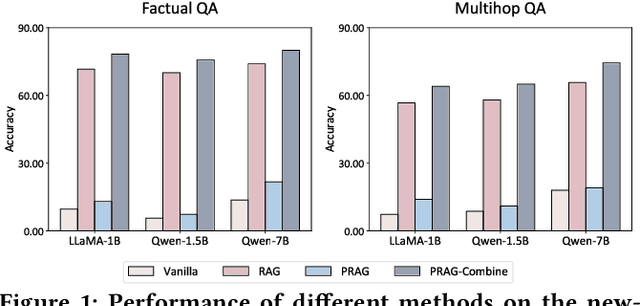
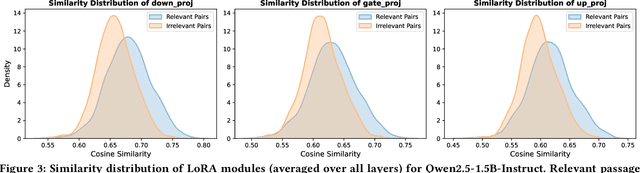
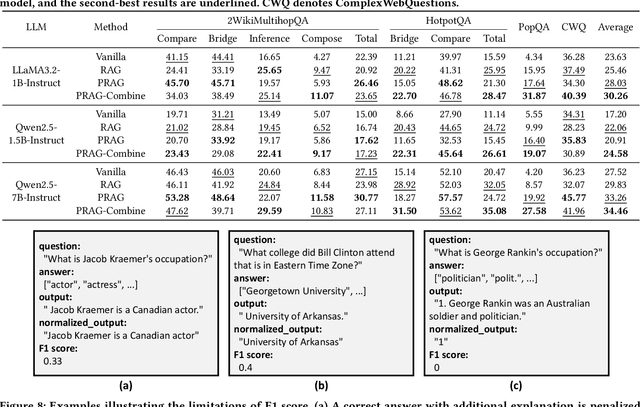
Retrieval-augmented generation (RAG) enhances large language models (LLMs) by retrieving external documents. As an emerging form of RAG, parametric retrieval-augmented generation (PRAG) encodes documents as model parameters (i.e., LoRA modules) and injects these representations into the model during inference, enabling interaction between the LLM and documents at parametric level. Compared with directly placing documents in the input context, PRAG is more efficient and has the potential to offer deeper model-document interaction. Despite its growing attention, the mechanism underlying parametric injection remains poorly understood. In this work, we present a systematic study of PRAG to clarify the role of parametric injection, showing that parameterized documents capture only partial semantic information of documents, and relying on them alone yields inferior performance compared to interaction at text level. However, these parametric representations encode high-level document information that can enhance the model's understanding of documents within the input context. When combined parameterized documents with textual documents, the model can leverage relevant information more effectively and become more robust to noisy inputs, achieving better performance than either source alone. We recommend jointly using parameterized and textual documents and advocate for increasing the information content of parametric representations to advance PRAG.