 Add to Chrome
 Add to Firefox
 Add to Edge
In vivo feasibility study of humanoid robots in surgery
Jul 08, 2026
Recent advances in actuation, control and learning have rapidly pushed humanoid robots from a distant vision towards near-term real-world deployment. Healthcare is a particularly pressing domain, in which staffing shortages and increasing care demand are widening the gap between clinical workload and available skilled labour. Although current automation has largely focused on digital and logistical tasks, much hospital work remains embodied, requiring mobility, manipulation and safe interaction in human-designed environments. Humanoid form factors offer unique potential, particularly for assisting with surgical tasks. Traditionally, robotic systems for surgery are purpose-built platforms such as Intuitive Surgical's da Vinci Surgical System, and it remains unclear how close current humanoid systems are to meeting the precision, control and safety requirements of minimally invasive surgery. Here we present a systematic evaluation of contemporary humanoid technology for laparoscopic surgical tasks. We develop a humanoid-based laparoscopic teleoperation framework using general-purpose instruments and assess its abilities through benchtop characterization, dry-laboratory user studies spanning diverse surgical experience levels and in vivo porcine studies. Across these evaluations, we quantify technical feasibility, task performance and clinical readiness relative to established surgical platforms. Together, our study provides an evidence-based assessment of current humanoid abilities and limitations for surgical applications, highlighting both their promise and key technical challenges that must be addressed before clinical deployment.

Real-time Rendering-based Surgical Instrument Tracking via Evolutionary Optimization
Mar 12, 2026Accurate and efficient tracking of surgical instruments is fundamental for Robot-Assisted Minimally Invasive Surgery. Although vision-based robot pose estimation has enabled markerless calibration without tedious physical setups, reliable tool tracking for surgical robots still remains challenging due to partial visibility and specialized articulation design of surgical instruments. Previous works in the field are usually prone to unreliable feature detections under degraded visual quality and data scarcity, whereas rendering-based methods often struggle with computational costs and suboptimal convergence. In this work, we incorporate CMA-ES, an evolutionary optimization strategy, into a versatile tracking pipeline that jointly estimates surgical instrument pose and joint configurations. Using batch rendering to efficiently evaluate multiple pose candidates in parallel, the method significantly reduces inference time and improves convergence robustness. The proposed framework further generalizes to joint angle-free and bi-manual tracking settings, making it suitable for both vision feedback control and online surgery video calibration. Extensive experiments on synthetic and real-world datasets demonstrate that the proposed method significantly outperforms prior approaches in both accuracy and runtime.
Differentiable Rendering-based Pose Estimation for Surgical Robotic Instruments
Mar 07, 2025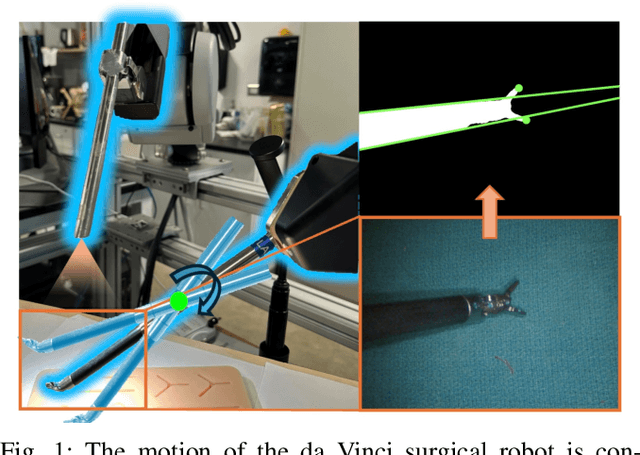
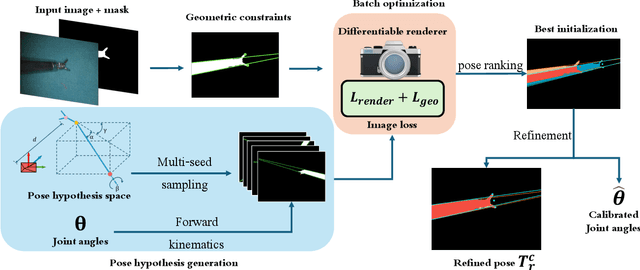
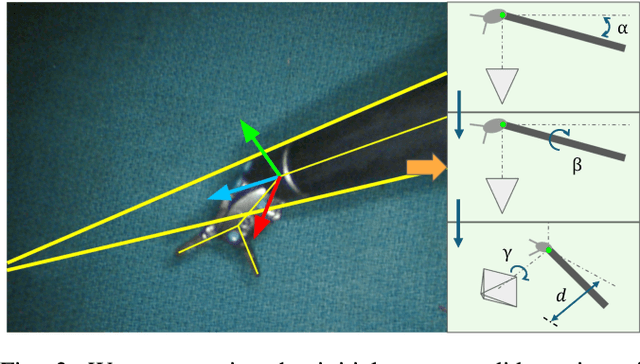
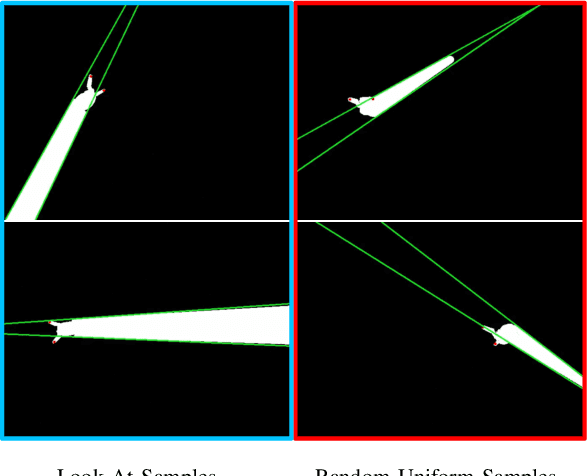
Robot pose estimation is a challenging and crucial task for vision-based surgical robotic automation. Typical robotic calibration approaches, however, are not applicable to surgical robots, such as the da Vinci Research Kit (dVRK), due to joint angle measurement errors from cable-drives and the partially visible kinematic chain. Hence, previous works in surgical robotic automation used tracking algorithms to estimate the pose of the surgical tool in real-time and compensate for the joint angle errors. However, a big limitation of these previous tracking works is the initialization step which relied on only keypoints and SolvePnP. In this work, we fully explore the potential of geometric primitives beyond just keypoints with differentiable rendering, cylinders, and construct a versatile pose matching pipeline in a novel pose hypothesis space. We demonstrate the state-of-the-art performance of our single-shot calibration method with both calibration consistency and real surgical tasks. As a result, this marker-less calibration approach proves to be a robust and generalizable initialization step for surgical tool tracking.
CtRNet-X: Camera-to-Robot Pose Estimation in Real-world Conditions Using a Single Camera
Sep 16, 2024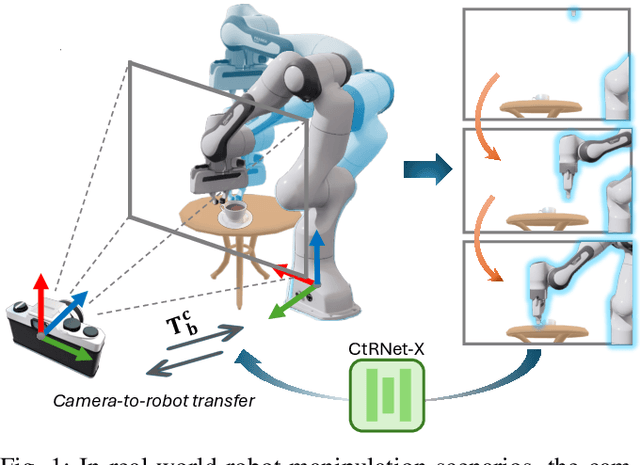
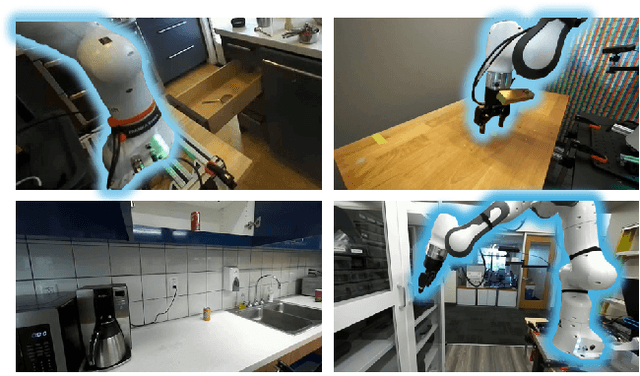
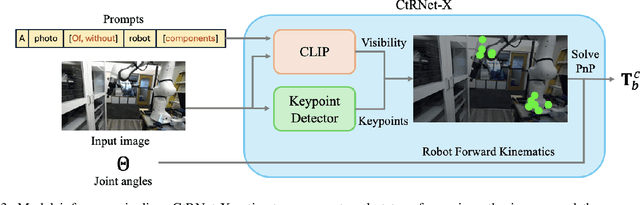
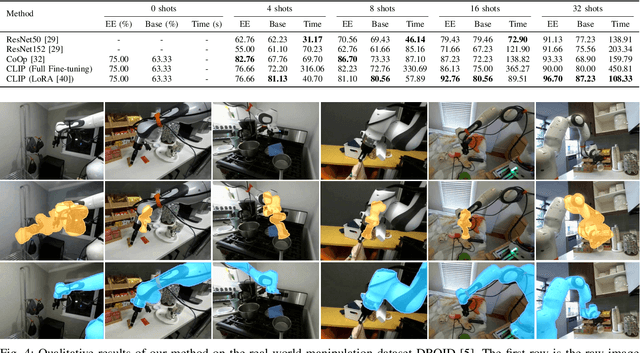
Camera-to-robot calibration is crucial for vision-based robot control and requires effort to make it accurate. Recent advancements in markerless pose estimation methods have eliminated the need for time-consuming physical setups for camera-to-robot calibration. While the existing markerless pose estimation methods have demonstrated impressive accuracy without the need for cumbersome setups, they rely on the assumption that all the robot joints are visible within the camera's field of view. However, in practice, robots usually move in and out of view, and some portion of the robot may stay out-of-frame during the whole manipulation task due to real-world constraints, leading to a lack of sufficient visual features and subsequent failure of these approaches. To address this challenge and enhance the applicability to vision-based robot control, we propose a novel framework capable of estimating the robot pose with partially visible robot manipulators. Our approach leverages the Vision-Language Models for fine-grained robot components detection, and integrates it into a keypoint-based pose estimation network, which enables more robust performance in varied operational conditions. The framework is evaluated on both public robot datasets and self-collected partial-view datasets to demonstrate our robustness and generalizability. As a result, this method is effective for robot pose estimation in a wider range of real-world manipulation scenarios.