 Add to Chrome
 Add to Firefox
 Add to Edge
Not Just What's There: Enabling CLIP to Comprehend Negated Visual Descriptions Without Fine-tuning
Feb 24, 2026
Vision-Language Models (VLMs) like CLIP struggle to understand negation, often embedding affirmatives and negatives similarly (e.g., matching "no dog" with dog images). Existing methods refine negation understanding via fine-tuning CLIP's text encoder, risking overfitting. In this work, we propose CLIPGlasses, a plug-and-play framework that enhances CLIP's ability to comprehend negated visual descriptions. CLIPGlasses adopts a dual-stage design: a Lens module disentangles negated semantics from text embeddings, and a Frame module predicts context-aware repulsion strength, which is integrated into a modified similarity computation to penalize alignment with negated semantics, thereby reducing false positive matches. Experiments show that CLIP equipped with CLIPGlasses achieves competitive in-domain performance and outperforms state-of-the-art methods in cross-domain generalization. Its superiority is especially evident under low-resource conditions, indicating stronger robustness across domains.

LTOS: Layout-controllable Text-Object Synthesis via Adaptive Cross-attention Fusions
Apr 21, 2024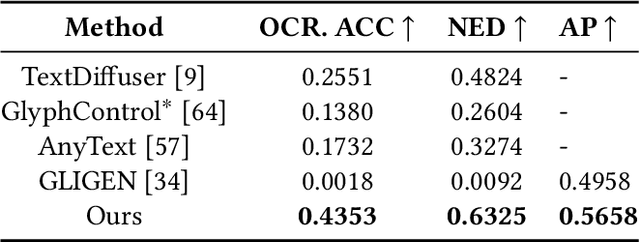
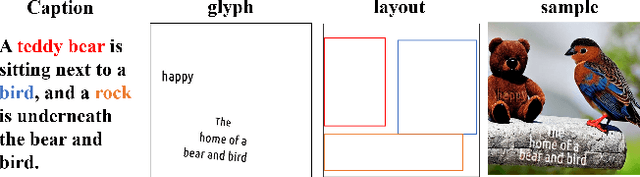
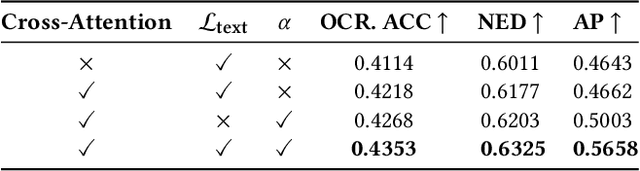
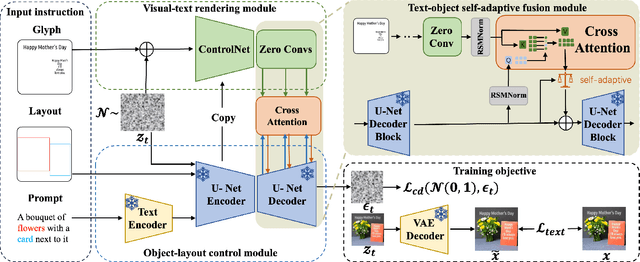
Controllable text-to-image generation synthesizes visual text and objects in images with certain conditions, which are frequently applied to emoji and poster generation. Visual text rendering and layout-to-image generation tasks have been popular in controllable text-to-image generation. However, each of these tasks typically focuses on single modality generation or rendering, leaving yet-to-be-bridged gaps between the approaches correspondingly designed for each of the tasks. In this paper, we combine text rendering and layout-to-image generation tasks into a single task: layout-controllable text-object synthesis (LTOS) task, aiming at synthesizing images with object and visual text based on predefined object layout and text contents. As compliant datasets are not readily available for our LTOS task, we construct a layout-aware text-object synthesis dataset, containing elaborate well-aligned labels of visual text and object information. Based on the dataset, we propose a layout-controllable text-object adaptive fusion (TOF) framework, which generates images with clear, legible visual text and plausible objects. We construct a visual-text rendering module to synthesize text and employ an object-layout control module to generate objects while integrating the two modules to harmoniously generate and integrate text content and objects in images. To better the image-text integration, we propose a self-adaptive cross-attention fusion module that helps the image generation to attend more to important text information. Within such a fusion module, we use a self-adaptive learnable factor to learn to flexibly control the influence of cross-attention outputs on image generation. Experimental results show that our method outperforms the state-of-the-art in LTOS, text rendering, and layout-to-image tasks, enabling harmonious visual text rendering and object generation.