 Add to Chrome
 Add to Firefox
 Add to Edge
Stability of Control Lyapunov Function Guided Reinforcement Learning
May 06, 2026
Reinforcement learning (RL) has become the de facto method for achieving locomotion on humanoid robots in practice, yet stability analysis of the corresponding control policies is lacking. Recent work has attempted to merge control theoretic ideas with reinforcement learning through control guided learning. A notable example of this is the use of a control Lyapunov function (CLF) to synthesize the reinforcement learning rewards, a technique known as CLF-RL, which has shown practical success. This paper investigates the stability properties of optimal controllers using CLF-RL with the goal of bridging experimentally observed stability with theoretical guarantees. The RL problem is viewed as an optimal control problem and exponential stability is proven in both continuous and discrete time using both core CLF reward terms and the additional terms used in practice. The theoretical bounds are numerically verified on systems such as the double integrator and cart-pole. Finally, the CLF guided rewards are implemented for a walking humanoid robot to generate stable periodic orbits.

Chasing Autonomy: Dynamic Retargeting and Control Guided RL for Performant and Controllable Humanoid Running
Mar 26, 2026Humanoid robots have the promise of locomoting like humans, including fast and dynamic running. Recently, reinforcement learning (RL) controllers that can mimic human motions have become popular as they can generate very dynamic behaviors, but they are often restricted to single motion play-back which hinders their deployment in long duration and autonomous locomotion. In this paper, we present a pipeline to dynamically retarget human motions through an optimization routine with hard constraints to generate improved periodic reference libraries from a single human demonstration. We then study the effect of both the reference motion and the reward structure on the reference and commanded velocity tracking, concluding that a goal-conditioned and control-guided reward which tracks dynamically optimized human data results in the best performance. We deploy the policy on hardware, demonstrating its speed and endurance by achieving running speeds of up to 3.3 m/s on a Unitree G1 robot and traversing hundreds of meters in real-world environments. Additionally, to demonstrate the controllability of the locomotion, we use the controller in a full perception and planning autonomy stack for obstacle avoidance while running outdoors.
Locomotion on Constrained Footholds via Layered Architectures and Model Predictive Control
Jun 11, 2025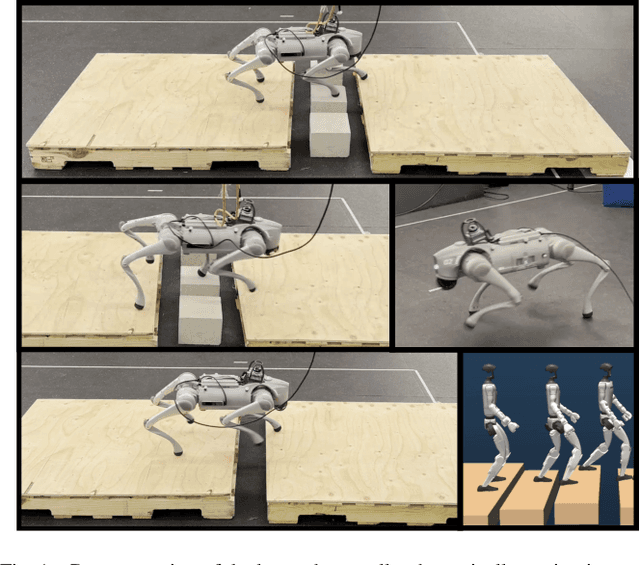
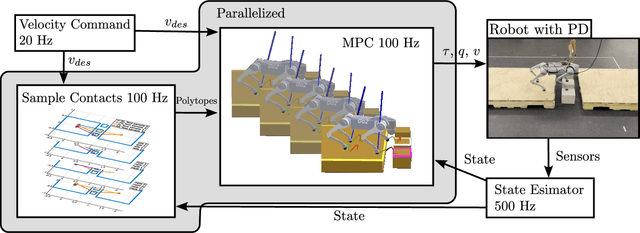
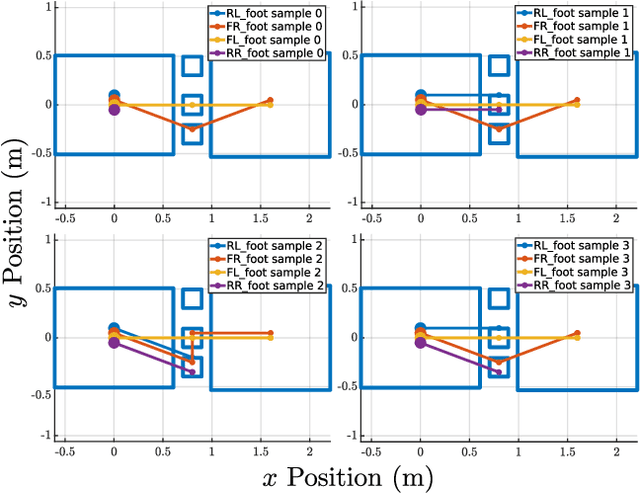
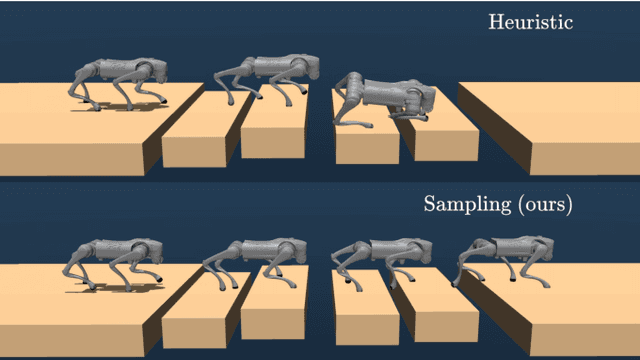
Computing stabilizing and optimal control actions for legged locomotion in real time is difficult due to the nonlinear, hybrid, and high dimensional nature of these robots. The hybrid nature of the system introduces a combination of discrete and continuous variables which causes issues for numerical optimal control. To address these challenges, we propose a layered architecture that separates the choice of discrete variables and a smooth Model Predictive Controller (MPC). The layered formulation allows for online flexibility and optimality without sacrificing real-time performance through a combination of gradient-free and gradient-based methods. The architecture leverages a sampling-based method for determining discrete variables, and a classical smooth MPC formulation using these fixed discrete variables. We demonstrate the results on a quadrupedal robot stepping over gaps and onto terrain with varying heights. In simulation, we demonstrate the controller on a humanoid robot for gap traversal. The layered approach is shown to be more optimal and reliable than common heuristic-based approaches and faster to compute than pure sampling methods.