 Add to Chrome
 Add to Firefox
 Add to Edge
Fast and principled equation discovery from chaos to climate
Apr 13, 2026
Our ability to predict, control, and ultimately understand complex systems rests on discovering the equations that govern their dynamics. Identifying these equations directly from noisy, limited observations has therefore become a central challenge in data-driven science, yet existing library-based sparse regression methods force a compromise between automation, statistical rigor, and computational efficiency. Here we develop Bayesian-ARGOS, a hybrid framework that reconciles these demands by combining rapid frequentist screening with focused Bayesian inference, enabling automated equation discovery with principled uncertainty quantification at a fraction of the computational cost of existing methods. Tested on seven chaotic systems under varying data scarcity and noise levels, Bayesian-ARGOS outperforms two state-of-the-art methods in most scenarios. It surpasses SINDy in data efficiency for all systems and noise tolerance for six out of the seven, with a two-order-of-magnitude reduction in computational cost compared to bootstrap-based ARGOS. The probabilistic formulation additionally enables a suite of standard statistical diagnostics, including influence analysis and multicollinearity detection that expose failure modes otherwise opaque. When integrated with representation learning (SINDy-SHRED) for high dimensional sea surface temperature reconstruction, Bayesian-ARGOS increases the yield of valid latent equations with significantly improved long horizon stability. Bayesian-ARGOS thus provides a principled, automated, and computationally efficient route from scarce and noisy observations to interpretable governing equations, offering a practical framework for equation discovery across scales, from benchmark chaotic systems to the latent dynamics underlying global climate patterns.

Real-time Hyper-Dimensional Reconfiguration at the Edge using Hardware Accelerators
Jun 10, 2022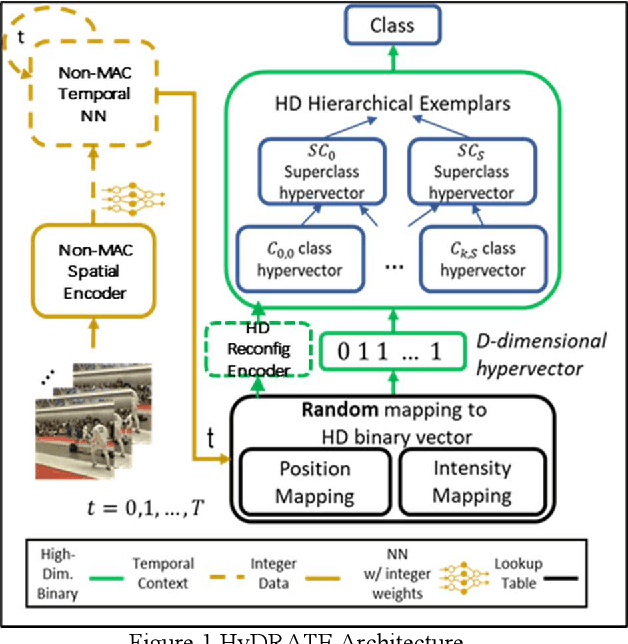
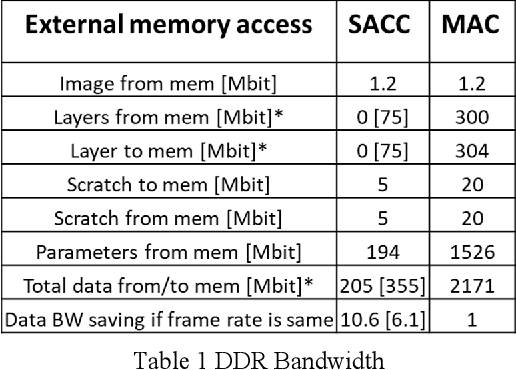
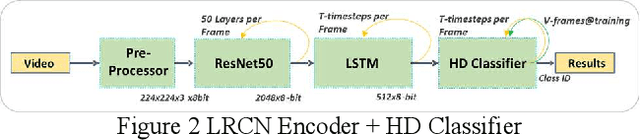
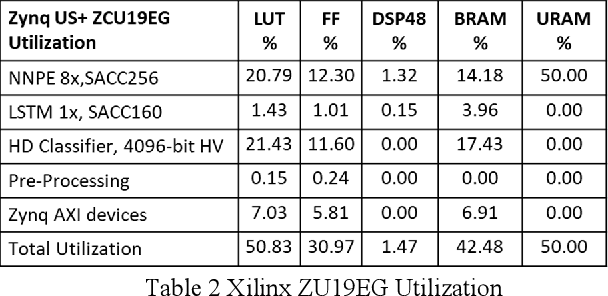
In this paper we present Hyper-Dimensional Reconfigurable Analytics at the Tactical Edge (HyDRATE) using low-SWaP embedded hardware that can perform real-time reconfiguration at the edge leveraging non-MAC (free of floating-point MultiplyACcumulate operations) deep neural nets (DNN) combined with hyperdimensional (HD) computing accelerators. We describe the algorithm, trained quantized model generation, and simulated performance of a feature extractor free of multiply-accumulates feeding a hyperdimensional logic-based classifier. Then we show how performance increases with the number of hyperdimensions. We describe the realized low-SWaP FPGA hardware and embedded software system compared to traditional DNNs and detail the implemented hardware accelerators. We discuss the measured system latency and power, noise robustness due to use of learnable quantization and HD computing, actual versus simulated system performance for a video activity classification task and demonstration of reconfiguration on this same dataset. We show that reconfigurability in the field is achieved by retraining only the feed-forward HD classifier without gradient descent backpropagation (gradient-free), using few-shot learning of new classes at the edge. Initial work performed used LRCN DNN and is currently extended to use Two-stream DNN with improved performance.