 Add to Chrome
 Add to Firefox
 Add to Edge
TRIMS: Trajectory-Ranked Instruction Masked Supervision for Diffusion Language Models
Apr 01, 2026
Diffusion language models (DLMs) offer a promising path toward low-latency generation through parallel decoding, but their practical efficiency depends heavily on the decoding trajectory. In practice, this advantage often fails to fully materialize because standard training does not provide explicit supervision over token reveal order, creating a train-inference mismatch that leads to suboptimal decoding behavior. We propose Trajectory-Ranked Instruction Masked Supervision (TRIMS), a simple trajectory-guided supervised fine-tuning framework that injects trajectory supervision into standard Masked Diffusion Language Model (MDLM) training with minimal overhead. Instead of relying on costly DLM-based distillation, TRIMS uses lightweight signals from an autoregressive teacher to guide a trajectory-aware masking strategy, encouraging the model to learn more effective decoding orders. Experiments on LLaDA and Dream across math and coding benchmarks show that TRIMS significantly improves the accuracy-parallelism trade-off over both standard MDLM training and train-free acceleration baselines, while achieving competitive performance with prior distillation-based approaches at substantially lower training cost. Further analysis shows that TRIMS leads to better decoding trajectories, validating the effectiveness of trajectory-guided supervision for DLMs.

SafeWork-R1: Coevolving Safety and Intelligence under the AI-45$^{\circ}$ Law
Jul 24, 2025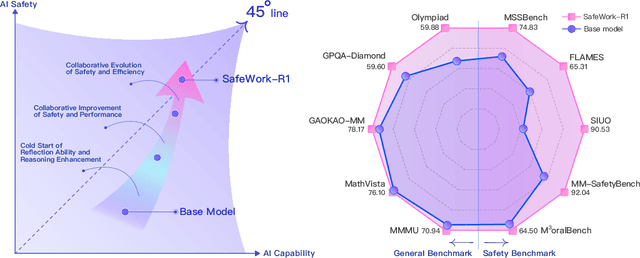
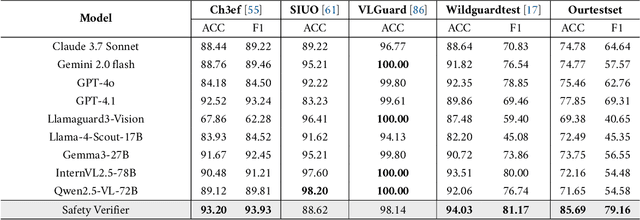
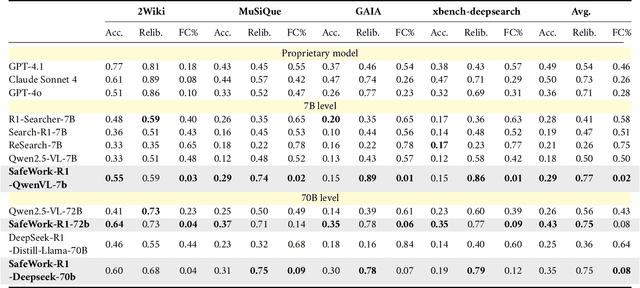
We introduce SafeWork-R1, a cutting-edge multimodal reasoning model that demonstrates the coevolution of capabilities and safety. It is developed by our proposed SafeLadder framework, which incorporates large-scale, progressive, safety-oriented reinforcement learning post-training, supported by a suite of multi-principled verifiers. Unlike previous alignment methods such as RLHF that simply learn human preferences, SafeLadder enables SafeWork-R1 to develop intrinsic safety reasoning and self-reflection abilities, giving rise to safety `aha' moments. Notably, SafeWork-R1 achieves an average improvement of $46.54\%$ over its base model Qwen2.5-VL-72B on safety-related benchmarks without compromising general capabilities, and delivers state-of-the-art safety performance compared to leading proprietary models such as GPT-4.1 and Claude Opus 4. To further bolster its reliability, we implement two distinct inference-time intervention methods and a deliberative search mechanism, enforcing step-level verification. Finally, we further develop SafeWork-R1-InternVL3-78B, SafeWork-R1-DeepSeek-70B, and SafeWork-R1-Qwen2.5VL-7B. All resulting models demonstrate that safety and capability can co-evolve synergistically, highlighting the generalizability of our framework in building robust, reliable, and trustworthy general-purpose AI.