 Add to Chrome
 Add to Firefox
 Add to Edge
Heterogeneous synaptic motifs bridge microscale structure and macroscale nonlinear dynamics
Jun 26, 2026
Recent breakthroughs in synaptic-resolution network connectomics have revealed that brain circuits feature fine-scale structural connectivity, such as pairs of correlated synaptic couplings known as second-order motifs. Large-scale recordings of neuronal activity in networks containing nonlinear neurons reveal macroscopic heterogeneous population dynamics throughout the brain. These findings rekindle the inquiry into this intriguing question: Can microscale synaptic structures contribute to macroscopic heterogeneous dynamics and computations in ways that canonical brain circuit models cannot? To answer this question, we create random RNNs with various cell types, nonlinear non-negative neural responses, and arbitrary marginal and second-order correlated synaptic statistics. We derive mean-field low-rank equations for P-population networks in which the pre- and postsynaptic neuronal population identities determine the synaptic and motif strengths. Our framework requires 2P latent dynamic variables with P variables describing mean population activity and P variables capturing within-population variability. Theoretical and simulational results demonstrate that chain motifs induce correlations in synaptic variability, enabling microscopic fluctuations to be integrated and influence mesoscopic mean population dynamics. We apply this framework to reverse engineer network connectivity that recapitulates the heterogeneous activity across the population in the mouse primary visual cortex. By bridging the gap between synaptic organization and nonlinear heterogeneous population dynamics, our results offer a principled approach and testable predictions regarding the relationship between fine-scale connectivity, heterogeneous dynamics, and functional computations.

Identifying the impact of local connectivity patterns on dynamics in excitatory-inhibitory networks
Nov 11, 2024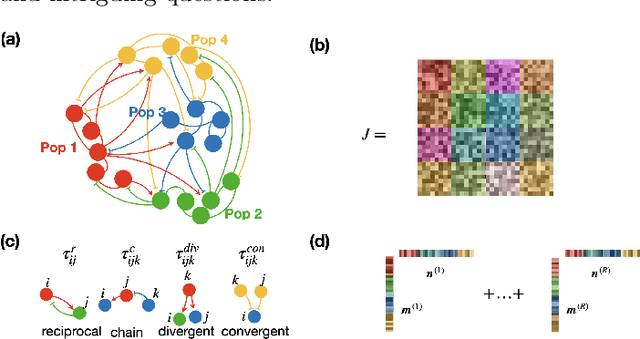
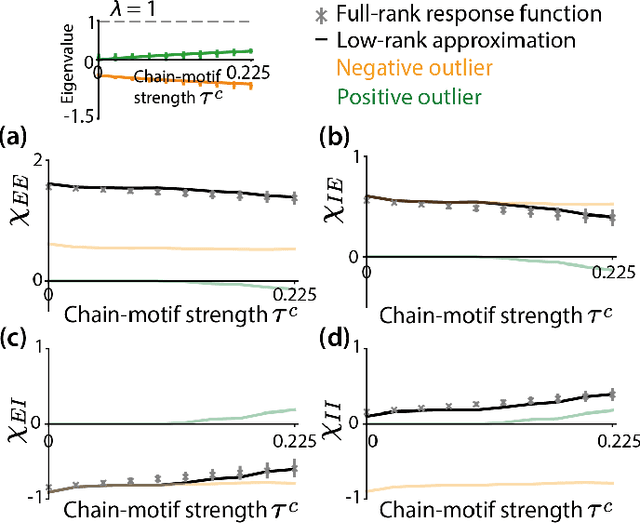
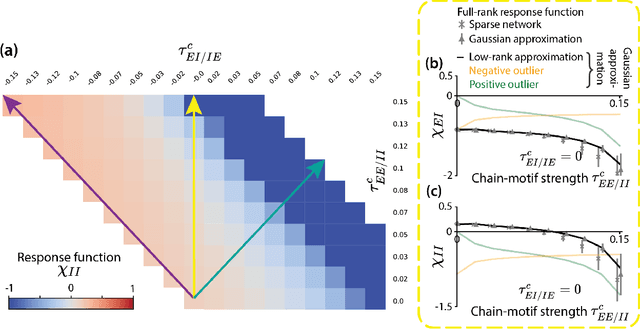
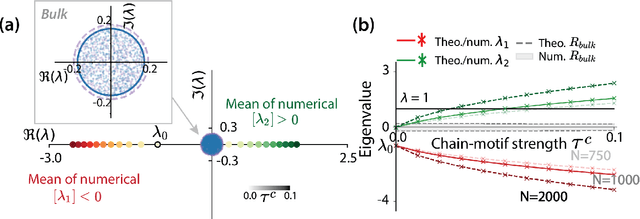
Networks of excitatory and inhibitory (EI) neurons form a canonical circuit in the brain. Seminal theoretical results on dynamics of such networks are based on the assumption that synaptic strengths depend on the type of neurons they connect, but are otherwise statistically independent. Recent synaptic physiology datasets however highlight the prominence of specific connectivity patterns that go well beyond what is expected from independent connections. While decades of influential research have demonstrated the strong role of the basic EI cell type structure, to which extent additional connectivity features influence dynamics remains to be fully determined. Here we examine the effects of pairwise connectivity motifs on the linear dynamics in EI networks using an analytical framework that approximates the connectivity in terms of low-rank structures. This low-rank approximation is based on a mathematical derivation of the dominant eigenvalues of the connectivity matrix and predicts the impact on responses to external inputs of connectivity motifs and their interactions with cell-type structure. Our results reveal that a particular pattern of connectivity, chain motifs, have a much stronger impact on dominant eigenmodes than other pairwise motifs. An overrepresentation of chain motifs induces a strong positive eigenvalue in inhibition-dominated networks and generates a potential instability that requires revisiting the classical excitation-inhibition balance criteria. Examining effects of external inputs, we show that chain motifs can on their own induce paradoxical responses where an increased input to inhibitory neurons leads to a decrease in their activity due to the recurrent feedback. These findings have direct implications for the interpretation of experiments in which responses to optogenetic perturbations are measured and used to infer the dynamical regime of cortical circuits.