 Add to Chrome
 Add to Firefox
 Add to Edge
Diffusion learning reveals viable parameter manifolds and compensation geometry in biological dynamical systems
Jul 04, 2026
Models of complex systems often have many parameters, yet are constrained by far fewer experimentally accessible observables: similar activity can emerge from coordinated parameter changes. We formalize these compatible parameter sets as \emph{viable parameter manifolds}: the inverse images of a system's target dynamical behaviors under a parameter-to-feature map. The relevant codimension is not the number of reported features, but the effective rank of that map at the target scale. Co-varying features lower the codimension, while poor conditioning, high curvature, or regime mixing degrade learnability. We train conditional score-based diffusion models on simulated parameter--feature pairs and use them as amortized samplers of prior-weighted viable sets. In the Lorenz system, scalar trajectory statistics generate thin viable sheets, and two-feature conditioning localizes a transition-adjacent corridor. In the Izhikevich neuron model, four firing descriptors lie close to a nearly two-dimensional family of features, and the learned inverse images reveal distinct regular and irregular compensation geometries. In a recent ODE reduction of finite spiking networks, the same framework reveals excitatory--inhibitory compensation, timescale--coupling tradeoffs, and input-dependent viable manifolds across 4--12 parameter dimensions. In this view, robustness, compensation, and hidden parameter dependencies are organized as inverse geometry, with diffusion models providing practical tools for sampling, visualizing, and interrogating that geometry.

Heterogeneous synaptic motifs bridge microscale structure and macroscale nonlinear dynamics
Jun 26, 2026Recent breakthroughs in synaptic-resolution network connectomics have revealed that brain circuits feature fine-scale structural connectivity, such as pairs of correlated synaptic couplings known as second-order motifs. Large-scale recordings of neuronal activity in networks containing nonlinear neurons reveal macroscopic heterogeneous population dynamics throughout the brain. These findings rekindle the inquiry into this intriguing question: Can microscale synaptic structures contribute to macroscopic heterogeneous dynamics and computations in ways that canonical brain circuit models cannot? To answer this question, we create random RNNs with various cell types, nonlinear non-negative neural responses, and arbitrary marginal and second-order correlated synaptic statistics. We derive mean-field low-rank equations for P-population networks in which the pre- and postsynaptic neuronal population identities determine the synaptic and motif strengths. Our framework requires 2P latent dynamic variables with P variables describing mean population activity and P variables capturing within-population variability. Theoretical and simulational results demonstrate that chain motifs induce correlations in synaptic variability, enabling microscopic fluctuations to be integrated and influence mesoscopic mean population dynamics. We apply this framework to reverse engineer network connectivity that recapitulates the heterogeneous activity across the population in the mouse primary visual cortex. By bridging the gap between synaptic organization and nonlinear heterogeneous population dynamics, our results offer a principled approach and testable predictions regarding the relationship between fine-scale connectivity, heterogeneous dynamics, and functional computations.
The Backpropagation Algorithm Implemented on Spiking Neuromorphic Hardware
Jun 13, 2021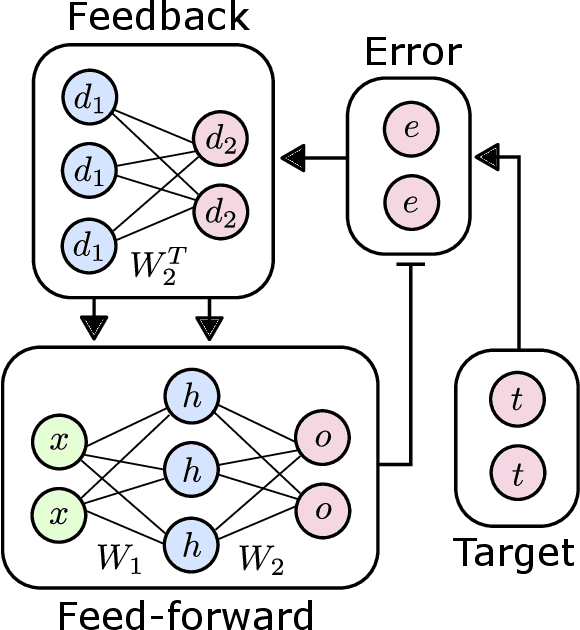
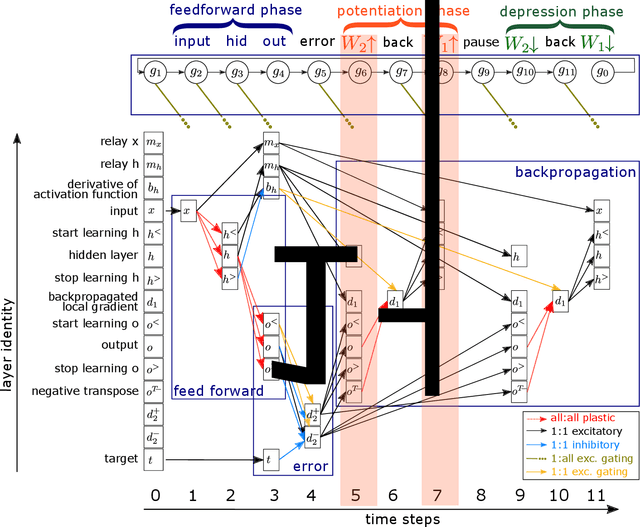
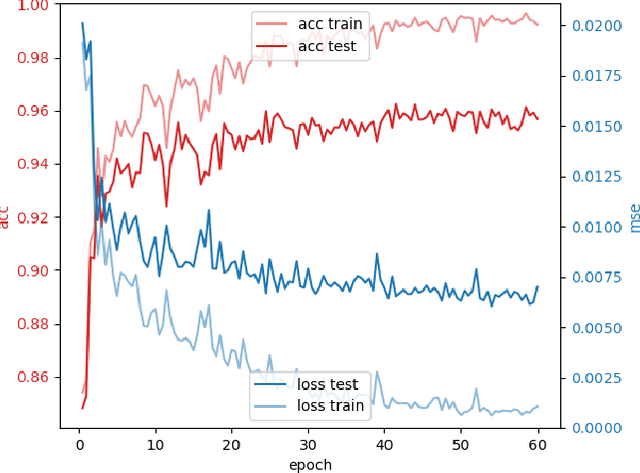
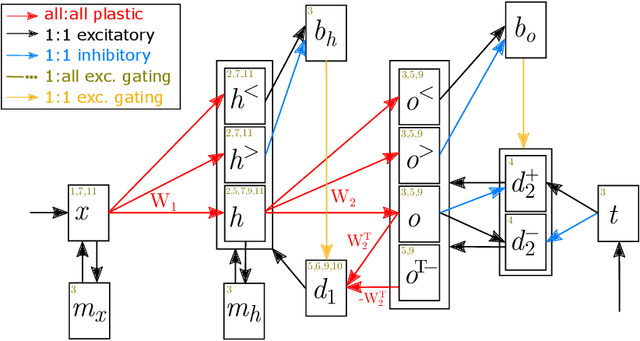
The capabilities of natural neural systems have inspired new generations of machine learning algorithms as well as neuromorphic very large-scale integrated (VLSI) circuits capable of fast, low-power information processing. However, most modern machine learning algorithms are not neurophysiologically plausible and thus are not directly implementable in neuromorphic hardware. In particular, the workhorse of modern deep learning, the backpropagation algorithm, has proven difficult to translate to neuromorphic hardware. In this study, we present a neuromorphic, spiking backpropagation algorithm based on pulse-gated dynamical information coordination and processing, implemented on Intel's Loihi neuromorphic research processor. We demonstrate a proof-of-principle three-layer circuit that learns to classify digits from the MNIST dataset. This implementation shows a path for using massively parallel, low-power, low-latency neuromorphic processors in modern deep learning applications.