 Add to Chrome
 Add to Firefox
 Add to Edge
How Robust is OCR-Reasoning? Evaluating OCR-Reasoning Robustness of Vision-Language Models under Visual Perturbations
Jun 24, 2026
Vision-language models (VLMs) have achieved strong performance on OCR-based benchmarks and increasingly focused on text-rich understanding, but their robustness under controlled visual degradation remains insufficiently understood. This gap is critical for OCR reasoning, where visual corruption can induce OCR errors and structural distortions, thereby introducing uncertainty into the reasoning task. To systematically study this problem, we introduce OCR-Robust, a benchmark designed for evaluating OCR reasoning robustness under visual perturbations. It contains 812 samples across two complementary subsets: OCR1.0, covering documents, scene text, receipts, handwriting, and mathematical content, and OCR2.0, focusing on charts, geometry diagrams, and tables. To enable efficient yet informative evaluation, we conduct a pilot study over 18 candidate perturbations and select 5 representative types at 3 severity levels each based on their impact and cross-model discriminability. We evaluate robustness using clean accuracy, Relative Corruption Retention (RCR), Worst-Case Retention (WCR), and a composite Corruption Robustness Index (CRI), and benchmark 18 models spanning proprietary systems, open-source VLMs, and OCR+LLM pipelines. Our results show that higher clean accuracy does not necessarily imply stronger robustness, and that models can suffer pronounced degradation in the worst case on OCR tasks that are sensitive to structure, and charts and tables are substantially more fragile than document-like inputs under perturbation.

A Survey on Data Contamination for Large Language Models
Feb 20, 2025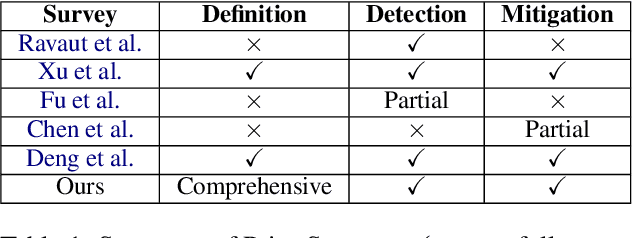
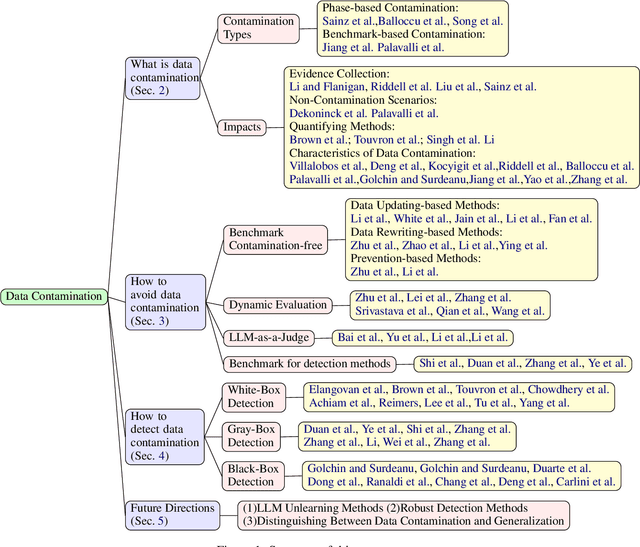
Recent advancements in Large Language Models (LLMs) have demonstrated significant progress in various areas, such as text generation and code synthesis. However, the reliability of performance evaluation has come under scrutiny due to data contamination-the unintended overlap between training and test datasets. This overlap has the potential to artificially inflate model performance, as LLMs are typically trained on extensive datasets scraped from publicly available sources. These datasets often inadvertently overlap with the benchmarks used for evaluation, leading to an overestimation of the models' true generalization capabilities. In this paper, we first examine the definition and impacts of data contamination. Secondly, we review methods for contamination-free evaluation, focusing on three strategies: data updating-based methods, data rewriting-based methods, and prevention-based methods. Specifically, we highlight dynamic benchmarks and LLM-driven evaluation methods. Finally, we categorize contamination detecting methods based on model information dependency: white-Box, gray-Box, and black-Box detection approaches. Our survey highlights the requirements for more rigorous evaluation protocols and proposes future directions for addressing data contamination challenges.