 Add to Chrome
 Add to Firefox
 Add to Edge
SwarmResearch: Orchestrating Coding Agents for Open-Ended Discovery
Jul 02, 2026
Long-running coding agents such as autoresearch can persistently discover optimizations for open-ended problems. However, they tend to converge onto a single high-level approach, then proceed with low-level edits while missing other superior approaches to the problem. We hypothesize two harness-level design choices contribute to this behavior: accumulating context in a single long-running agent and only exposing a single program state to edit. We introduce SwarmResearch, an orchestrator-subagent harness in which a Shepherd Agent uses global context to steer a population of Search Agents, each operating with local context in their respective git branch. On open-ended optimization tasks, SwarmResearch discovers better or comparable solutions to state-of-the-art LLM-guided evolution and multi-agent techniques on 13/15 tasks, driven by higher-level exploration. Compared with fixed scaling of serial and parallel agents, SwarmResearch's orchestrator-guided scaling discovers better-performing solutions by adapting parallelism at different search depths.

Enhancing Trust in LLM-Generated Code Summaries with Calibrated Confidence Scores
Apr 30, 2024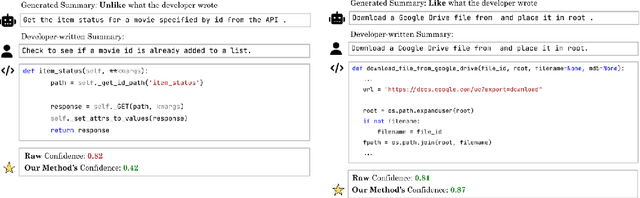
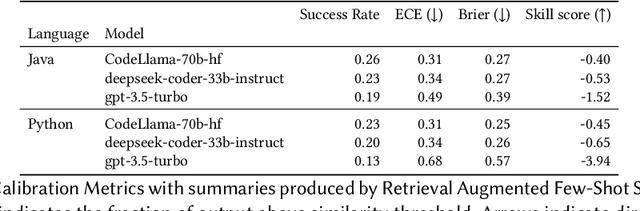
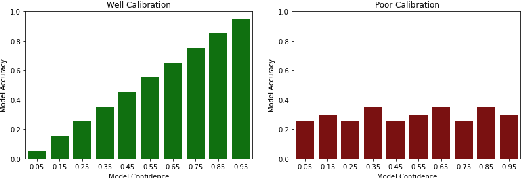
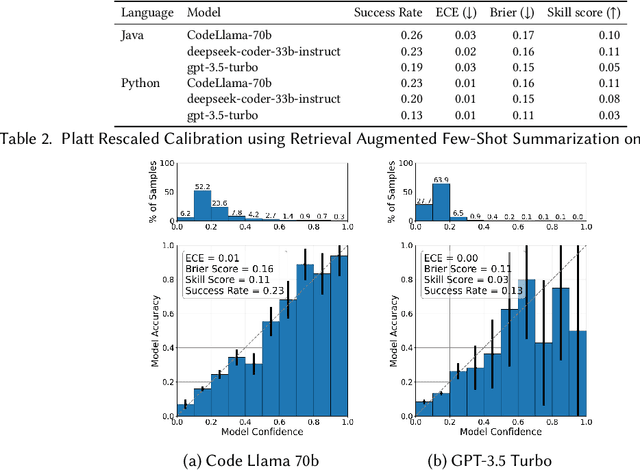
A good summary can often be very useful during program comprehension. While a brief, fluent, and relevant summary can be helpful, it does require significant human effort to produce. Often, good summaries are unavailable in software projects, thus making maintenance more difficult. There has been a considerable body of research into automated AI-based methods, using Large Language models (LLMs), to generate summaries of code; there also has been quite a bit work on ways to measure the performance of such summarization methods, with special attention paid to how closely these AI-generated summaries resemble a summary a human might have produced. Measures such as BERTScore and BLEU have been suggested and evaluated with human-subject studies. However, LLMs often err and generate something quite unlike what a human might say. Given an LLM-produced code summary, is there a way to gauge whether it's likely to be sufficiently similar to a human produced summary, or not? In this paper, we study this question, as a calibration problem: given a summary from an LLM, can we compute a confidence measure, which is a good indication of whether the summary is sufficiently similar to what a human would have produced in this situation? We examine this question using several LLMs, for several languages, and in several different settings. We suggest an approach which provides well-calibrated predictions of likelihood of similarity to human summaries.